

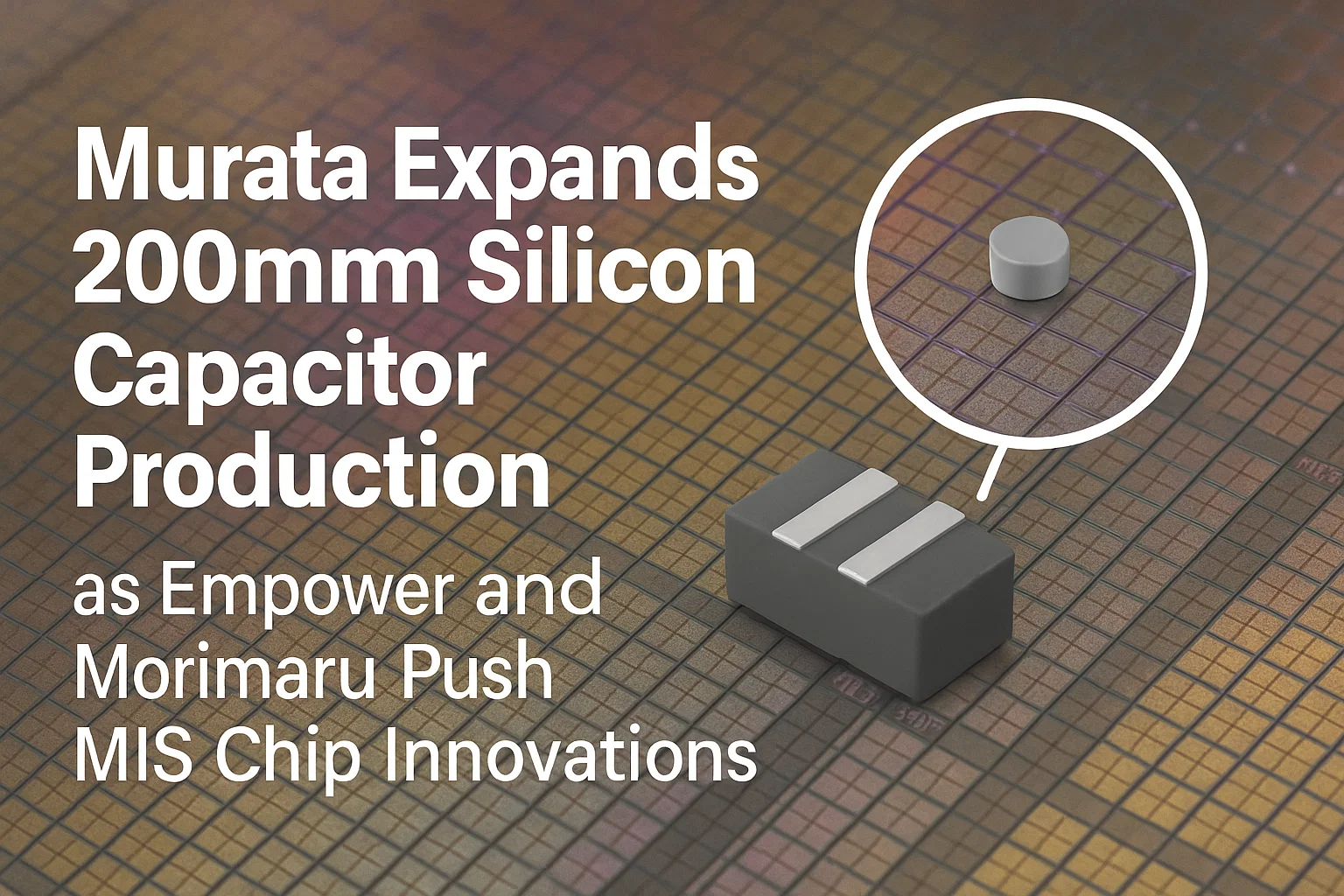
Murata Expands 200mm Silicon Capacitor Production as Empower and Morimaru Push MIS Chip Innovations
In the fast-evolving landscape of electronics, miniaturization, speed, and reliability have become central to innovation. One of the unsung heroes driving these advancements is the Semiconductor MIS (Metal-Insulator-Semiconductor) Chip Capacitor. These capacitors are not just passive components; they are critical enablers of high-frequency performance, noise suppression, power integrity, and signal stability in today’s compact devices.
The global Semiconductor MIS Chip Capacitors Market has witnessed steady growth in recent years, riding on surging demand from consumer electronics, telecommunications, automotive electronics, and cutting-edge applications like AI computing, 5G, and optical communications. The market was valued at USD 880 million in 2024 and is projected to reach USD 1,308 million by 2032, expanding at a CAGR of 6.0% during the forecast period.
Access Your Free Sample Report- Semiconductor MIS Chip Capacitors Market
Understanding Semiconductor MIS Chip Capacitors
What Are MIS Chip Capacitors?
A Metal-Insulator-Semiconductor (MIS) capacitor is a structure where a thin dielectric insulator (often SiO₂ or other advanced dielectrics) is sandwiched between a conducting metal electrode and a semiconductor substrate. These capacitors are integrated on silicon wafers, offering advantages in:
- Miniaturization – Extremely compact form factors compared to traditional MLCCs.
- High Capacitance Density – Allows multiple functionalities in limited space.
- Low Parasitics (ESR/ESL) – Enables high-frequency applications.
- Thermal and Voltage Stability – Ensures reliability in demanding environments.
These properties make them indispensable for RF circuits, AI accelerators, optical transceivers, power distribution networks (PDN), and advanced automotive systems.
Market Size and Forecast
The trajectory of the Semiconductor MIS Chip Capacitors market reflects the rising integration of these devices across industries:
- 2024 Market Value: USD 880 million
- 2025 Projection: USD 934 million
- 2032 Forecast: USD 1,308 million
- CAGR (2025–2032): 6.0%
The market is benefiting from increasing global reliance on high-performance semiconductors, 5G/6G communications infrastructure, electrification of vehicles, and booming AI hardware demand.
Recent Industry Developments
1. Morimaru Electronics Launches High-Density DTC/MIS Capacitors
In one of the most notable advancements, Morimaru Electronics announced the mass production of high-density silicon chip capacitors that include DTC, MIM, and MIS structures. These capacitors are designed to compete directly with established players like Murata.
Key Features:
- High capacitance density
- Excellent voltage resistance
- Extremely low ESR and ESL
- High stability across wide temperature ranges
- Superior reliability for mission-critical applications
Target Applications:
- RF matching circuits
- High-speed optical communication modules
- Coupling/decoupling in SoCs and transceivers
- Power distribution network decoupling for processors
This development is especially significant as it demonstrates how emerging manufacturers are bridging the performance gap with global leaders, adding competitive pressure to the market.
2. Empower Semiconductor Introduces EC1005P Ultra-Low ESL Capacitor
In another groundbreaking development, Empower Semiconductor introduced the EC1005P silicon capacitor, which has redefined the standards of parasitic control:
- Capacitance: 16.6 µF
- ESL (Equivalent Series Inductance): ~1 pH (among the lowest ever achieved)
- ESR (Equivalent Series Resistance): <3 mΩ
- Package Size: 3.64 × 3.04 mm (120 pad chip-scale)
This capacitor is designed specifically for AI accelerators, HPC (high-performance computing), and SoCs, where tight voltage regulation is critical. By embedding these capacitors in interposers or near die-level power rails, designers can minimize voltage ripple and maximize performance efficiency.
Why This Matters:
With AI models and HPC workloads demanding exponential power density, the EC1005P represents a leap forward in addressing power integrity challenges that traditional MLCCs or larger capacitors cannot solve.
Download Sample Report PDF- Semiconductor MIS Chip Capacitors Market
3. Murata Expands Silicon Capacitor Production with New 200-mm Line
Murata, a global leader in passive components, has announced the launch of a 200-mm production line for silicon capacitors.
Impact of This Move:
- Higher Yield and Efficiency: Transition to 200-mm wafers allows more devices per wafer and better economies of scale.
- Meeting Rising Demand: Supports massive demand in 5G infrastructure, IoT devices, and electric vehicles.
- Reinforces Market Leadership: Murata is fortifying its supply chain and production capacity to stay ahead of emerging competitors like Morimaru.
This expansion underscores the industrial shift toward silicon-based capacitors, which are gradually complementing or replacing traditional ceramic MLCCs in critical high-performance applications.
Growth Drivers
Several factors are fueling the growth of the Semiconductor MIS Chip Capacitors market:
- Miniaturization in Consumer Electronics
- Smartphones, wearables, and tablets require ultra-compact capacitors.
- MIS capacitors offer integration and high capacitance density in minimal footprints.
- 5G/6G Telecommunications
- Base stations and devices need ultra-low ESR/ESL capacitors for stable signal integrity.
- High reliability across frequency bands is critical.
- Artificial Intelligence and HPC
- AI accelerators and GPUs require tight voltage regulation at unprecedented power densities.
- Silicon capacitors embedded at die-level are solving “last-inch” power delivery problems.
- Automotive Electronics
- EV powertrains, ADAS, and infotainment systems rely on stable, reliable capacitors.
- MIS capacitors perform well in high-temperature automotive environments.
- Optical Communications
- High-speed optical modules need capacitors with low noise and stability.
- MIS capacitors meet stringent performance and size requirements.
Challenges in the Market
While the future looks promising, the market faces some challenges:
- High Manufacturing Costs: Compared to MLCCs, MIS capacitors require advanced semiconductor fabrication processes.
- Material and Supply Chain Risks: Dependence on high-quality dielectrics and semiconductor wafers.
- Competition from Alternatives: MLCCs and advanced polymer capacitors remain cost-effective for many use cases.
- Design Complexity: Embedding MIS capacitors in interposers and advanced packaging requires sophisticated design expertise.
Regional Insights
- Asia-Pacific: Largest market, driven by electronics manufacturing hubs in China, Japan, South Korea, and Taiwan.
- North America: Growth led by AI chip development, data centers, and electric vehicles.
- Europe: Strong demand from automotive electronics and telecommunications infrastructure.
Click Here To Download Full Sample Report- Semiconductor MIS Chip Capacitors Market
Future Outlook
The next decade for Semiconductor MIS Chip Capacitors looks promising, with technological breakthroughs aligning with market demand. Key trends expected to shape the market include:
- Integration with Advanced Packaging: MIS capacitors will increasingly be embedded in chip substrates and interposers for AI and HPC systems.
- Miniaturization and High Density: Capacitor sizes will shrink further, targeting 01005, 008004, or even smaller footprints.
- Reliability in Extreme Environments: Growing role in aerospace, defense, and automotive under-the-hood electronics.
- Green and Sustainable Manufacturing: Manufacturers will focus on energy-efficient fabrication and reduced material wastage.
As the market grows from USD 880 million in 2024 to USD 1,308 million by 2032, the pace of innovation will determine which companies capture the lion’s share of this expanding pie. Players that invest in scalable production, advanced packaging integration, and ultra-reliable capacitor designs are likely to emerge as the leaders in this fast-moving market.

Comments (0)