

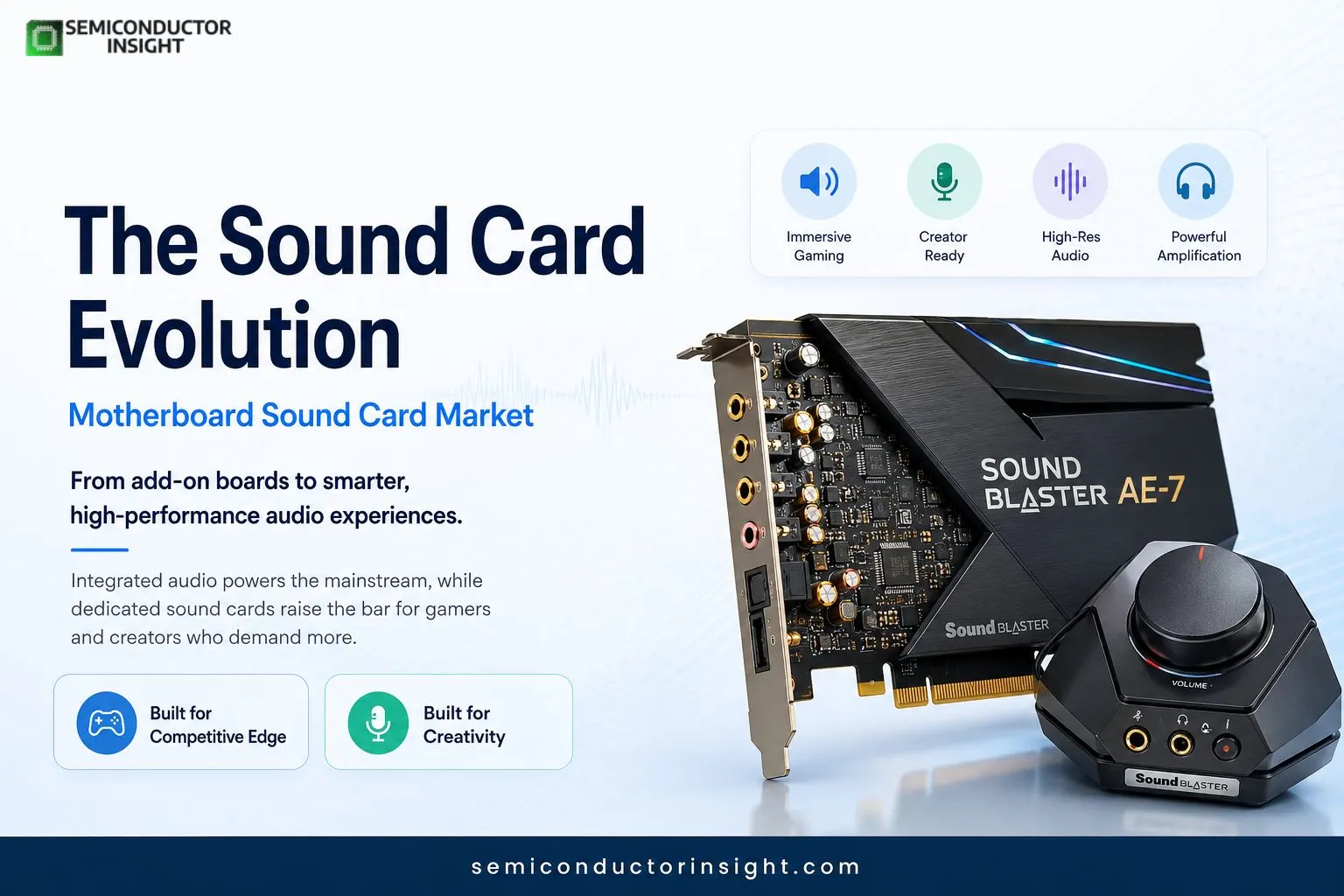
Motherboard Sound Card Market 2026: From Integrated HD Audio to 384 kHz Hi-Res PC Sound
The sound card has changed dramatically from the large expansion boards used in older desktop computers. Modern motherboards commonly integrate audio circuitry directly onto the board, combining an audio codec, DAC, amplifiers and software controls into a compact solution.
This has made basic audio available without requiring a separate PCIe card. At the same time, premium desktop users continue to purchase dedicated sound cards when they need stronger headphone amplification, cleaner signal processing or more advanced surround and recording capabilities.
What Is Actually Being Sold in This Market?
The motherboard sound card segment now covers several layers of hardware rather than one simple product category. Integrated motherboard audio is the mainstream configuration, while PCIe sound cards occupy the enthusiast and specialist end.
Dedicated products can add features such as dedicated DSP processing, higher dynamic range, optical connectivity, headphone amplification and professional recording support. Creative’s Sound Blaster AE-7, for example, uses a PCIe interface, an ESS SABRE-class 9018 DAC, 127 dB dynamic range and playback reaching 32-bit/384 kHz PCM.
384 kHz Is Becoming a Specification Benchmark
- Audio specifications have become one of the clearest ways manufacturers differentiate premium solutions.
- The AE-7 supports PCM playback at 16-bit, 24-bit and 32-bit resolutions, with sampling rates extending from 44.1 kHz to 384 kHz and DSD64 support.
- Its headphone amplifier is rated for headphones ranging from 16 ohms to 600 ohms.
- These figures do not mean every gaming or music application requires 384 kHz playback.
- They do, however, show where high-end PC audio hardware is being positioned. Buyers increasingly compare DAC architecture, output impedance, dynamic range and amplification alongside conventional motherboard specifications.
Gaming Is Turning Audio into a Competitive Feature
PC gaming has changed expectations around sound. Footstep positioning, directional effects, voice communication and environmental audio can influence how players experience competitive titles.
The wider PC hardware ecosystem remains substantial. Steam’s August 2026 Hardware Survey shows that 91.45% of surveyed systems were using DirectX 12 GPUs, while Windows 11 accounted for 75.53% of surveyed Windows systems.
Although Steam does not separately report sound-card ownership, these figures illustrate the modern performance-oriented PC environment in which gaming audio hardware is being developed.
To find out more, feel free to browse our latest updated report: https://semiconductorinsight.com/report/motherboard-sound-card-market/
Why Dedicated Cards Still Have a Place?
Integrated audio has become good enough for ordinary music, video calls, streaming and gaming. That has narrowed the reason to buy a separate sound card.
Dedicated hardware still has an advantage when users require higher-end headphone amplification, multiple analog outputs, optical connectivity or specialized audio processing. The AE-7, for instance, provides 5.1 discrete speaker output, 7.1 virtual headphone surround and an external Audio Control Module for easier access to audio connections.
This creates a two-tier market. Motherboard audio serves the majority of mainstream PC users, while dedicated cards target enthusiasts, gamers, music listeners and creators seeking specific improvements.
Content Creators Are Changing the Upgrade Equation
- Audio is no longer limited to entertainment. Streamers, podcasters, video editors and home-studio users need clean microphone input alongside reliable playback.
- Modern dedicated sound cards therefore combine DACs, headphone amplifiers, microphone inputs and recording capabilities.
- The AE-7 supports ASIO 2.3 and recording through its microphone input, giving it relevance beyond gaming.
- This broader usage gives motherboard audio manufacturers another benchmark to consider: not simply whether sound works, but how well one PC can handle gaming, communication, music and content production simultaneously.
Software Is Becoming Part of the Audio Hardware
The modern sound experience is increasingly shaped by drivers and software. Equalization, surround virtualization, microphone processing and application-specific profiles can change the perceived performance of the same physical audio hardware.
That makes software support an increasingly important part of motherboard and sound-card design. Hardware specifications remain useful, but the user experience now depends on the combination of codec, amplifier, operating-system support and audio-processing software.
The Next Upgrade May Be Smaller Than the Old Sound Card
Motherboard sound card market is moving toward a less obvious form of competition. Instead of simply selling larger expansion cards, manufacturers are improving integrated audio isolation, DAC performance, amplifier stages and software capabilities directly on the motherboard.
Dedicated PCIe cards will continue to serve users who want specialized audio performance. Meanwhile, mainstream buyers are likely to expect increasingly capable onboard solutions as standard equipment. The result is not the disappearance of the sound card, but its transformation from a basic PC component into a more specialized audio platform.

Comments (0)