
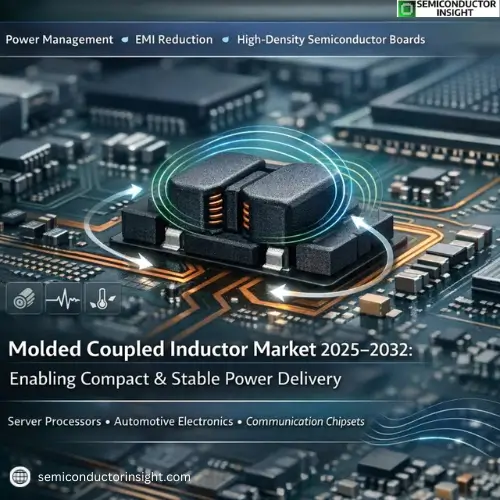
Molded Coupled Inductors Market Outlook: Compact Power Solutions Shaping Next-Gen Circuits
A Quiet Enabler inside Today’s Most Demanding Circuits
Molded coupled inductor market is emerging as a critical enabler of efficient, compact, and reliable power management across advanced semiconductor applications.
Power management has become one of the most decisive factors in modern electronics design. As devices grow smaller, faster, and more energy-conscious, engineers are increasingly turning to components that can deliver efficiency without sacrificing stability. Molded coupled inductors fall squarely into this category. Though rarely visible to end users, they play a central role in keeping power rails balanced, noise suppressed, and performance consistent across compact electronic systems.
This blog explores how the molded coupled inductor market is evolving, why it is gaining strategic importance across semiconductor-driven industries, and how design priorities are reshaping supplier innovation.
What Defines a Molded Coupled Inductor?
A molded coupled inductor integrates two or more windings within a single magnetic core, encapsulated through a molding process. This structure allows magnetic coupling between windings, enabling functions such as ripple current cancellation, improved transient response, and reduced electromagnetic interference.
Discrete inductors positioned independently on a board, nonetheless, molded coupled inductors offer tight parameter control, mechanical robustness, and predictable electrical behavior, qualities that are increasingly valued in high-density semiconductor applications.
Take a Quick Glance at Our In-Depth Analysis Report:
https://semiconductorinsight.com/report/molded-coupled-inductor-market/
Why Designers Are Re-Evaluating Power Components?
Semiconductor systems today operate under narrower electrical margins. Voltage drops, current spikes, or thermal instability can compromise entire subsystems. Molded coupled inductors address several of these concerns simultaneously.
From a design standpoint, they reduce the number of external components required for power conditioning. Fewer parts translate into smaller footprints, simplified layouts, and higher assembly reliability. This is especially critical in applications such as server processors, automotive control units, and communication chipsets, where board space and thermal headroom are tightly constrained.
Demand Signals Emerging Across End-Use Segments
The market is being shaped by multiple semiconductor-linked industries that now demand more refined power architectures.
Data centres and cloud infrastructure are adopting molded coupled inductors to stabilize multi-phase voltage regulator modules feeding high-core-count processors. Automotive electronics, particularly electric power steering, battery management systems, and advanced driver-assistance platforms, are also driving uptake due to the components’ vibration resistance and thermal durability.
Consumer electronics manufacturers, meanwhile, value these inductors for their ability to suppress noise in fast-switching circuits used in smartphones, wearable, and gaming devices without inflating component count.
Material Science and Manufacturing Precision
One of the less visible drivers of this market is progress in magnetic materials and molding technologies. Manufacturers are refining powdered metal compositions to balance saturation current, core losses, and thermal stability. At the same time, advanced molding techniques are improving mechanical consistency and reducing variation across production batches.
This manufacturing precision is increasingly important as semiconductor OEMs demand tighter tolerances to support automated assembly and high-yield production lines. Molded construction also enhances long-term reliability by protecting windings from moisture, dust, and mechanical stress.
Performance Advantages That Influence Purchasing Decisions
Rather than competing solely on price, suppliers in the molded coupled inductor market are differentiating on performance metrics that directly impact system efficiency and lifecycle cost.
Key attributes influencing procurement include:
- Stable inductance under high current loads
- Lower core losses at elevated switching frequencies
- Reduced audible noise and electromagnetic emissions
- Consistent thermal behavior across operating ranges
These factors are particularly important for OEMs producing mission-critical electronics where downtime or failure carries significant cost.
Regulatory and Compliance Considerations
Although inductors themselves are passive components, they must align with broader regulatory expectations governing electronic systems. Compliance with automotive standards, industrial safety norms, and electromagnetic compatibility requirements is shaping product development strategies.
Manufacturers are investing in qualification testing to meet regional standards across North America, Europe, and Asia-Pacific, allowing their components to be integrated into globally distributed semiconductor platforms without redesign.
Competitive Landscape: Strategy over Scale
Molded coupled inductor market favors suppliers with deep application knowledge rather than sheer production volume. Long-term relationships with semiconductor designers, power module manufacturers, and Tier-1 electronics suppliers often determine success.
Strategic priorities across leading players include:
- Co-design partnerships with power IC developers
- Custom inductance and current ratings for platform-specific needs
- Expansion of high-frequency and high-temperature product lines
This collaboration-driven approach helps suppliers embed their components deeper into customer designs, creating durable revenue streams.
Market Direction and Strategic Takeaways
Looking ahead, the molded coupled inductor market is expected to grow in parallel with semiconductor architectures that demand cleaner, more efficient power delivery. As switching frequencies rise and board real estate shrinks, the role of magnetics will continue to expand rather than diminish.
The target market’s trajectory suggests a shift from standardized components toward application-tuned power solutions, where reliability, consistency, and engineering support matter as much as electrical specifications. For stakeholders across the semiconductor value chain, molded coupled inductors are no longer auxiliary parts they are becoming foundational elements of modern electronic design.

Comments (0)