
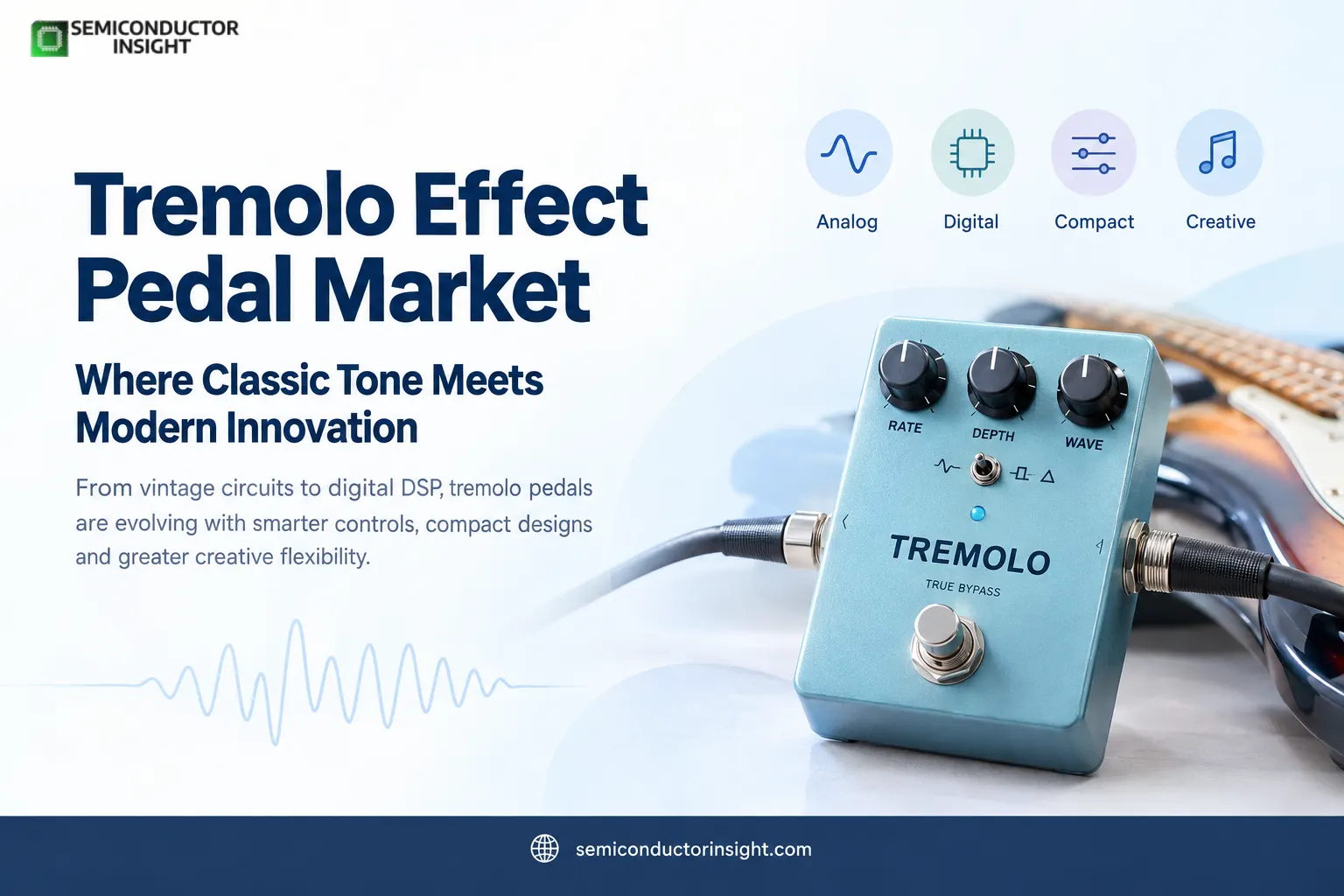
Modern Pedalboard Innovation Puts the Tremolo Effect Pedal Market Back in Focus in 2026
Tremolo occupies an interesting position in guitar technology because its name is frequently confused with vibrato. True tremolo changes the volume or amplitude of an audio signal, while vibrato changes pitch. Fender describes tremolo as a rhythmic variation in volume controlled through parameters such as rate and depth.
This distinction has become increasingly important as modern pedals reproduce several historical amplifier circuits inside compact digital and analog enclosures.
The effect has moved from amplifier circuitry into dedicated stompboxes, multi-effects processors and hybrid pedals. That transition has opened a much wider design space for manufacturers and musicians.
A Market Built Around Three Control Variables
At the heart of a conventional tremolo pedal is a low-frequency oscillator, or LFO, which periodically modifies the guitar signal. Traditional designs commonly use sine or triangle waveforms, while modern pedals can add square, harmonic and other waveform variations.
The operating concept can be represented as:
Guitar signal → LFO modulation → waveform shaping → amplitude variation → output signal
Rate determines how quickly the volume fluctuates, while depth controls how pronounced the change becomes. Waveform selection determines whether the movement sounds smooth, pulsing, choppy or more mechanical.
From Vacuum Tubes to DSP
- The evolution of tremolo technology is closely tied to amplifier engineering.
- Fender’s historical tremolo circuits included tube-bias and optical approaches, with optical systems using a light-dependent resistor to vary signal level.
- Modern stompboxes can reproduce these behaviors electronically while adding functions that were difficult to achieve in traditional amplifier circuits.
The result is a market divided across distinct technology approaches:
Tube-inspired circuits → optical designs → transistor analog pedals → digital DSP → hybrid analog-digital platforms
- This progression has allowed manufacturers to target both vintage-oriented players and musicians seeking programmable modulation.
The Numbers behind Today’s Pedal Ecosystem
The broader effects category provides a useful indication of the environment in which tremolo pedals compete. NAMM reported that U.S. effects pedal shipments reached nearly 1.5 million units, with an estimated retail value of $199.8 million in its latest industry reporting. Multi-effects processor shipments were around 160,000 units, while the category recorded a 6.4% decline.
NAMM’s 2025 Show post-event data also recorded 19,998 attendee interests in effects and pedals, placing the category among the major product-interest areas at the event.
These figures cover effects pedals broadly rather than tremolo alone, but they demonstrate the sizeable ecosystem in which specialized modulation pedals operate.
Our most recent updated related study is available for free at this link: https://semiconductorinsight.com/report/tremolo-effect-pedal-market/
Why Tap Tempo Has Become More Than a Premium Feature?
One of the clearest changes in tremolo design is the move from manually adjusted speed controls toward tempo-aware operation. Fender’s current Tre-Verb pedal incorporates tap tempo alongside independent tremolo and reverb sections, stereo inputs and outputs, and three tremolo voices including optical, bias and harmonic vibrato.
This reflects a practical shift in how pedals are used. Tremolo can now be synchronized more deliberately with song structure, live performance and recording workflows instead of functioning only as a manually adjusted atmospheric effect.
Compact Hardware Is Becoming a Processing Platform
- Modern tremolo pedals increasingly resemble small audio computers. Strymon’s Flint V2, for example, combines tremolo and reverb with 24-bit/96 kHz converters, a 520 MHz ARM processor, 32-bit floating-point processing, MIDI connectivity and stereo operation.
- At the simpler end, the BOSS TR-2 continues to use dedicated Rate, Depth and Wave controls in a compact 73 × 129 × 59 mm enclosure and operates from a 9V supply.
- This creates two distinct product philosophies: immediate hands-on control and deeper programmable processing.
Vintage Sound Meets Modern Amplification
The demand for classic tremolo character has not disappeared with digital technology. Fender’s current Tone Master Princeton Reverb uses digital technology while recreating the company’s traditional reverb and tube-bias tremolo behavior. The amplifier provides 100–240V operation, a USB port for firmware updates and dedicated Speed and Intensity controls.
This combination illustrates the broader direction of the category: vintage sonic references are increasingly being reproduced through modern electronics rather than requiring every player to own vintage hardware.
Where Tremolo Is Finding New Creative Space
Tremolo is increasingly being used as a rhythmic production tool rather than simply an old-school guitar effect. Adjustable waveforms, stereo routing, tap tempo, expression control and digital presets allow musicians to move between subtle amplitude movement and sharply gated patterns.
For pedal manufacturers, the opportunity therefore lies less in recreating one historical circuit and more in combining recognizable tremolo character with contemporary control architecture. The 2026 landscape is consequently defined by a blend of analog heritage, DSP capability, compact hardware and increasingly sophisticated pedalboard integration.

Comments (0)