

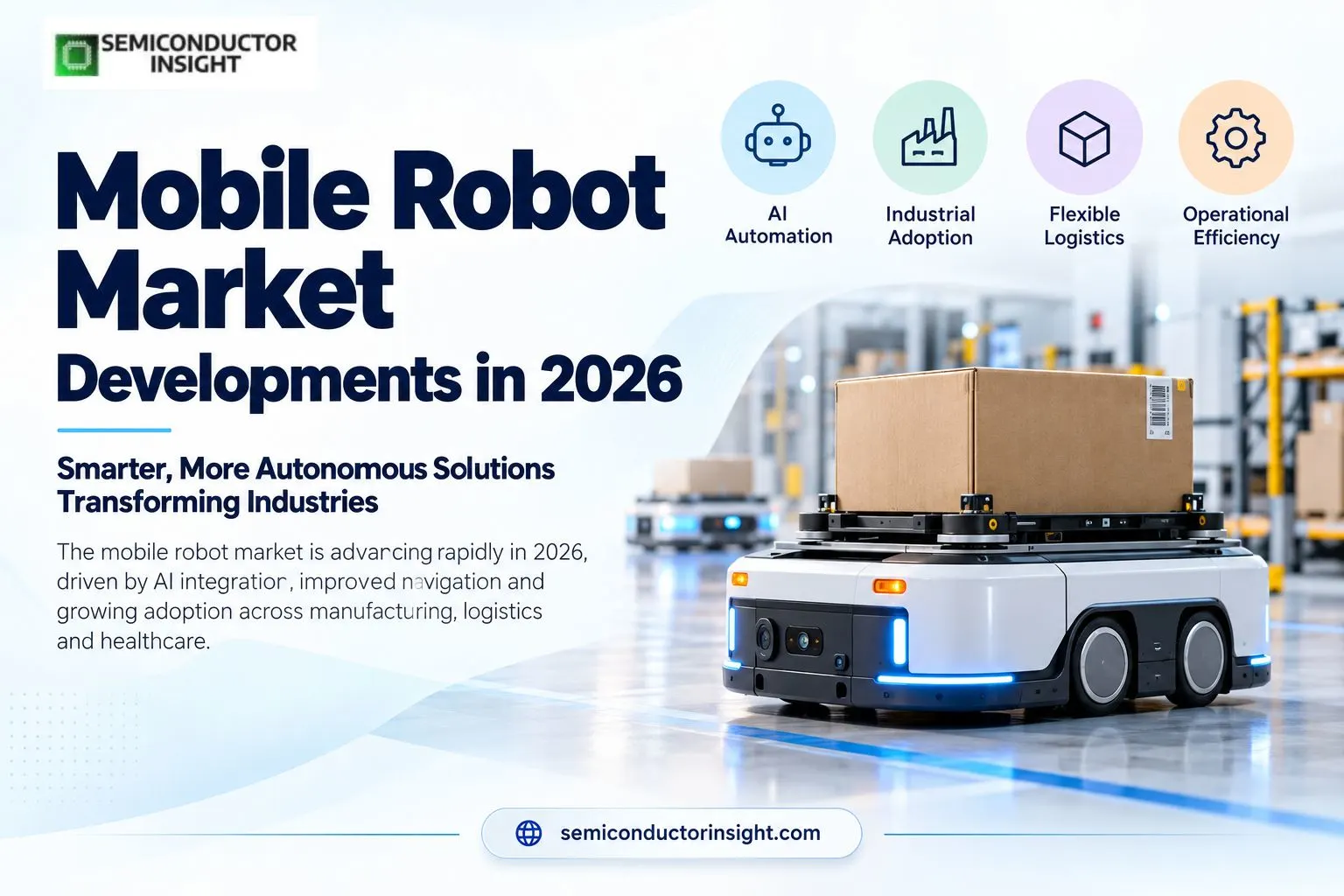
Mobile Robot Market Developments in 2026 as Industrial Automation Expands Across Supply Chains
Semiconductor factories are becoming more complex as advanced chips require tightly coordinated manufacturing steps, controlled environments, and precise material handling. In this setting, mobile robots are moving beyond conventional warehouse transport to support the movement of wafer carriers, reticle pods, tools, and production materials inside sensitive facilities.
- This blog explores how mobile robotics is evolving in semiconductor manufacturing, from cleanroom-compatible platforms to AI-assisted navigation and the emerging need for dedicated safety standards.
What Makes a Mobile Robot Valuable Inside a Semiconductor Fab?
A mobile robot is a self-propelled platform designed to transport materials or perform tasks while navigating a facility. Depending on the application, it may follow predefined routes or use sensors, cameras, and mapping software to move around obstacles.
Semiconductor environments impose additional requirements. Robots must limit particle generation, protect sensitive components, fit through narrow aisles, and coordinate safely with people and production equipment. The value proposition is therefore not simply faster movement; it is reliable material delivery without compromising process cleanliness or traceability.
SEMI’s overview of factory automation explains how material-handling systems help coordinate the movement and storage of materials throughout complex wafer fabs.
A Real-World Shift from Transport to Precision Handling
One of the most relevant developments is the use of compact autonomous mobile robots for reticle and wafer-carrier logistics. These systems can combine navigation with robotic arms or specialized handling mechanisms, allowing a single platform to travel between locations and interact with equipment.
- In July 2026, Fabmatics reported that its HERO Scout autonomous mobile robot had been evaluated with Infineon Technologies Dresden under real production conditions in a 200 mm semiconductor fab. The trial covered reticle SMIF pods and wafer carriers in lithography operations, including narrow cleanroom aisles and complex handling scenarios. This is a concrete example of mobile robotics being assessed for actual fab workflows rather than only warehouse demonstrations.
Why Older Factories Are Becoming an Important Test Case?
Building automation into a new semiconductor facility is different from introducing it into an established plant. Older facilities may have narrow passages, tightly arranged equipment, legacy control systems, and limited room for fixed transport infrastructure.
SEMI has highlighted these issues in semiconductor assembly and test operations, where manual material movement and inconsistent carrier designs can complicate automation. Mobile platforms may offer a way to automate selected routes or processes without redesigning an entire facility. However, successful deployment still depends on suitable interfaces, usable production data, and careful workflow planning.
The Numbers behind the Wider Mobile Robotics Opportunity
- The broader robotics market provides useful context. The International Federation of Robotics reported almost 200,000 professional service robots sold in 2024.
- Transportation and logistics accounted for 102,900 units, making it the largest application category in that report.
- These figures are not specific to semiconductor fabs, but they illustrate the wider adoption of automated material movement across professional environments.
- For semiconductor manufacturers, the more meaningful measures are likely to include delivery reliability, transport cycle time, human intervention frequency, contamination performance, and the number of production interfaces a robot can support.
Don’t Forget to Surf Our Updated Related Report for More Detailed Analysis: https://semiconductorinsight.com/report/mobile-ois-controller-ic-market/
Safety Standards Are Becoming Part of the Technology Story
Mobile robots in a semiconductor fab operate in conditions that differ from those in a conventional warehouse. They may share aisles with personnel, interact with manufacturing equipment, and transport materials subject to strict process requirements.
– A July 2026 SEMI standards activity document proposed developing a safety guideline specifically for autonomous mobile robots used in semiconductor manufacturing and laboratory environments. It identifies issues such as cleanroom constraints, equipment interaction, and fab-specific hazards. The proposal signals that safety and interoperability are becoming important parts of the sector’s automation discussion; it should not be interpreted as confirmation that a final standard has already been published.
Where Robot Suppliers Can Differentiate
For equipment manufacturers and automation integrators, differentiation is increasingly tied to more than payload capacity or travel speed. Cleanroom compatibility, compact design, accurate docking, robotic handling, software integration, and the ability to operate alongside existing infrastructure can be equally important.
- The KUKA KMR iisy CR, announced in 2025, illustrates this direction with a mobile manipulator designed for cleanroom use in semiconductor and electronics applications.
- KUKA describes cleanroom-class certification, electrostatic-discharge protection, and payload variants of 11 kg and 15 kg.
The Next Measure of Progress
Mobile robot market’s role in semiconductor manufacturing will depend on how effectively machines, software, safety systems, and factory equipment work together. The next stage is not simply deploying more robots; it is enabling dependable, traceable movement across production environments with different layouts and levels of automation.
For semiconductor companies, that makes mobile robotics a practical part of the wider smart-factory transition. For suppliers, the strongest opportunities may come from solving specific fab-level problems especially cleanroom transport, legacy-facility upgrades, and precise handling rather than offering a one-size-fits-all robot.

Comments (0)