
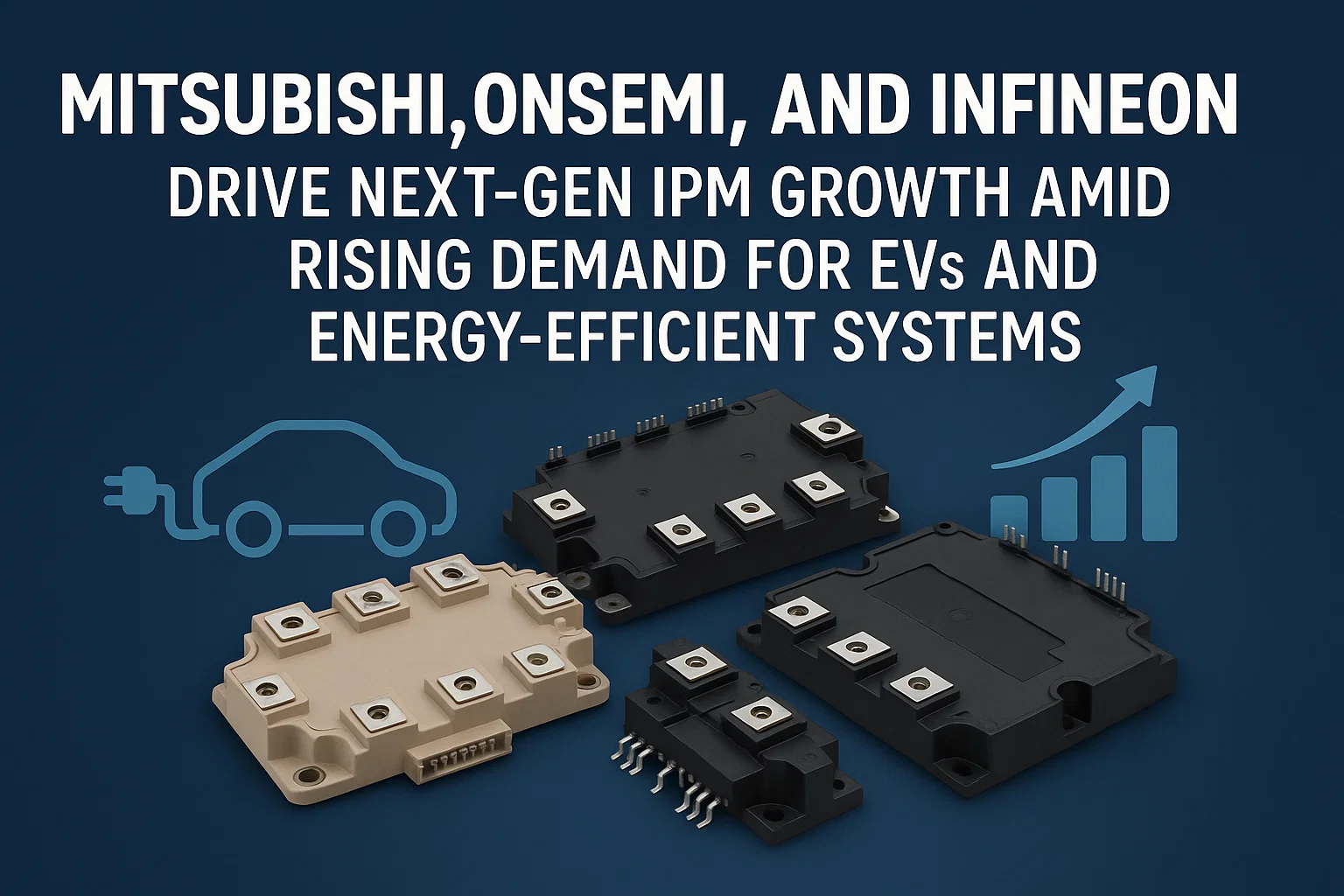
Mitsubishi, onsemi, and Infineon Drive Next-Gen IPM Growth Amid Rising Demand for EVs and Energy-Efficient Systems
Integrated Intelligent Power Modules (IPMs) are fast becoming a key technology in the drive toward greater electrical efficiency, miniaturization, and thermal performance in industries ranging from HVAC to electric vehicles and industrial automation. Recent product announcements from major companies like onsemi and Mitsubishi Electric highlight how far IPM technology has come in terms of power density, integration, cost reduction, and application flexibility.
In 2024, the global IPM market was valued at about US$ 5,383 million, and forecasts project it will grow to approximately US$ 7,720 million by 2032, translating into a compound annual growth rate (CAGR) of about 5.8% over the forecast period.
Access Your Free Sample Report- Integrated Intelligent Power Module (IPM) Market
What is an IPM?
Before diving into the recent news, a quick refresher. An Integrated Intelligent Power Module (IPM) is a power semiconductor module which integrates power switching devices (such as MOSFETs or IGBTs), driver circuits, protection functions (undervoltage, overcurrent, thermal), sometimes temperature sensors, and other supporting components in a single package optimized for efficient power conversion. The “intelligent” aspect refers to the inclusion of these driver / protection / sensing functions, not just the bare switches.
IPMs are used in inverters (DC to AC), variable frequency drives (VFDs), motor drives, compressors, heat pumps, robotics, and more. Key performance metrics include:
- Voltage & current rating
- Switching speed and switching losses
- Thermal performance and cooling (junction-to-case, case-to-ambient)
- Protection features (short-circuit, undervoltage etc.)
- Physical size, footprint, and integration level
As applications demand more power, more efficiency, smaller sizes, and lower system cost, manufacturers are pushed to innovate across all these axes.
The Market: Size, Drivers, and Projections
- Market valuation (2024): approximately US$ 5,383 million.
- Projected market (2032): US$ 7,720 million.
- Expected CAGR (2024-2032): ~ 8%.
These figures suggest steady growth. What are driving factors?
- Energy Efficiency & Sustainability Pressures
Governments and industries are pushing for lower energy consumption and reduced carbon emissions. IPMs help by improving inverter and motor drive efficiency, reducing associated losses and cooling demands. - Electrification in Multiple Sectors
- Electric vehicles (motor drives, traction inverters)
- Renewable energy systems (solar inverters, wind turbine controls)
- HVAC / heat pump systems, which are increasingly prevalent as heating/cooling contributes substantially to energy use in buildings.
- Demand for Compact, High-Density Solutions
As everything gets more compact, from home appliances to data center cooling systems, there’s a demand for smaller power electronics modules that deliver as much (or more) current & voltage, with better thermal performance. - Wide Bandgap Semiconductor Adoption
Technologies like silicon carbide (SiC) and gallium nitride (GaN) are becoming more mature and cost-competitive. They offer reduced conduction and switching losses, allowing higher efficiency and higher switching frequencies. - Cost Pressures
Not just for the semiconductor module itself, but for the total system – design, board area, cooling, power losses, maintenance. IPMs that reduce auxiliary components, reduce heat sinks or cooling requirements, or enable lighter or simpler designs carry value. - Geographic & Application Expansion
Air conditioners, heat pumps, industrial motors, fans, robotics, data centers, etc., are all expanding in markets needing better power electronics, especially in Asia, Europe, North America. Cold-weather capable modules are also becoming more important.
Recent Developments in IPM Technology (2024-2025)
1. onsemi’s EliteSiC SPM 31 IPMs
What was announced
- In March 2025, onsemi introduced a new generation of IPMs under the EliteSiC SPM 31 These modules are based on 1200 V silicon carbide (SiC) MOSFETs, as opposed to traditional IGBTs.
- These IPMs are aimed at three-phase inverter drive applications: EC (electronically commutated) fans (e.g. in AI data centers), HVAC / heat pumps, industrial pump & fan drives, robotics, servo-motors, VFDs.
- They deliver higher thermal performance, reduced power losses, fast switching capability, and higher power density in a more compact package than modules built with earlier IGBT technologies (specifically, Field Stop 7 (“FS7”) IGBTs).
- Current ratings for the EliteSiC SPM 31 units range across 40 A to 70 A. These are complemented by the existing onsemi SPM 31 IGBT portfolio, which covers lower currents (15 A to 35 A). This gives onsemi a “broadly scalable” offering across both low and mid currents.
Key technical features & advantages
- Higher power density, smaller footprint: Because SiC MOSFETs have lower losses (especially switching losses), and can be switched faster, the supporting passive components (inductors, capacitors etc.) can often be smaller; also, thermal margin can improve, allowing more tightly packed designs.
- Improved efficiency and lower system cost: Using SiC modules can reduce the total energy consumption and operating cost, especially in units that run continuously or under moderate to heavy load (for example cooling fans in AI data centers). onsemi claims that for an EC fan using a module with 70% load and 500 W of power loss (in a previous IGBT-based module), switching to the EliteSiC SPM 31 could reduce annual energy use and cost by ~52%.
- Thermal & Protection Integration: These modules include built-in under-voltage protection (UVP), temperature sensors (a thermistor or VTS), gate driver circuits, built-in bootstrap diodes and resistors, internal boost diodes for the gate drive, etc. Also a design that separates source connections for the lower legs gives more flexibility in control algorithm design.
Implications
- For industries like data centers and HVAC, where power consumption and cooling costs are large components of total cost, such efficiency improvements can have significant pay-back.
- The move from IGBT to SiC for IPMs in these mid-voltage ranges (≈ 600-1200V) is accelerating, especially where thermal efficiency and switching frequency matter.
- Design houses will likely revise inverter designs to accommodate faster switching, possibly moving to higher switching frequencies, lighter cooling infrastructure, and possibly more compact mechanical layouts.
2. Mitsubishi Electric’s Compact DIPIPM Series (PSS30SF1F6 & PSS50SF1F6)
What was announced
- In September 2025, Mitsubishi Electric announced a new Compact DIPIPM series of power semiconductor modules. Two variants: PSS30SF1F6 (30 A, 600 V) and PSS50SF1F6 (50 A, 600 V).
- Samples are set to begin shipping on September 22, 2025.
- These modules use reverse-conducting IGBTs (RC-IGBTs). One of their main features is a drastically reduced footprint: about 53% of the size of the company’s previous Mini DIPIPM Ver.7 modules.
Technical features & advantages
- Reduced footprint: By using RC-IGBTs, the new modules manage to halve the module area (roughly) compared to older versions. This is crucial for applications where PCB or inverter substrate real estate is constrained.
- Temperature range & environmental performance: They are designed to operate at continuous lower-side temperatures of -40°C, which makes them more suitable for colder climates (North America, Northern Europe) where outdoor units might be exposed to cold.
- Interlock function for short-circuit protection: The modules include a new interlock function for arm short-circuit protection, which simplifies the protection design of inverter substrates. This means fewer external components or simpler board design for designers/integrators.
- Maintained insulation distance: Although the modules are smaller, the insulation distance from terminals to the heat sink is equivalent to that of older, larger modules, which helps with compatibility and safety.
Implications
- This module is well suited to consumer and industrial equipment: packaged air conditioners, heat pumps, hot water heating systems, and similar. In many of these, the inverter module is outdoors, has to handle fluctuations in ambient temperature, and has constraints on size and cost. The reduced footprint and cold-temperature tolerance allow for better deployment in diverse climates.
- The interlock/short-circuit protection built in reduces system design complexity (fewer external protection circuits, possibly lower component count), which can reduce cost, reliability risk, and assembly complexity.
- The footprint reduction also can improve thermal paths, possibly allowing better cooling integration or a smaller heatsink / casing, reducing materials and costs.
Comparative Analysis: SiC vs IGBT & Compact Footprints
These two announcements from onsemi and Mitsubishi illustrate two complementary but distinct paths of innovation:
| Feature | onsemi EliteSiC SPM 31 | Mitsubishi Compact DIPIPM PSS30/50SF1F6 |
| Semiconductor type | SiC MOSFETs (1200V) with accompanying protection & driver ICs. | RC-IGBTs (600V) with integrated control / protection. |
| Current/Voltage ratings | 40-70 A (SiC); supported by 15-35 A IGBT versions. Voltage = 1200V. | 30 A & 50 A, Voltage = 600V. |
| Target applications | EC fans, data centers, heat pumps, HVAC, robotics, VFDs, industrial pumps & fans. | Packaged AC, heat pump heating and hot water, consumer / industrial, outdoor units in climate control. |
| Size / Footprint | Smaller form factor than comparable FS7 IGBTs plus higher power density; thermals allow tighter package. | ≈ 53% of footprint compared to earlier Mini DIPIPM Ver.7; same insulation distances. |
| Environmental / Temperature resilience | Improved thermal behavior; benefits in high load, continuous operation. | Lower continuous temperature down to -40°C; suitable for cold climates. |
| Protection / Safety / Design simplification | Integrated UVP, gate-driver, temperature sensors, source-leg flexibility etc. | New interlock function, preserved insulation, simplified substrate design. |
From this comparison, a few observations emerge:
- For high voltage and high efficiency thermal performance, SiC is becoming the clear choice, especially for continuous loads, faster switching, and applications where losses or cooling are a critical cost factor.
- For moderately high voltage (600V), IGBTs (especially RC-IGBT structures) remain viable, particularly where cost, established supply chains, and compatibility with existing designs (older inverters, etc.) matter.
- Size reduction and system integration (driver + protection + sensing) remain major competitive levers. The less auxiliary board space, fewer external components, or simpler cooling, the more attractive an IPM is to OEMs seeking compact, efficient designs.
- Temperature range (cold-weather capability) is another differentiator in many markets (Northern Europe, colder parts of North America, etc.) since many outdoor AC/heat pump units suffer performance or reliability issues in cold temperature if not designed properly.
Download Sample Report PDF- Integrated Intelligent Power Module (IPM) Market
How These Innovations Fit into the Market Growth Projections
Based on the market numbers you provided (US$ 5,383 million in 2024 → US$ 7,720 million by 2032 at CAGR ~5.8%), these recent product releases align well with what the market needs to fulfill that growth. Here’s how:
- Broadening the Product Portfolio
With onsemi covering higher voltage SiC modules, and Mitsubishi improving IGBT-based modules with smaller footprints, the industry is catering to both ends: high efficiency premium applications and cost-sensitive ones. This broad coverage is necessary for growth because different segments grow at different speeds. - Enabling Upgrades in Existing Systems
OEMs who have legacy designs using IGBT modules now have options to replace or upgrade to more efficient SiC-based modules, or more compact IGBT modules. This triggers retrofit markets or next-generation product lines, accelerating growth. - Geographic Expansion, Especially in Cold Climates
Mitsubishi’s design catering to -40°C continuous operation helps penetrate markets that were challenging earlier. This opens up demand in colder geographies. Meanwhile, onsemi’s modules large target application like data centers (global) and HVAC systems (global) supports demand everywhere. - System-Level Cost Reductions
Greater efficiency (less energy wasted), reduced cooling infrastructure, fewer external components (protection circuits, driver ICs, etc.), smaller mechanical envelopes all contribute to lower total system cost. That lowers barriers to adoption, including in price-sensitive markets. As costs come down (especially for SiC manufacturing), we can expect more competitive pricing, accelerating adoption. - Meeting Regulatory & Energy Standards
Globally, energy efficiency standards are tightening (e.g. for buildings, appliances, motors). These product innovations help manufacturers meet stricter regulations, which tends to spur replacement of older less efficient modules or adoption of newer ones. This is a powerful growth driver.
So, the recent developments are not just incremental they are structural improvements that map well onto what the market is demanding. They help justify the projected ~5.8% CAGR by enabling performance improvements, cost reductions, expansion into new use-cases and geographies.
Additional Insights & Future Directions
Beyond what has already been announced, here are some additional insights: what to expect, where challenges lie, and what could make or break this market in the next few years.
a) Widespread Adoption of Wide Bandgap Semiconductors (SiC/GaN)
- While onsemi’s EliteSiC is a clear example of SiC MOSFETs moving into mainstream IPM territory for AC drives, we can expect more manufacturers to follow suit. As the production yield and cost of SiC improve, the premium over IGBT drops, making SiC more accessible.
- GaN devices could play a role especially in lower voltage (< 600V) or high-frequency switching situations but are somewhat less mature for high current/high power overnight applications. Integration of GaN-based switches into IPMs might be next frontier.
b) Thermal Management Becomes Ever More Critical
- Efficiency improvements result in less heat, but heat still is the key bottleneck in power electronics. Innovations in packaging (e.g. direct-bond copper substrates, advanced cooling, better thermal interfaces), as well as designs that reduce thermal resistance from junction to heat sink + ambient, will give competitive edges.
- Additionally, modular systems might begin to adopt active cooling at module level, or more thermal monitoring and smart protection to prevent overheating.
c) Integration & Simplification
- Integrated protection, driver, thermal sensing etc., reduce external components and improve reliability. As IPMs continue to add more “intelligence,” designs become simpler for OEMs (less external circuitry, fewer ancillary parts). This reduces BOM cost, size, and failure points.
- Footprint reduction, as shown in Mitsubishi’s new DIPIPMs, is a strong trend. Also maintaining safety / insulation standards while shrinking size is not trivial, so designs that manage both well will be favored.
d) Operating Environments & Reliability
- Many deployments are outdoors or in harsh environments: heat, cold, humidity, vibration. Modules that can reliably perform in wide temperature ranges, with robust insulation and protection, will gain in importance.
- As demands for outdoor / rooftop installations of heat pumps, air conditioners etc. increase (especially in colder climates), design requirements for cold temperature starts, frost/dust, etc., will challenge manufacturers.
e) Cost, Supply Chain & Material Constraints
- Component cost especially SiC wafers and manufacturing yield remains a challenge. For wide adoption, margins, cost stability, and supply chain robustness are essential.
- As more players enter, and as demand rises, silicon carbide and other raw materials might present constraints. Manufacturers who secure good supply and improve yield will have advantage.
- Also regulatory environment (tariffs, environmental regulations, import/export restrictions) could affect where modules are produced and at what cost.
f) Application Trends & New Use Cases
- Data centers: as power per rack increases (due to AI, high-performance computing), cooling becomes a dominant cost and design constraint. Module efficiency and density will directly affect cooling requirements and energy use.
- Electrification in transport: IPMs are required in EV motor drives, onboard chargers, DC-DC converters. The higher voltages and power levels there present opportunities for SiC, large IPMs, etc.
- Renewables & Smart Grids: solar inverters, battery energy storage systems, microgrids, etc., need efficient power conversion, frequently under variable load and environmental conditions.
- Consumer / Residential Appliances: air conditioners, heat pumps, etc., are increasingly inverter equipped. As consumers demand quieter, more efficient, more compact systems, the IPMs enabling these features will be essential.
Challenges & Risks
Even with strong trends and promising new product releases, there are challenges that could slow down adoption or impact growth.
- Cost of SiC & Manufacturing Complexity
While SiC offers advantages, it is more difficult / expensive to produce (substrate cost, defect control, packaging). Manufacturers must balance performance gains against cost. - Reliability & Lifetime under Stress
High switching frequency, wide temperature swings, thermal cycling, and environmental stress (humidity, dust, vibration) test module lifetime. Failures often come at joints, leads, packaging interfaces. - Thermal Management Limits
Shrinking size raises heat density. Even if losses drop, cooling becomes more challenging in compact modules. Designers must ensure adequate cooling paths. - Standardization / Compatibility Issues
OEMs often have existing footprints, board designs, voltage/current specs. New modules that require changing substrates or cooling systems may face resistance unless the benefits are substantial. - Regulation and Certification Requirements
Modules must meet safety, insulation, EM-compatibility, environmental (RoHS etc.), and regional standards. Every market has quirks. Modules intended for cold regions need low-temperature certification etc. - Supply Chain Constraints
Raw materials (SiC wafers, packaging materials), testing equipment, foundry capacity, etc., are all critical. Scaling up without bottlenecks is nontrivial.
What OEMs & System Designers Should Watch For
Given all this, what should designers, manufacturers, and system integrators be keeping an eye on?
- Benchmarking energy savings in real-world conditions: Not just lab specs. How much energy, cooling, size, weight, and cost is saved when replacing legacy modules with newer SiC IPMs or compact IGBTs?
- Lifecycle cost: Including design cost, cooling hardware, efficiency over time, maintenance, etc. Modules with better upfront specs but shorter lifetime might be less desirable overall.
- Thermal interface materials & packaging innovations: Sometimes small improvements (in substrate, die attach, lead frame, heat spreaders) lead to large benefits in reliability and performance.
- Modular architectures: Use of scalable modules which cover a range of currents/voltages with the same basic architecture helps with inventory, design reuse, and cost.
- Supplier roadmap & support:Will module manufacturers continue innovating (e.g., next gen SiC, GaN, higher voltages)? What is their backed support for environmental, certifications, long-term supply?
- Regulatory & Incentive environment: Government incentives for energy efficiency, regulations about appliance efficiency, building codes, etc., can create pull (market demand) for more efficient IPMs. Staying alert to regulatory changes in key markets (EU, US, China, etc.) is critical.
Projection Reconciliation: How Recent Products Supplement Market Growth
Let’s tie in the specific product advances to the projected market figures.
- With the market growing from US$ 5,383 million in 2024 to ~US$ 7,720 million by 2032, that means an increase of about US$ 2,337 million over 8 years. That growth must come from:
- Replacement of older, less efficient modules (IGBT-based, poorly integrated, large footprint)
- Demand from new or expanding application sectors (data centers, heat pumps, EVs, etc.)
- Geographic expansion (cold climates, developing markets)
- Upgrades allowed by cost improvements and performance gains (SiC becoming more affordable)
The recent innovations address multiple of these levers:
- onsemi’s SiC IPMs allow higher performance, lower system energy loss – helping capture demand from data centers, HVAC, industrial motors. The performance improvements could make high-efficiency systems more cost-effective and thus accelerate replacement of older technologies.
- Mitsubishi’s compact IGBT/RC-IGBT offerings allow OEMs under constraints of size, environment, cost to adopt more efficient modules without full redesigns (same insulation footprint, similar mounting etc.) and penetrate markets that may have been underserved due to cost or environmental constraints.
Therefore, these innovations do more than maintain market share they likely expand the addressable market by making IPMs viable in more places, under more constraints, and appealing across more price points. This helps support the ~5.8% CAGR forecast.
Case Study: Impact in Data Centers & HVAC (Example)
To illustrate concretely how these innovations might change things, consider a few hypothetical (but realistic) cases.
Example 1: Data Center Cooling Fans
- Suppose a data center has many EC cooling fans that run 24/7. They use traditional IGBT-based IPMs, and the inverter losses amount to, say, 500 W per fan when running at 70% load, plus associated cooling costs.
- Replacing these with SiC‐based EliteSiC SPM 31 modules, which reduce losses significantly, would reduce energy consumption (and cooling overhead) perhaps by ~50% for just the inverter portion. Over a year, that means significant savings both in electric bills and in cooling infrastructure wear & costs, plus reduced carbon footprint.
- The smaller footprint and better thermal performance might allow more compact designs, possibly lower cost heatsinks, or reduced cooling fan sizes, further compounding savings.
Example 2: Outdoor Air Conditioner / Heat Pump Units in Cold Climates
- For outdoor HVAC units in cold parts (Northern US, Europe), issues include cold start, performance in low ambient temperatures, weather exposure. If a module can guarantee operation down to -40°C and maintain insulation and protection, that reduces risk, returns for OEMs that produce equipment for cold climates.
- Also, compact modules are easier to integrate, cheaper to ship and install, possibly lighter, and may reduce enclosure size or simplify mounting.
- If energy efficiency is boosted (reduced switching losses, better thermal behavior), units may meet or exceed regulatory requirements in efficiency, enabling OEMs to certify or appeal to consumers who care about energy efficiency.
Click Here To Download Full Sample Report- Integrated Intelligent Power Module (IPM) Market
What to Expect Next: The Road Ahead
Based on what we’re seeing, here are predictions for what might emerge in the next few years:
- Even more aggressive SiC adoption
Companies will move higher voltage and higher current SiC IPMs toward maturity. We may see 1500 V, 2000 V classes for certain industrial and automotive uses. - GaN integration
While currently less common, GaN-based IPMs (or hybrid SiC/GaN) could become more feasible, especially in high switching frequency, moderate voltage applications (e.g., UPS systems, lighter EV auxiliary systems, RF etc.). - Smarter, more connected modules
Real-time temperature, current/voltage monitoring, health diagnostics built in. Possibly even self-adjusting protection (adaptive overcurrent thresholds etc.), firmware within driver ICs for better efficiency, remote monitoring of module health. - Packaging innovation
Further reductions in size and improvements in thermal resistance. Better materials (e.g., improved die attach, better thermal interface, possibly embedded cooling channels). More rugged packaging for outdoor exposure. - Cost scaling and commoditization
As manufacturing scale of SiC and RC-IGBT and advanced packaging increases, costs will drop. This will make premium efficiency IPMs more accessible in price-sensitive markets. - Regulatory / policy support
Increased policy emphasis on energy efficiency (e.g. for buildings, appliances) and possibly incentives for more efficient modules. Stringent standards may drive earlier obsolescence of inefficient designs, opening up demand for newer IPMs. - Supply chain localization
To control costs, risks, and meet local regulation, we might see more regional manufacturing, especially in Asia, Europe, etc., for SiC IPMs. Localization can reduce costs and delays.
Given the market data (US$ 5,383 million in 2024 growing to US$ 7,720 million by 2032 at 5.8% CAGR), these innovations are essential for meeting the performance, cost, and application demands needed to reach that projected market size. OEMs, system integrators, and designers who leverage these advances stand to gain in energy savings, size, reliability, and competitive differentiation.

Comments (0)