Key Statistics
Key Takeaways
- Market size and growth: the market is estimated at USD 5.89 billion in 2026 and is projected to reach USD 8.45 billion by 2034, representing a 4.6% CAGR during 2026–2034.
- IGBT-based IPMs remain the largest type because industrial drives, appliances and many traction-related systems rely on mature high-voltage switching with integrated gate drive and protection.
- New-energy vehicles are an important growth engine as electrification raises power-electronics content across traction, thermal management and auxiliary systems; the IEA reported more than 20 million electric-car sales globally in 2025.
- Asia Pacific leads through the combined weight of appliance manufacturing, industrial automation, EV production and a dense power-semiconductor supplier ecosystem in China, Japan and South Korea.
- Wide-bandgap integration is reshaping premium modules as SiC and GaN enable lower switching loss and higher power density, although cost, packaging and thermal design remain adoption constraints.
Integrated Intelligent Power Module (IPM) Market Overview
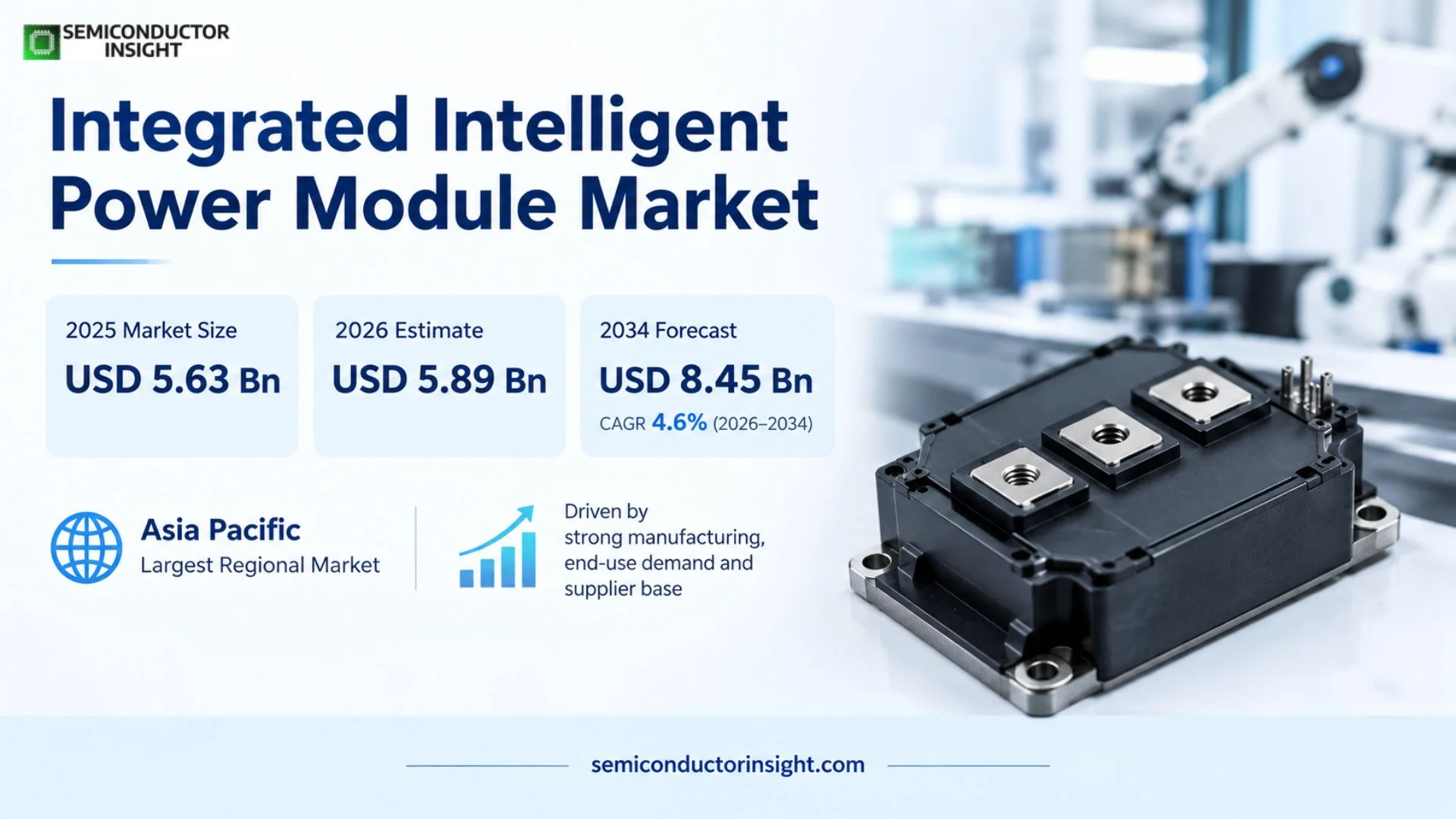
Integrated Intelligent Power Module Market was valued at USD 5.63 billion in 2025 and is estimated at USD 5.89 billion in 2026. The market is projected to reach USD 8.45 billion by 2034, representing a CAGR of 4.6% during 2026–2034. Asia Pacific is the largest regional market, supported by the strongest concentration of manufacturing, end-use demand and supplier infrastructure.
Base year: 2025 · Estimated year: 2026 · Forecast period: 2026–2034 · Values in USD million unless otherwise stated
Integrated intelligent power modules combine power switching devices, gate drivers, protection functions and thermal packaging in a compact assembly designed to simplify motor-drive and power-conversion systems. The architecture can use IGBTs or MOSFETs and increasingly incorporates silicon-carbide devices in higher-efficiency designs. The commercial value extends beyond component reduction: an IPM gives appliance, industrial and automotive designers coordinated short-circuit, overtemperature and undervoltage protection while reducing board design effort and shortening validation cycles for inverter platforms.
Demand spans inverter appliances, industrial motor control, electric vehicles, renewable-energy conversion and other systems where efficient switching must be integrated into a compact package. Variable-speed compressors, pumps, robotics and servo systems create a broad recurring base, while vehicle electrification expands controlled power stages. The International Energy Agency reported that global electric-car sales exceeded 20 million in 2025, representing one-quarter of new car sales and reinforcing long-term demand for efficient power semiconductor modules.
Technology competition is shifting from basic integration toward lower loss, higher power density, advanced diagnostics and improved thermal cycling. Direct-bonded substrates, refined die attach and wide-bandgap power devices allow higher switching frequency and smaller cooling systems, but they also increase packaging and qualification complexity. Suppliers with strong semiconductor-device technology, module packaging, application engineering and long automotive or industrial qualification histories therefore retain structural advantages over companies competing primarily on assembly cost.
Segment Analysis: By Type
The market is segmented into IGBT Based IPM, MOSFET Based IPM and other module architectures. IGBT-based products retain the largest position because their voltage capability, ruggedness and mature cost structure fit industrial drives, HVAC compressors and many appliance systems. MOSFET-based designs gain relevance where higher switching frequency and compactness are important, while SiC-based variants extend the performance envelope in premium efficiency and high-voltage applications.
| Type | Market role | Commercial outlook |
|---|---|---|
| IGBT Based IPM | Mature high-voltage switching for compressors, industrial drives and appliance inverters. | Largest type; broad installed base and strong cost-performance position. |
| MOSFET Based IPM | Higher-frequency switching for compact low- and medium-power systems, including advanced silicon and SiC devices. | Growing where efficiency, switching frequency and thermal size justify a higher device value. |
| Others | Application-specific hybrid or emerging switching architectures. | Smaller share, concentrated in tailored power-conversion designs. |
Segment Analysis: By Application
Applications include home appliances, industrial systems, new-energy vehicles, wind power generation and other power-conversion uses. Appliances and industrial drives provide a large recurring volume base, while new-energy vehicles create the strongest structural growth logic because traction, thermal-management and auxiliary systems all require efficient switching. Wind and distributed-energy equipment add demand where module reliability, compactness and long operating life are central purchasing criteria.
| Application | Demand characteristics |
|---|---|
| Home Appliances | Inverter air conditioners, refrigerators and washing machines use IPMs to improve motor efficiency and simplify compact control boards. |
| Industrial | Robotics, CNC machines, pumps, fans and servo drives require rugged switching with predictable protection and thermal behavior. |
| New Energy Vehicles | Traction-related and auxiliary systems increasingly use advanced power modules as electrification and higher-voltage architectures expand. |
| Wind Power Generation | Power conversion and auxiliary drives require reliable high-voltage switching with long service life. |
| Others | Includes storage, commercial HVAC and specialized inverter platforms. |
Segment Analysis: By Protection Feature
Protection integration creates a clear value ladder because a localized switching fault can damage a motor, DC link or control system. Basic modules handle core overcurrent and temperature functions, while advanced modules combine short-circuit, undervoltage and thermal protection with more precise diagnostics. Reliability-sensitive industrial and automotive platforms accept higher module prices when integrated protection reduces external circuitry, board area and system-validation effort over the full product lifecycle.
| Protection Feature | Commercial role |
|---|---|
| Basic Protection IPM | Cost-sensitive appliances and general industrial systems with more external diagnostics. |
| Advanced Protection IPM | Automotive and premium industrial systems requiring deeper fault handling and diagnostics. |
Segment Analysis: By Power Rating
Power rating determines the electrical and thermal burden carried by the module. Low-power devices dominate compact appliances and light automation, medium-power products serve industrial drives and commercial HVAC, and high-power modules address traction, wind and larger motor-control systems. As output increases, purchasing emphasis shifts from board-space savings toward switching efficiency, junction-temperature control, isolation, reliability and the total cost of the cooling architecture around the module.
| Power Rating | Typical use |
|---|---|
| Low Power (Up to 10kW) | Home appliances, pumps, fans and compact automation. |
| Medium Power (10kW–100kW) | Industrial drives, commercial HVAC, robotics and selected EV auxiliaries. |
| High Power (Above 100kW) | Traction, wind conversion and heavy industrial motor control. |
Regional Analysis
Asia Pacific is the largest market, supported by the region’s concentration of appliance manufacturing, industrial automation, electric-vehicle production and power-semiconductor suppliers. Europe and North America remain high-value markets where automotive electrification, renewable-energy systems and stringent efficiency requirements favor advanced IPM designs. Regional competition is therefore shaped as much by customer qualification, lifecycle support and application engineering as by local manufacturing cost.
Regional IPM demand follows the geography of motor-drive manufacturing and electrification. Asia Pacific combines the broadest volume base with the deepest local supplier network. Europe has strong automotive and industrial engineering demand, while North America combines automation, energy systems and growing domestic semiconductor investment. South America and Middle East & Africa remain smaller and rely more heavily on imported modules, but HVAC, industrial modernization and renewable-energy projects provide selective opportunities for qualified suppliers.
| Region | Position | Growth profile | Demand mechanism | Supplier selection |
|---|---|---|---|---|
| Asia Pacific | Largest | Strong | Appliances, EVs and industrial drives | Local supply, cost and qualification |
| North America | Major | Steady growth | Industrial, EV and energy systems | Performance and supply resilience |
| Europe | Major | Steady growth | Automotive and industrial electrification | Efficiency and engineering support |
| South America | Smaller | Selective | HVAC and industrial drives | Distributor access and landed cost |
| Middle East & Africa | Emerging | Selective | HVAC, utilities and infrastructure | Thermal reliability and support |
Competitive Landscape
Competition centers on semiconductor-device technology, package design, thermal performance and customer qualification. Leading suppliers combine IGBT or MOSFET dies with proprietary gate drivers, protection circuits and high-reliability packaging, then support customers through inverter development. Automotive and industrial buyers also value long product lifecycles and stable quality, so a technically capable module can still lose a platform position if supply continuity or application support is weak.
Infineon, Mitsubishi Electric, STMicroelectronics, Fuji Electric, onsemi and ROHM compete from strong power-semiconductor portfolios and extensive application engineering. Their scale allows coordinated device, driver and package roadmaps rather than sourcing every layer independently. Japanese suppliers remain particularly strong in industrial motor drives and appliance platforms, while European and U.S. suppliers maintain broad automotive and industrial customer relationships that create durable qualification-based positions.
Chinese suppliers including Hangzhou Silan Microelectronics and China Resources Microelectronics are expanding in appliance, industrial and domestic automotive programs where local engineering and cost competitiveness matter. The competitive gap is narrowing fastest in mainstream silicon modules, while automotive-grade SiC and high-reliability industrial products still reward deep qualification history. This creates a market in which regional suppliers can gain volume without immediately displacing global leaders in the highest-value applications.
Recent competition is increasingly linked to wide-bandgap integration. SiC modules can reduce switching losses and cooling burden in high-voltage systems, while GaN is attractive in higher-frequency lower-power conversion. The module supplier must translate those device advantages into reliable package-level performance, making substrate design, die attach, interconnect, thermal cycling and gate-control behavior central competitive capabilities rather than secondary packaging considerations.
| Competitive tier | Representative companies | How they compete |
|---|---|---|
| Global power-semiconductor leaders | Infineon Technologies, Mitsubishi Electric, STMicroelectronics, Fuji Electric, onsemi, ROHM | Integrated device and module technology, automotive/industrial qualification and global support. |
| Established module specialists | Sanken Electric, Semikron Danfoss, Renesas, Texas Instruments | Application-specific platforms, drivers and industrial relationships. |
| Regional growth players | Hangzhou Silan Microelectronics, China Resources Microelectronics, Zhuhai GREE Xinyuan Electronic | Local supply, competitive pricing and expanding domestic design wins. |
Key Participants
The profiled competitive set includes Infineon Technologies, Mitsubishi Electric, STMicroelectronics, Fuji Electric, onsemi, ROHM Semiconductor, Sanken Electric, Semikron Danfoss, Renesas Electronics, Texas Instruments, Hangzhou Silan Microelectronics, China Resources Microelectronics, Zhuhai GREE Xinyuan Electronic. Market participation varies by product depth, geography, qualification history and application specialization. The strongest suppliers combine technical engineering with dependable production, field support and customer-specific validation, while regional specialists can remain competitive where they possess unique design wins, process expertise or cost structures suited to a particular end-use segment.
Production Capacity Analysis
Production capacity in the integrated intelligent power module (ipm) market depends on more than nominal factory throughput. Suppliers must combine qualified inputs, controlled assembly or processing, final inspection and customer-specific validation before output becomes commercially interchangeable. The practical bottleneck is therefore qualified capacity rather than installed machinery alone. This distinction is important in markets serving semiconductor, automotive or industrial customers because a new line may require months of process stabilization and customer approval before it can support high-volume programs.
Geographic capacity also affects commercial resilience. Customers increasingly prefer suppliers that can support major production clusters with local inventory, technical engineering and rapid replacement or failure-analysis capability. A diversified manufacturing footprint lowers disruption risk, but moving production between sites is not automatic when materials, tooling and process controls are tied to an approved specification. Leading companies consequently invest in both manufacturing scale and duplicate qualification capability rather than relying on a single centralized plant.
Upstream availability of power semiconductor dies, driver ICs and thermal substrates can constrain finished-product growth even when downstream assembly capacity is adequate. Long lead-time inputs, specialized materials and application-specific components create exposure to supply shocks and price volatility. Buyers respond through dual sourcing, strategic inventory and earlier design qualification. Suppliers that secure critical inputs and maintain transparent lifecycle planning can convert supply assurance into a competitive advantage, particularly for programs expected to remain in production for several years.
| Capacity / supply factor | Market implication |
|---|---|
| Power Semiconductor Dies, Driver Ics And Thermal Substrates | Availability and qualification of critical inputs determine how quickly finished capacity can expand. |
| Qualified manufacturing | Process control and customer approval define usable output rather than nominal equipment capacity. |
| Regional support | Local inventory and engineering reduce downtime, logistics risk and launch delays. |
| Lifecycle continuity | Long-term component and material planning protects customers from forced redesigns. |
Market Dynamics
Growth is supported by electrification, industrial automation and energy-efficiency requirements, while adoption is moderated by thermal constraints, design complexity and the premium cost of advanced wide-bandgap devices. Buyers increasingly evaluate total system cost instead of module price alone, giving suppliers room to monetize lower cooling requirements, smaller passives, integrated protection and faster development. The strongest commercial positions will combine efficiency gains with proven reliability and secure long-term supply.
MARKET DRIVERS
| Driver | Impact on growth | Commercial mechanism |
|---|---|---|
| EV and xEV growth | High | Adds high-value power-conversion content across traction and auxiliary systems. |
| Industrial motor efficiency | High | Variable-speed drives and automation favor integrated switching and protection. |
| Inverter appliances | Medium-High | Efficient compressors and motors expand high-volume IPM use. |
| Wide-bandgap adoption | Medium-High | Raises value where efficiency and density justify premium materials. |
Electrification expands power-module content
The International Energy Agency reported more than 20 million electric-car sales in 2025 and expects electrification to continue expanding across major markets. Electric platforms require multiple controlled power stages for traction, thermal management, charging and auxiliary loads. Although not every subsystem uses a conventional IPM, the broader shift increases demand for integrated high-efficiency switching modules and sustains investment in IGBT, SiC and advanced MOSFET packaging.
Industrial automation sustains a large recurring base
Factories continue replacing fixed-speed motors and mechanically controlled equipment with electronically managed drives. Robotics, machine tools, pumps, fans and conveyors require deterministic motor control and reliable protection, making IPMs attractive where an integrated module can reduce engineering effort. The installed industrial base also provides replacement and redesign demand even when new capital-equipment spending softens, supporting a more stable revenue profile than vehicle programs alone.
Efficiency requirements reinforce inverter adoption
Appliance and HVAC manufacturers face ongoing pressure to reduce energy consumption, acoustic noise and equipment size. Variable-speed compressors and motors are a proven route to better efficiency, but they require compact and reliable inverter stages. IPMs reduce the number of discrete power components and protection circuits, allowing high-volume manufacturers to standardize motor-control platforms across product families and improve production consistency.
MARKET RESTRAINTS
| Restraint | Impact on growth | Commercial mechanism |
|---|---|---|
| Thermal management | High | Higher power density can shift cost into substrates and cooling systems. |
| Wide-bandgap cost | Medium-High | Premium SiC/GaN devices limit penetration in price-sensitive platforms. |
| Qualification cycles | Medium | Automotive and industrial validation slows supplier substitution. |
| Design fragmentation | Medium | Voltage, current and package requirements create many application-specific SKUs. |
Thermal density limits compactness
Integration saves board area, but concentrating switching devices and drivers in one package increases thermal-management demands. Junction temperature, substrate resistance, thermal cycling and interface materials determine whether electrical efficiency can be sustained in the actual system. Customers may reject a smaller module if it requires a costly cooling plate or creates reliability risk during overload and high ambient operation, limiting simple size-driven adoption.
Advanced devices remain cost sensitive
SiC and GaN improve switching performance, yet their die cost, packaging requirements and qualification burden remain higher than mature silicon in many applications. Appliance and general industrial customers will continue using silicon where energy savings do not justify a premium. This slows the rate at which wide-bandgap technology can reshape the entire IPM market even while adoption advances quickly in selected high-value segments.
Long design cycles reduce switching speed
Automotive, appliance and industrial platforms are validated over multi-year development cycles, and power modules are tightly coupled to gate timing, cooling and electromagnetic compatibility. Replacing a module can require electrical redesign, thermal revalidation and reliability testing. This creates durable supplier positions but limits the pace at which new entrants can convert technical capability into market share after a platform has entered production.
MARKET OPPORTUNITIES
SiC-enabled high-voltage IPMs
Higher-voltage EV and industrial systems can use SiC to reduce switching loss and cooling burden. Suppliers integrating die, gate drive and package design can capture more system value than companies selling commodity switching devices, especially where reduced passive and cooling requirements offset the semiconductor premium over the vehicle or machine lifetime.
Smart diagnostic modules
Temperature, current and fault telemetry can support predictive maintenance and more precise derating. Industrial users value diagnostic visibility where unplanned downtime carries high cost, creating room for differentiated modules with digital interfaces, better protection logging and condition information that can be integrated into factory maintenance systems.
Localized automotive supply
Regional investment in semiconductor manufacturing creates opportunities to qualify local production and reduce concentration risk. Automotive customers increasingly treat continuity of supply as a design criterion rather than a procurement afterthought, rewarding module suppliers that can provide duplicate manufacturing, long lifecycle support and transparent capacity planning.
High-efficiency HVAC platforms
Heat pumps, commercial HVAC and data-center cooling systems use large numbers of inverter-driven motors and compressors. Energy-efficiency mandates and electrification of heating can expand the addressable market for medium-power IPMs, particularly products that reduce cabinet size and simplify motor-drive electronics while retaining robust protection.
Supply Chain Analysis
Power semiconductor wafers and dies
Gate-driver ICs, substrates and passives
Module assembly, encapsulation and test
OEM inverter and motor-drive integration
Upstream supply combines silicon or wide-bandgap power dies with gate-driver ICs, sensors, ceramic substrates, copper structures and thermal materials. Performance depends on how these inputs interact, so module suppliers with device and packaging knowledge can optimize switching speed without creating excessive electromagnetic interference or thermal stress. Tight supply in one critical material can delay finished output even when module assembly capacity is available, making upstream sourcing strategy a core commercial capability.
Module assembly places power dies on thermally conductive substrates, adds electrical interconnects, integrates control and protection functions and completes molding or housing before electrical and thermal testing. High-power and automotive modules require rigorous reliability validation across temperature cycling, humidity, vibration and transient conditions. This makes process control and test capability part of the product rather than a final inspection step, especially for safety- and uptime-sensitive applications.
Downstream manufacturers design the module into motor drives, inverters, appliances or vehicle platforms. Once the cooling system, gate timing and protection logic are validated around a particular module, switching suppliers becomes costly. Long-term supply agreements, second-source qualification and lifecycle support therefore influence purchasing alongside efficiency and price, particularly for products expected to remain in production for many years.
Recent Developments
20 May 2026 – Global EV Outlook 2026 confirms continued electrification
The IEA reported electric-car sales above 20 million in 2025 and continued growth expectations, supporting the long-term demand base for high-efficiency automotive power electronics. Source
2026 – Power-module suppliers continue wide-bandgap portfolio expansion
Infineon continues to position intelligent power modules across appliance, industrial and power-conversion applications while expanding advanced power-semiconductor technologies. Source
2026 – Mitsubishi Electric maintains broad IPM platforms
Mitsubishi Electric continues to market IPMs for inverter appliances and industrial systems, reflecting persistent demand for integrated switching, driver and protection functions. Source
REPORT SCOPE & SEGMENTATION
| Base Year | 2025 |
| Estimated Year | 2026 |
| Forecast Year | 2034 |
| 2025 Market Size | USD 5.63 billion |
| 2026 Market Size | USD 5.89 billion |
| 2034 Market Size | USD 8.45 billion |
| CAGR | 4.6% during 2026–2034 |
| Largest Market | Asia Pacific |
| By Type | IGBT Based IPM; MOSFET Based IPM; Others |
| By Application | Home Appliances; Industrial; New Energy Vehicles; Wind Power Generation; Others |
| By Protection Feature | Basic Protection IPM; Advanced Protection IPM |
| By Power Rating | Low Power (Up to 10kW); Medium Power (10kW–100kW); High Power (Above 100kW) |
Frequently Asked Questions
What is the integrated intelligent power module market size?
The market is estimated at USD 5.89 billion in 2026 and is projected to reach USD 8.45 billion by 2034, representing a 4.6% CAGR during 2026–2034. The 2025 market size is USD 5.63 billion.
Which IPM type leads the market?
IGBT-based IPMs lead because they combine mature high-voltage capability, rugged switching and established manufacturing economics across industrial drives, HVAC systems, appliances and other motor-control platforms.
Which applications offer the strongest growth?
New-energy vehicles, industrial automation, high-efficiency HVAC and renewable-energy conversion provide strong growth because each requires efficient and reliable power switching with increasing demands for compactness, protection and diagnostics.
Which region is the largest?
Asia Pacific is the largest market because the region combines appliance manufacturing, industrial automation, electric-vehicle production and a deep power-semiconductor supply chain across China, Japan and South Korea.
How are SiC and GaN changing IPM design?
Wide-bandgap devices reduce switching losses and enable higher switching frequency and smaller cooling systems. Adoption is strongest where efficiency, power density and thermal performance justify the higher device and packaging cost.
What limits market growth?
Thermal-management requirements, wide-bandgap material cost, long qualification cycles and fragmented voltage, current and package requirements can slow adoption and supplier switching.
Research Sources & Evidence Base
Get Sample Report PDF for Exclusive Insights
Report Sample Includes
- Table of Contents
- List of Tables & Figures
- Charts, Research Methodology, and more...
 Download Sample Report PDF