
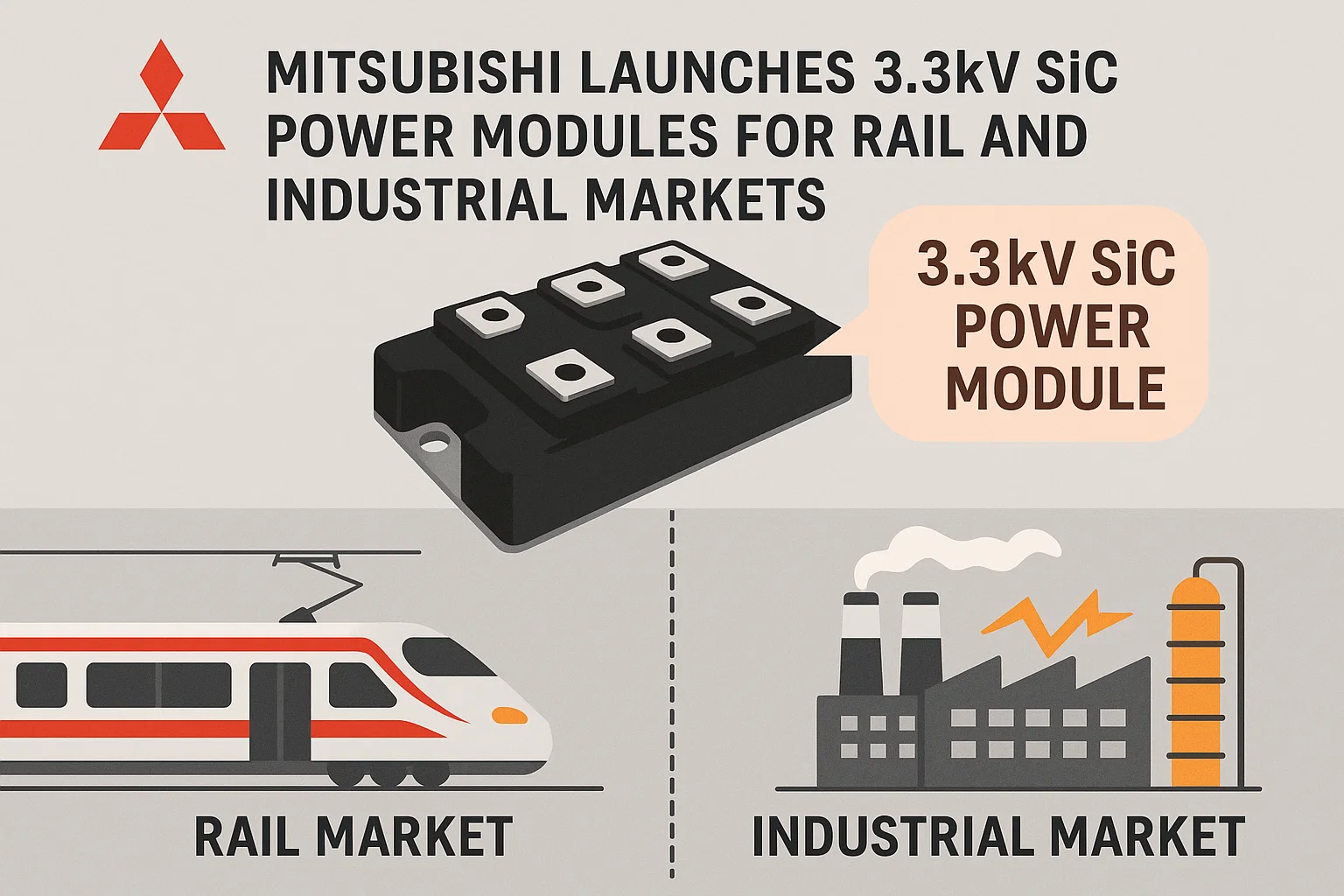
Mitsubishi Launches 3.3kV SiC Power Modules for Rail and Industrial Markets
The global energy and electronics landscapes are undergoing a significant transformation, driven by emerging technologies that promise more efficiency, sustainability, and performance. At the heart of this revolution lies Wide Bandgap (WBG) semiconductor power devices and modules, particularly those built on silicon carbide (SiC) and gallium nitride (GaN). These advanced materials are pushing the boundaries of power conversion, electric mobility, and industrial automation.
Access Your Free Sample Report- Wide Bandgap Power (WBG) Semiconductor Power Devices and Modules Market
A Market on the Rise: From $2.73 Billion to $8.47 Billion
According to the latest data, the global WBG semiconductor power devices and modules market was valued at US$ 2.73 billion in 2024. It is projected to reach a staggering US$ 8.47 billion by 2032, growing at a CAGR of 17.4% from 2025 to 2032. This growth is fueled by increasing adoption across electric vehicles (EVs), renewable energy systems, data centers, industrial drives, and consumer electronics.
The inherent advantages of WBG materials—higher breakdown voltage, superior thermal conductivity, and faster switching speeds—make them ideal for high-efficiency and high-density power applications.
Tesla’s Strategic Move: Embracing SiC in Next-Gen Powertrains
In early 2025, Tesla reaffirmed its commitment to SiC technology by announcing that its next-generation powertrains for the Model Y and Cybertruck would utilize more than 75% silicon carbide components. The automaker is sourcing SiC power modules from STMicroelectronics and Wolfspeed, two giants in the WBG ecosystem.
This shift is about more than just efficiency—it represents a strategic pivot to increase vehicle range, reduce inverter losses, and improve thermal performance. By integrating SiC into its traction inverters, Tesla is paving the way for lighter, more efficient, and potentially more cost-effective EVs.
This move has cascading effects on the industry, prompting other OEMs to accelerate their own SiC adoption to stay competitive.
Wolfspeed’s Mega Fab: Scaling SiC Production in the U.S.
Another headline-maker this year was Wolfspeed’s $5 billion investment into its new Mohawk Valley Fab in North Carolina. Touted as the world’s largest dedicated SiC wafer fabrication facility, this fab focuses on 200mm SiC wafer production, a leap from the traditional 150mm wafers.
The implications of this development are huge:
- Increased wafer output to meet the demands of EVs and industrial applications.
- Cost reductions through economies of scale.
- A stronger domestic semiconductor supply chain in the U.S., reducing reliance on overseas suppliers.
Wolfspeed’s expansion is not just about quantity—it’s about setting a benchmark for quality, reliability, and scalability in the SiC domain.
Hyundai and Kia Double Down with Infineon
The South Korean auto giants Hyundai and Kia took a bold step in May 2025 by signing a long-term strategic partnership with Infineon Technologies. This deal includes a secure supply of next-generation 1200V SiC MOSFETs, which are critical for EV drivetrains and fast-charging infrastructure.
But this isn’t just a supply deal—it also involves joint R&D initiatives aimed at optimizing power module efficiency and thermal management.
Why it matters:
- Ensures supply chain stability for Hyundai/Kia’s ambitious EV roadmap.
- Positions Infineon as a preferred partner in high-voltage WBG solutions.
- Drives down cost and development cycles through shared innovation.
This partnership illustrates the increasing vertical integration trend in the auto industry, where OEMs are forming closer ties with semiconductor companies.
Apple Quietly Taps into GaN Power Management
In an unexpected move, Apple has reportedly deepened its investment in GaN power IC startups to enhance the power efficiency of its future iPhones, MacBooks, and chargers. While Apple has yet to make a public announcement, sources from Financial Times and Nikkei Asia confirm ongoing collaborations with GaN-focused innovators.
Why GaN? Compared to silicon-based power chips, GaN allows for:
- Smaller charger designs
- Higher efficiency and lower heat
- Faster charging speeds
Apple’s interest signals a growing demand for WBG technologies even in consumer electronics, not just in automotive or industrial domains.
Download Sample Report PDF- Wide Bandgap Power (WBG) Semiconductor Power Devices and Modules Market
Mitsubishi’s High-Voltage Push: 3.3kV SiC Modules
Mitsubishi Electric unveiled a 3.3kV SiC power module aimed at railway systems and heavy-duty industrial use in February 2025. With embedded cooling technology and a high-density packaging design, this module is designed to perform under harsh, high-voltage environments.
Key features:
- High-voltage operation with lower conduction loss.
- Compact form factor for space-constrained applications.
- Optimized thermal performance for longevity.
This development expands WBG’s reach beyond the typical 650V–1200V range into ultra-high-voltage sectors, including smart grid infrastructure, wind turbines, and locomotive systems.
Europe’s WBG Offensive: The €1.5 Billion Semiconductor Fund
In June 2025, the European Commission announced a €1.5 billion WBG semiconductor fund under the broader umbrella of the EU Chips Act. This initiative aims to:
- Boost domestic SiC and GaN manufacturing.
- Support startups and research initiatives in Germany, France, and the Netherlands.
- Reduce dependency on foreign WBG suppliers.
With power electronics playing a crucial role in the energy transition, Europe sees WBG semiconductors as strategic assets. The fund is expected to bolster Europe’s competitiveness in clean energy and next-gen mobility.
Driving Factors Behind the WBG Surge
The explosive growth in WBG power semiconductors is being fueled by several converging trends:
1. EV Adoption
Electric vehicles require compact, efficient, and high-power-density components. WBG semiconductors meet all three criteria, particularly in fast-charging, onboard chargers, and drive inverters.
2. Renewable Energy
Inverters in solar and wind energy systems benefit from the fast switching and low losses of SiC and GaN devices, improving overall system efficiency.
3. Data Centers
GaN is becoming a go-to material for efficient power supplies in hyperscale data centers where energy savings and space optimization are paramount.
4. Consumer Electronics
From ultra-compact laptop adapters to 5G-enabled smartphones, GaN is redefining performance metrics in the consumer segment.
5. Industrial Automation
Smart factories and Industry 4.0 systems need high-reliability, high-efficiency power solutions, which WBG materials can provide.
Challenges Still Loom
Despite the enthusiasm, there are hurdles to overcome:
- High manufacturing costs
- Limited availability of 200mm wafers
- Thermal management and packaging issues
- Design complexity requiring skilled engineering talent
However, with continued investment in R&D and manufacturing, many of these challenges are being actively addressed.
Click Here To Download Full Sample Report- Wide Bandgap Power (WBG) Semiconductor Power Devices and Modules Market
The Road Ahead: What to Expect
Looking forward, the WBG industry is expected to evolve in the following ways:
- Mass adoption of 200mm wafers to improve cost efficiency.
- Stronger OEM-semiconductor partnerships to ensure vertical integration.
- Emergence of hybrid modules combining Si, SiC, and GaN.
- New entrants and startup innovations, especially in packaging and system integration.
By 2032, WBG power devices won’t just be high-performance alternatives—they will likely become the mainstream standard in most power electronics applications.
The WBG semiconductor revolution is no longer a distant dream—it’s unfolding now, reshaping industries, products, and possibilities. With heavyweights like Tesla, Apple, Hyundai, Wolfspeed, and Mitsubishi doubling down, and governments investing billions, the momentum is undeniable.
For engineers, policymakers, and business leaders, understanding and embracing WBG technology is no longer optional—it’s essential for staying ahead in the new energy and electronics frontier.
Whether you’re optimizing EV powertrains, designing next-gen solar inverters, or crafting ultra-fast mobile chargers, Wide Bandgap semiconductors are lighting the path forward.

Comments (0)