

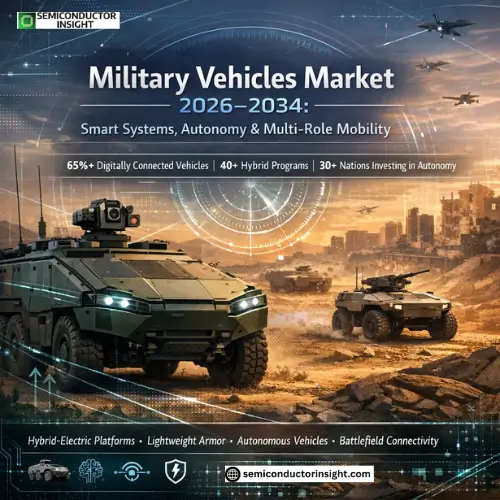
Military Vehicles Market Outlook Strengthens as Next-Gen Defence Mobility Accelerates
Military Vehicles Market is undergoing a significant transformation as defence forces shift from conventional armored systems to intelligent, connected, and multi-role platforms. Modern military vehicles are no longer just transport or combat units they are becoming integrated systems equipped with sensors, communication modules, and advanced protection technologies. Over 65% of newly procured military vehicles globally are now equipped with digital communication systems, enabling real-time battlefield coordination and data sharing.
Recent developments highlight how armies are prioritizing mobility and survivability simultaneously. For instance, next-generation infantry fighting vehicles now incorporate modular armor and adaptive suspension systems, allowing them to operate efficiently across deserts, mountains, and urban combat zones without performance compromise.
Please Take a Look at Our Updated Report before Continuing:
https://semiconductorinsight.com/report/military-specification-battery-terminal-market/
Accelerating Adoption of Hybrid and Electric Military Platforms
A notable shift within Military Vehicles Market is the emergence of hybrid and electric propulsion systems. Defence agencies are increasingly testing electric armored vehicles to reduce thermal signatures and improve stealth capabilities. Reports indicate that over 40+ defence programs worldwide are currently focused on hybrid-electric military vehicle development.
In recent trials, hybrid combat vehicles demonstrated fuel efficiency improvements of up to 20% while significantly reducing acoustic noise. This evolution is particularly crucial in reconnaissance and covert missions, where detection risk must be minimized. Electric propulsion also supports on board power systems, enabling advanced electronics, drones, and surveillance tools to operate seamlessly.
Armored Protection Meets Lightweight Engineering
Balancing protection and mobility has always been a challenge in military vehicle design. However, advancements in composite materials and reactive armor systems are redefining this balance. Today, nearly 55% of armored vehicle upgrades involve lightweight composite armor integration, reducing overall vehicle weight while maintaining high ballistic resistance.
An example can be seen in modern armored personnel carriers, where multi-layered protection systems can withstand improvised explosive devices (IEDs) and anti-tank threats while still maintaining high-speed maneuverability. This shift is enabling faster deployment times and improved operational efficiency across diverse combat scenarios.
Autonomous and Unmanned Ground Vehicles Enter the Battlefield
- Autonomy is rapidly becoming a defining feature of Military Vehicles Market.
- Unmanned Ground Vehicles (UGVs) are being deployed for logistics, surveillance, and even combat support roles.
- Currently, more than 30 countries are actively investing in autonomous military vehicle programs, signalling a strong global push toward unmanned warfare systems.
- Recent instances include robotic supply vehicles capable of carrying 500-1,000 kg of payload across difficult terrain without human intervention. These systems not only reduce risks for soldiers but also enhance operational endurance in prolonged missions.
- Additionally, AI-enabled navigation allows these vehicles to adapt to changing battlefield environments in real time.
Urban Warfare Driving Compact and Agile Vehicle Designs
As military operations increasingly shift toward urban environments, the demand for compact, agile vehicles is growing. Modern urban combat vehicles are built for speedy deployment, tight bends, and narrow streets, in contrast to conventional huge armoured groups.
Data suggests that nearly 35% of new military vehicle procurement programs focus on light tactical vehicles optimized for urban warfare. These vehicles often feature enhanced visibility systems, remote weapon stations, and improved maneuverability, making them suitable for complex city-based operations.
A recent example includes lightweight armored vehicles used in peacekeeping and counter-insurgency missions, where agility and rapid response are more critical than heavy firepower.
Integration of Advanced Electronics and Battlefield Connectivity
Military Vehicles Market is increasingly influenced by advancements in electronics and semiconductor technologies. Modern military vehicles now function as mobile command centers, integrating radar systems, GPS, thermal imaging, and secure communication networks.
More than 70% of newly deployed military vehicles include integrated battlefield management systems, enabling seamless coordination between ground units, drones, and command headquarters. This level of connectivity ensures faster decision-making and improved mission outcomes.
For example, network-enabled armored vehicles can share real-time threat data, allowing nearby units to respond proactively rather than reactively. This capability is reshaping how military operations are planned and executed.
Global Defence Spending Boosting Fleet Modernization
- Rising geopolitical tensions and evolving security threats are accelerating investments in military vehicle modernization.
- Governments are allocating significant portions of defence budgets toward upgrading existing fleets and acquiring next-generation platforms.
- In 2025 alone, several countries initiated large-scale procurement programs involving thousands of armored and tactical vehicles, focusing on replacing aging fleets with technologically advanced alternatives.
- This includes multi-role vehicles capable of performing reconnaissance, combat, and support operations within a single platform.
- Such modernization efforts are not only expanding fleet sizes but also improving operational readiness and adaptability across multiple combat domains.
From Combat Machines to Multi-Role Strategic Assets
Military vehicles are evolving into multi-functional assets that go beyond traditional combat roles. Today’s platforms are designed to support disaster relief, border security, and humanitarian missions alongside battlefield operations.
With increasing emphasis on versatility, nearly 50% of modern military vehicles are now designed for multi-role applications, allowing defence forces to maximize utility and cost efficiency. This shift reflects a broader strategic approach where mobility, adaptability, and technological integration define the future of defence systems.

Comments (0)