
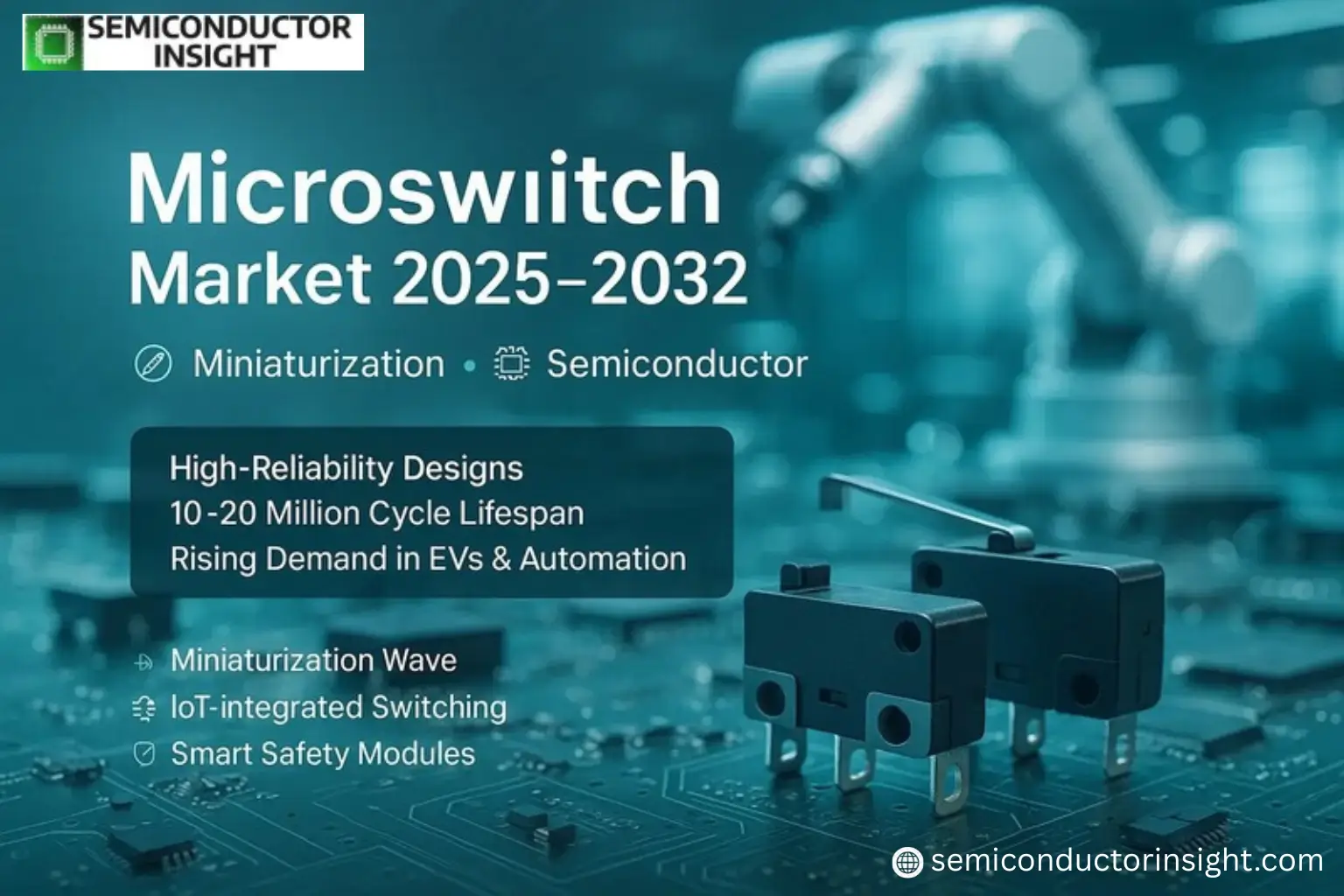
Microswitch Market: Precision at the Heart of Modern Electronics
In an era where every device is shrinking while expectations keep rising, microswitches have become the unseen gatekeepers of reliability. These tiny yet critical components triggered by the lightest mechanical touch now anchor safety systems, consumer gadgets, industrial automation, and EV architectures. As electronics grow smarter, quieter, and more compact, the demand for high-performance microswitches is quietly escalating behind the scenes.
This blog explores how the microswitch market is evolving through smarter materials, tighter tolerances, high-reliability design, and new semiconductor-driven innovations shaping next-generation electronics.
The Precision Powerhouse: What Makes Microswitches Irreplaceable
Microswitches stand out because they deliver ultra-fast actuation, consistent repeatability, and long operational endurance qualities that engineers lean on when safety or precision cannot fail. Their unique snap-action mechanism ensures stable performance even under vibration, temperature stress, or continuous cycling. From door interlocks in home appliances to limit switches in industrial robots, their reliability often defines the system’s safety envelope.
Real-World Applications Reshaping Market Identity
- Industrial Automation
Factories deploy microswitches as limit switches, safety interlocks, and position sensors segments driven by global robotics growth.
- Automotive & EV Systems
Pedal sensors, seatbelt latches, battery modules, and door locks all integrate high-durability microswitches engineered for heat, vibration, and insulation resistance.
- Medical & Diagnostics
Microswitches enable precision movements in infusion pumps, ventilators, and handheld diagnostic devices.
- Smart Home & Consumer Electronics
From microwave doors to headphone folding mechanisms, microswitches maintain consistent performance despite thousands of cycles.
The Miniaturization Wave Transforming Demand
As hardware gets smaller, manufacturers are pushing for:
- Thinner housings with higher actuation accuracy
- Low-travel designs suited for wearable and portable medical devices
- High-load microswitches: enabling compact EV battery pack designs
- Dust & waterproofing standards (IP67/IP68) for harsh environments
This race toward smaller yet tougher microswitches is reshaping supply chains and engineering priorities across Asia-Pacific and the U.S.
Industry Updates:
For instance, in June 2025,
Nintendo has released the Switch 2, a portable gaming system. The new Switch model has a proprietary Nvidia chip, a big 7.9-inch 1080p LCD display, and 256GB of internal storage while maintaining the popular hybrid format that enables handheld, tabletop, and docked play. Along with updated Joy-Con 2 controllers, it promises improved graphics, more fluid gaming, and extensive compatibility with current Switch games.
You Can Now Browse Our Latest Report Here:
https://semiconductorinsight.com/report/microswitch-market/
Where Innovation Is Happening Now?
- Material Evolution: Beyond Traditional Metals
The latest microswitches integrate:
- Conductive polymers
- Silver-nickel contact alloys
- Reinforced thermoplastics
These materials enhance arc resistance and extend lifespan in high-use systems.
- Quiet-Click & No-Click Engineering
Consumer electronics brands are requesting acoustically neutral microswitches, blending tactile precision with sound-dampening innovations especially important in smart home devices and medical diagnostics.
- Semiconductor Synergy
Today’s microswitches increasingly sync with:
- Microcontrollers
- Smart sensors
- Signal-conditioning ICs
This turns simple on/off hardware into data-aware control elements for automation.
Market Shifts
Device Miniaturization → Engineering Redesign → High-Reliability Testing → OEM Integration → Volume Expansion across Industries
The Innovation Pulse of the Microswitch Market
Manufacturers in the microswitch ecosystem are rapidly shifting toward hyper-durability platforms, introducing components tested for 10-20 million cycles to meet the demands of industrial robots and expanding EV charging networks. Alongside durability, anti-contamination engineering is becoming mainstream, with hermetically sealed housings and innovative dust-block channels now standard for outdoor or heavy-duty environments.
Sustainability is also influencing product design, as companies explore recyclable housings, halogen-free plastics, and energy-efficient metal forging to align with ESG expectations. Adding another layer of advancement, smart safety modules are emerging microswitches embedded with IoT chips that monitor device health, track failure cycles, and enable real-time maintenance insights, pushing the category into an era of intelligent switching solutions.
Competitive Landscape Snapshot
The market is shaped by companies focused on precision engineering, automated semiconductor manufacturing, and global certification compliance. Many leaders are expanding capacity in Southeast Asia to meet demand from EVs, consumer electronics, and automation.
Forward Drive: What the Next Era Brings?
- Silent-actuation designs for high-end consumer tech
- Micro-molded housings enabling ultra-compact switches
- High-current microswitches for EV safety circuits
- Predictive performance modeling using AI/ML engineering tools

Comments (0)