
Microprocessor Market; The Silent Intelligence Powering Our Digital Future
Firstly, to know that this blog explores how Microprocessor Market is transforming through AI-centric design, chiplet innovation, power smart architectures, and the rising need for security driven, scalable, globally resilient computing.
In a world that runs on screens, automation, and instant decisions, microprocessors have quietly become the ‘invisible intelligence’ behind every digital moment. From smart retail counters to self-learning cars, nothing functions without these tiny computational engines.
Yet the market behind them is no longer just about speed or transistor counts it’s about designing silicon that understands real-world behavior, consumes less energy, learns faster, and adapts as ecosystems evolve.
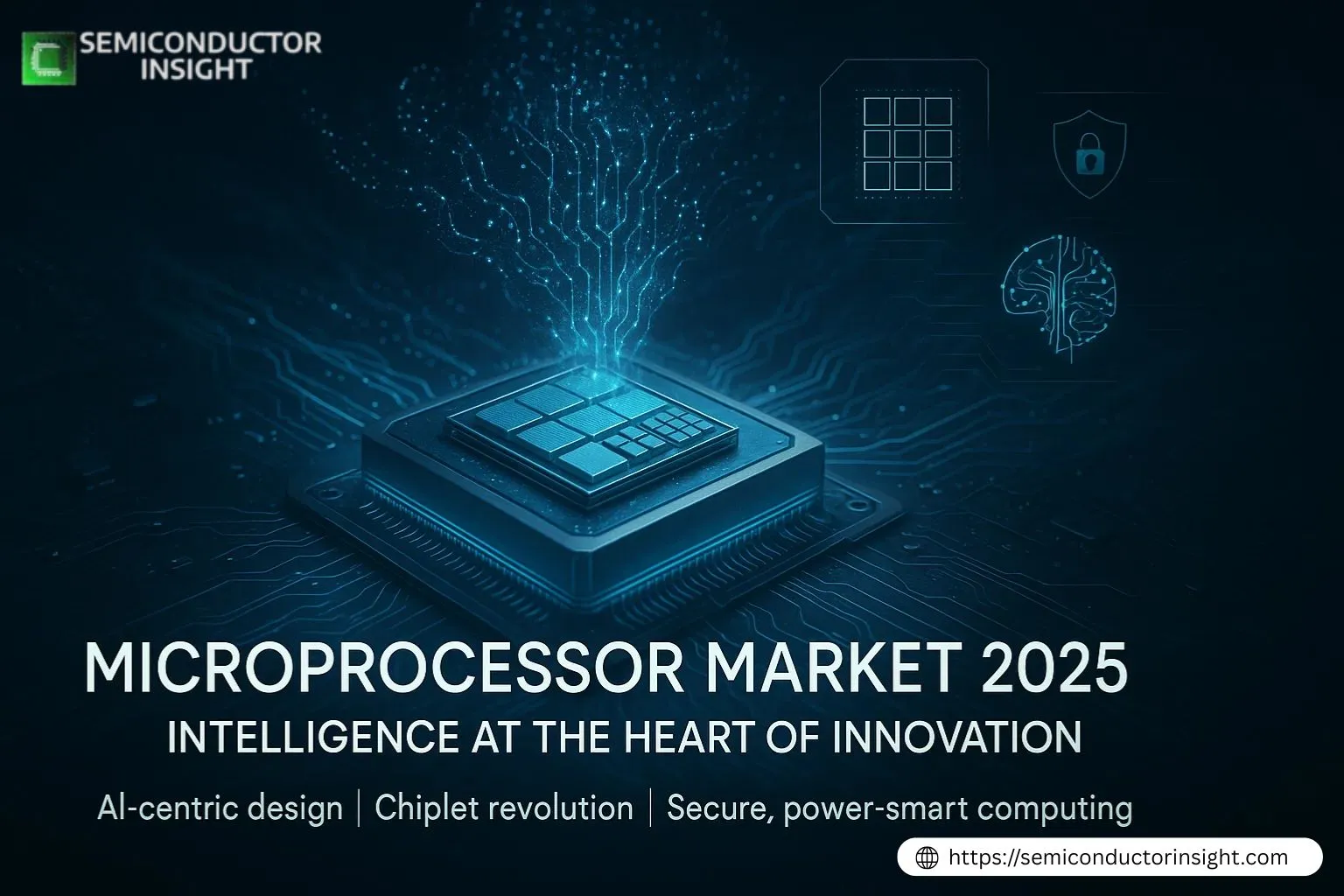
The Evolving Role of Microprocessors: More Than Raw Performance
- Microprocessors were once judged by a single metric: processing power.
- Today, the narrative is infinitely bigger.
- Consumers expect longer battery life, enterprises need real-time insights, and industries demand machines that think faster, predict failures, and secure data from the chip upward.
- In this new landscape, performance is still crucial but it’s meaningless without energy efficiency, AI-readiness, thermal control, and architecture-level security.
- This shift is rewriting how companies design, package, and manufacture processors.
The Forces Reshaping Demand: What’s Fueling the Market Surge
AI Everywhere to Architecture Reinvention
- With AI moving into every domain consumer, automotive, industrial, cloud manufacturers are creating CPUs with integrated accelerators, neural engines, and hybrid cores that balance heavy tasks with lightweight operations.
Hyperscaler Customization
- AWS, Google, Microsoft, and Meta are no longer satisfied buying off-the-shelf processors.
They are building custom microprocessors optimized for data center efficiency, cloud AI, and specific workloads accelerating ARM and RISC-V adoption.
Energy Pressure across All Devices
From wearable to EVs, energy constraints are reshaping architecture choices.
This is booming the given following factors
- Ultra-low-power cores
- Intelligent task scheduling
- Dynamic thermal balancing
- Packaging that optimizes heat dissipation
- Micro-Infographic Snapshot: Old vs. New Era Thinking
Yesterday’s Priority: Today’s Reality:
Max clock speed → Max performance per watt
Monolithic design → Chiplet-based modular CPUs
x86 as default → ARM + RISC-V gaining power
One-size-fits-all → Application-specific processors
Give a Glance At One Of Our Updated Report: https://semiconductorinsight.com/report/microprocessor-market/
The Innovation Pulse: What’s Actually Changing inside the Silicon?
Instead of repeating the typical market outlook, here’s a more original, innovation-driven lens:
- Chiplet Ecosystems Becoming Standard
Chiplet-based design reduces manufacturing risk and allows brands to mix specialized compute blocks on one package.
It is affordable, scalable, and perfect for AI-heavy environments where flexibility matters more than uniformity.
- Intelligence at the Edge
Factories, vehicles, cameras, and drones now require instant inferencing without relying on the cloud.
This is pushing microprocessor makers to build silicon capable of:
- Real-time processing
- Zero-lag decision making
- Rugged, temperature-stable performance
- Security Embedded at the Silicon Level
Cyber threats today target firmware and hardware layers.
Microprocessors are therefore integrating:
- Trusted execution environments
- Secure boot fabrics
- Hardware-level isolation
- Encrypted memory channels
Security is no longer an add-on its part of the processor’s DNA.
What Experts Are Asking Behind Closed Doors
- How do we push AI performance without breaking thermal limits?
- Can chiplet supply chains match global scale and consistency?
- Will RISC-V challenge ARM and x86 long term?
- How do manufacturing geopolitics influence advanced node availability?
These questions show how the market’s direction depends as much on geography as on engineering.
The Next Leap: What Will Define the Future?
- Neuromorphic & Brain-Inspired Processors: Low-power, massively parallel chips modeled after neural systems ideal for edge AI.
- Software-Defined Silicon: Processors that can shift behavior or power profiles through firmware tweaks instead of full hardware redesigns.
- Automotive-Grade Microprocessors: With EVs and autonomous driving rising, processors must meet safety-critical standards (ASIL-D and beyond).
- Compute-in-Memory Architectures: Blending memory and logic to eliminate bandwidth bottlenecks and reduce power consumption.
Final Takeaway: The Market Isn’t Growing It’s Re-Architecting Itself
The microprocessor market is not expanding because devices are increasing.
It’s growing because every device is expected to be intelligent predictive, efficient, secure, and responsive. From data centers running trillion-parameter models to pocket-sized gadgets monitoring your health, the future runs on silicon that thinks smarter, lasts longer, and adapts seamlessly.

Comments (0)