
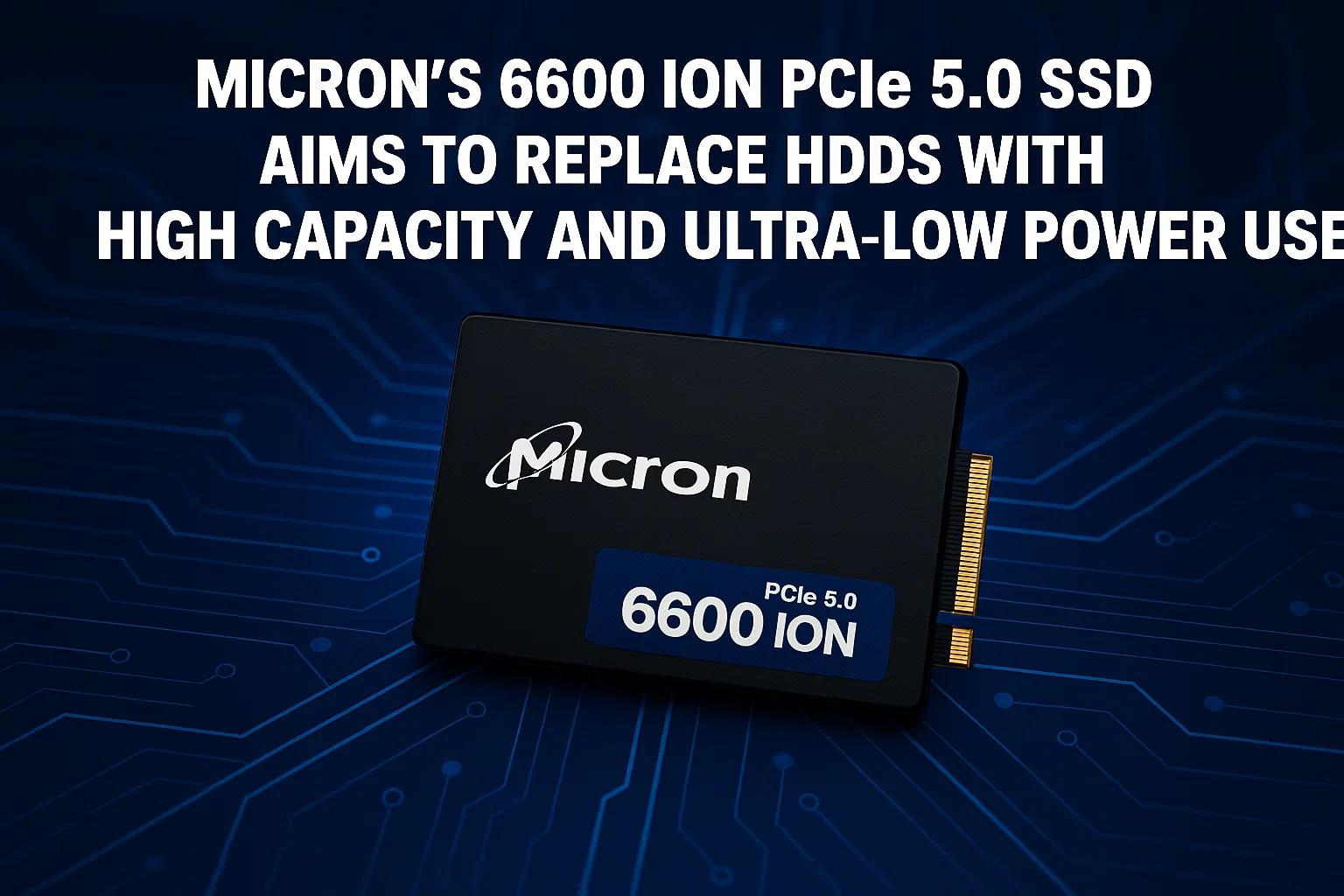
Micron’s 6600 ION PCIe 5.0 SSD Aims to Replace HDDs with High Capacity and Ultra-Low Power Use
The storage industry is undergoing a massive transformation, driven by the exponential growth of artificial intelligence (AI), machine learning (ML), cloud computing, and the ever-expanding demand for high-speed, energy-efficient data storage. Among the most exciting innovations in recent years has been the emergence of low power consumption PCIe 5.0 SSDs (Solid State Drives). These cutting-edge storage devices combine the blazing-fast performance of PCIe Gen 5 with highly optimized power efficiency, addressing a critical challenge faced by both consumer and enterprise computing systems: reducing energy usage while maintaining top-tier performance.
According to recent industry data, the Low Power Consumption PCIe 5.0 SSD Market was valued at USD 295 million in 2024 and is projected to reach USD 489 million by 2032, growing at a CAGR of 8.3% during the forecast period. This growth reflects a broader industry trend where power-efficient technologies are gaining priority due to rising energy costs, sustainability initiatives, and the need to manage thermals in compact, high-performance computing environments.
Access Your Free Sample Report- Low Power Consumption PCIe 5.0 SSD Market
Understanding PCIe 5.0 and the Push for Power Efficiency
PCIe (Peripheral Component Interconnect Express) is the backbone of modern high-performance computing, enabling fast data transfer between storage devices, GPUs, and CPUs. With the introduction of PCIe 5.0, bandwidth doubled compared to PCIe 4.0, delivering up to 32 GT/s (gigatransfers per second) per lane. This upgrade allows PCIe 5.0 SSDs to achieve read/write speeds exceeding 14 GB/s, catering to demanding workloads such as real-time AI inference, 8K video editing, and large-scale data analytics.
However, the dramatic increase in speed has traditionally come at the cost of higher power consumption and heat generation. Without power optimization, PCIe 5.0 SSDs often require active cooling systems, which can increase complexity and operational costs. This is where low power consumption PCIe 5.0 SSDs emerge as game-changers. By leveraging advanced controller designs, optimized NAND flash, and smarter firmware, these SSDs maintain ultra-fast performance while consuming significantly less energy.
The shift towards energy-efficient PCIe 5.0 SSDs is not just about performance it’s about sustainability. Data centers account for nearly 1-2% of global electricity consumption, and as storage demand grows, optimizing power usage is critical to reducing carbon footprints.
Recent Industry Developments
The past year has seen a surge of innovation as leading tech companies launch next-generation PCIe 5.0 SSDs designed for low power consumption. Below are some of the most significant advancements reshaping the market.
-
Samsung PM9E1 – Redefining Power Efficiency in Consumer SSDs
In late 2024, Samsung Electronics announced the mass production of its PM9E1 PCIe 5.0 SSD, a landmark development in the storage industry. Built on a 5nm controller paired with 8th-generation V-NAND, the PM9E1 delivers exceptional speed while drastically reducing power usage.
- Performance Gains: Up to 14 GB/s sequential read and 11 GB/s sequential write speeds, making it ideal for gaming laptops, AI-powered PCs, and workstations.
- Power Efficiency: Samsung claims over 50% improvement in power efficiency compared to its predecessor, the PM9A1a.
- Thermal Control: Enhanced firmware algorithms manage temperature intelligently, reducing reliance on bulky heatsinks.
The PM9E1 is particularly relevant for portable devices like ultrabooks and high-end gaming laptops, where battery life and heat management are top priorities. By focusing on power efficiency, Samsung addresses consumer demand for faster, cooler, and longer-lasting devices.
-
Micron 9550 – AI-Optimized, Power-Aware Data Center SSD
The rise of AI and machine learning workloads has driven unprecedented demand for high-performance storage. In July 2024, Micron Technology introduced the Micron 9550 NVMe SSD, which delivers class-leading performance-per-watt for data centers.
Key highlights include:
- Optimized for AI Training: Supports graph neural network (GNN) workloads and other data-intensive AI applications.
- Energy Savings: Up to 43% lower average power consumption during certain AI training tasks compared to traditional Gen4 SSDs.
- High Throughput: Sequential read speeds up to 14.5 GB/s and write speeds up to 13.5 GB/s.
By combining speed with energy efficiency, the Micron 9550 enables data centers to process massive AI datasets without significantly increasing operational costs or energy use. This is a crucial development as hyperscale cloud providers and AI labs grapple with sustainability concerns.
-
Micron 6550 ION – Balancing Capacity and Energy Efficiency
Micron also unveiled the 6550 ION, a 60TB PCIe 5.0 SSD in the E3.S form factor. Designed for hyperscale environments, this drive emphasizes energy-efficient, high-density storage:
- Throughput: Up to 12 GB/s while consuming only 20W of power.
- Efficiency Metric: A major milestone in delivering more storage capacity per watt.
- Use Case: Ideal for cloud storage, AI data lakes, and enterprise environments seeking to lower energy costs per terabyte.
The 6550 ION demonstrates how low power consumption PCIe 5.0 SSDs are poised to replace legacy HDDs in data centers, offering both performance and sustainability benefits.
Download Sample Report PDF- Low Power Consumption PCIe 5.0 SSD Market
-
Micron 6600 ION – Towards HDD Replacement at Scale
In another bold move, Micron introduced the 6600 ION, a high-capacity SSD offering 122TB of storage, with plans to scale up to 245TB in future models.
- Power Density Advantage: Consumes 1 watt per 4.9TB, drastically reducing energy usage compared to traditional HDDs.
- Strategic Goal: To fully replace hard drives in certain enterprise storage applications by providing higher density and lower power consumption.
- Industry Impact: Sets a new benchmark for sustainable data center storage, aligning with global green computing initiatives.
-
Silicon Motion SM2508 Controller – Enabling Cooler PCIe 5.0 SSDs
Silicon Motion, a leading SSD controller manufacturer, introduced the SM2508, a next-gen controller built using TSMC’s 6nm EUV process. This innovation enables consumer PCIe 5.0 SSDs to achieve high speeds without excessive heat or power draw.
- Performance:
- Up to 14.5 GB/s read
- 13.6 GB/s write
- 2.5 million IOPS
- Power Efficiency: Operates under 7W, significantly lower than competing Gen5 SSDs that often exceed 10W.
- Cooling Benefits: Lower power consumption minimizes the need for active cooling systems, making it suitable for compact desktop and laptop designs.
The SM2508 is expected to be integrated into SSDs by major brands like Corsair, ADATA, and Kingston, fueling the next wave of high-performance yet energy-efficient consumer storage solutions.
-
Western Digital and SanDisk – 7W Power Target
At Computex 2024, Western Digital revealed upcoming SanDisk-branded PCIe 5.0 SSDs that maintain peak throughput while consuming only 7W of power.
- Variants:
- TLC NAND version for performance-focused users.
- QLC NAND version for cost-effective storage.
- Target Market: Gaming enthusiasts and creators seeking top speed without thermal throttling.
This development signals a broader trend in consumer electronics where low power consumption is becoming a competitive differentiator.
-
Samsung 9100 PRO – Power and Thermal Breakthrough
Samsung’s 9100 PRO PCIe 5.0 SSD, aimed at gamers and content creators, delivers a 49% improvement in power efficiency over its predecessor.
- Thermal Management: Incorporates advanced heatsinks and firmware algorithms for cooler operation.
- Use Case: High-end gaming rigs and workstations that require both speed and stability.
By combining thermal innovations with reduced power draw, Samsung strengthens its leadership in the consumer SSD space.
Market Dynamics and Growth Drivers
The projected 8.3% CAGR of the low power consumption PCIe 5.0 SSD market reflects several key drivers:
- Rising Energy Costs
As global electricity prices rise, both consumers and enterprises are seeking technologies that reduce operational costs. Energy-efficient SSDs help lower total cost of ownership (TCO) in data centers.
- Sustainability and Green Computing
Governments and corporations are prioritizing sustainability goals. Low power consumption SSDs align perfectly with net-zero emissions initiatives, making them attractive for environmentally conscious organizations.
- AI and Machine Learning Growth
AI workloads require high-speed, low-latency storage. Optimizing power usage ensures scalability without overwhelming power infrastructure.
- Edge Computing Expansion
Edge devices, such as autonomous vehicles and IoT hubs, demand storage solutions that are both fast and energy-efficient, driving adoption of low power PCIe 5.0 SSDs.
Challenges in Adoption
While the outlook is positive, several challenges could impact market growth:
- Higher Initial Costs:
PCIe 5.0 SSDs are still more expensive than Gen4 models, potentially slowing adoption among budget-conscious consumers. - Thermal Management:
Even with power optimization, PCIe 5.0 devices can run hot under heavy loads, requiring careful thermal design. - Compatibility Issues:
Full performance benefits require compatible motherboards and CPUs, limiting usage in older systems.
Regional Insights
- North America:
Leads the market due to early adoption by hyperscale data centers and AI companies. - Asia-Pacific:
Expected to see the fastest growth, driven by manufacturing hubs in China, South Korea, and Taiwan, alongside booming gaming and mobile markets. - Europe:
Growth fueled by sustainability regulations and the rapid expansion of cloud services.
Click Here To Download Full Sample Report- Low Power Consumption PCIe 5.0 SSD Market
Future Outlook
Looking ahead, several trends will shape the future of the low power consumption PCIe 5.0 SSD market:
- PCIe 6.0 Transition:
As PCIe 6.0 rolls out, SSDs will need to balance even greater bandwidth with stringent power budgets. - AI-Driven Firmware Optimization:
Future SSDs may use AI algorithms to dynamically adjust power usage based on workload. - Wider Consumer Adoption:
As costs decrease, mainstream laptops and desktops will increasingly adopt Gen5 SSDs with low power profiles. - Data Center Sustainability Mandates:
Global tech giants like Google and Amazon will push vendors to meet aggressive energy efficiency targets.
As the market grows from USD 295 million in 2024 to USD 489 million by 2032, low power SSDs will play a pivotal role in powering the next generation of computing whether in hyperscale AI data centers, gaming laptops, or edge devices.

Comments (0)