
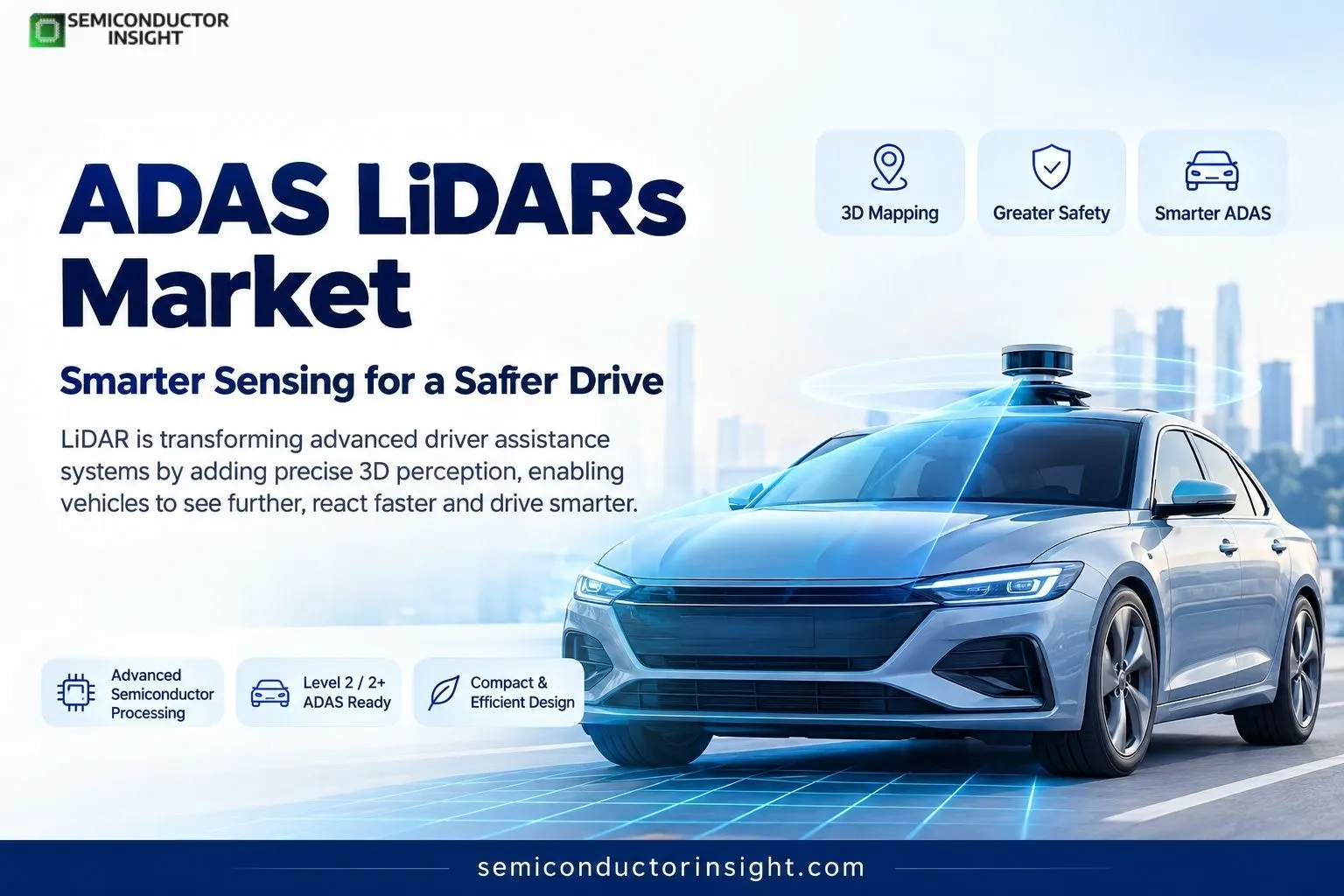
MEMS vs. Digital LiDAR in ADAS Lidars Market Which Architecture Fits the Next Vehicle Generation
A car equipped with cameras can recognize a traffic sign, lane marking or vehicle, but LiDAR adds something fundamentally different measurable three-dimensional distance. By sending laser pulses into the surrounding environment and measuring their return time, automotive LiDAR creates a point cloud that allows software to determine where objects are, how far away they are and how their positions change.
That capability is pushing LiDAR beyond autonomous-driving prototypes and into production vehicles equipped with increasingly sophisticated Level 2 and Level 2+ advanced driver assistance systems.
The sensor is becoming a semiconductor system
Modern automotive LiDAR is no longer simply an optical assembly mounted on a roof. It increasingly resembles a compact semiconductor platform containing lasers, detectors, scanning electronics, signal-processing chips and software.
The basic architecture can be viewed as:
Laser emission → Optical scanning → Photon detection → Time-of-flight measurement → Point-cloud processing → Object perception → ADAS decision
This is where semiconductor innovation becomes critical. SPAD arrays, ASICs, VCSELs and increasingly digital architectures are allowing manufacturers to increase resolution while reducing the physical footprint of the sensor.
The numbers are moving quickly
- The specifications of recently launched automotive LiDAR platforms illustrate how rapidly sensor performance is advancing.
- RoboSense’s EMX, introduced for L2 ADAS applications, uses 192 beams, generates up to 2.88 million points per second, provides 0.08° × 0.1° angular resolution, reaches 300 meters of maximum detection range and operates at up to 20 Hz.
- Meanwhile, Ouster’s OS1 platform demonstrates another approach, combining 128 channels, up to 5.2 million points per second, a 45° vertical field of view and a maximum specified range of 200 meters.
- The important shift is therefore not simply “longer range.” It is the simultaneous improvement of point density, angular resolution, frame rate, field of view and computational efficiency.
Why the chip inside LiDAR matters more than ever?
A new generation of automotive LiDAR is increasingly being designed around dedicated silicon. Photon detection, timing and signal processing can all be optimized through application-specific semiconductor architectures.
RoboSense’s EM4, for example, combines a SPAD-SoC with VCSEL-based digital architecture and is configurable from more than 500 beams to as many as 2,160 beams. Its disclosed configuration reaches 600 meters maximum detection range under specified conditions.
That progression illustrates a wider semiconductor trend: more of the sensing workload is moving from discrete components toward integrated processing architectures.
1550 nm is opening another performance window
Wavelength selection is another important design decision. Automotive LiDAR developers have explored both approximately 905 nm and longer-wavelength 1550 nm architectures.
Luminar’s disclosed Iris architecture uses a 1550 nm laser and specifies detection capability up to 600 meters, with more than 200 points per square degree in its stated configuration. Its automotive program reached high-volume production in 2024 for the Volvo EX90.
The significance of 1550 nm is not merely the wavelength itself. It is connected to the broader engineering question of achieving longer-range sensing while satisfying automotive requirements for power, thermal performance, package size, reliability and cost.
From prototype sensor to factory-installed hardware
- The strongest evidence of LiDAR’s changing role is appearing in production programs.
- RoboSense reported that its EM digital platform secured design wins for 45 vehicle models across eight leading OEMs in less than six months after its launch. The company also reported a record 120,000 LiDAR units delivered in October 2025 alone.
- China’s vehicle ecosystem is particularly important in this transition. RoboSense cited Chinese Ministry of Industry and Information Technology data showing 7.76 million new passenger vehicles equipped with combined ADAS systems were sold between January and July 2025, representing 62.6% penetration during that period.
- This creates an important distinction: the LiDAR opportunity is increasingly being shaped by production volumes, not just autonomous-driving demonstrations.
The Waymo signal is about system maturity
The commercial autonomous-driving sector is also moving forward. In February 2026, Waymo announced the beginning of fully autonomous operations with its sixth-generation Driver. The company said its system had accumulated nearly 200 million fully autonomous miles across more than 10 major cities and was designed around a streamlined sensor configuration for broader deployment.
The lesson for the ADAS LiDAR ecosystem is significant. Sensor technology is increasingly evaluated as part of a complete perception stack rather than as an isolated component.
For additional report info, feel free to view our most recent edition: https://semiconductorinsight.com/report/adas-lidars-market/
The next specification race is happening at the edge
The most interesting developments are now happening around digital LiDAR, solid-state scanning, SPAD detectors, VCSEL arrays, sensor fusion and automotive-grade processing.
The industry is gradually moving toward a model where:
Higher photon sensitivity
↓
More usable point data
↓
Faster onboard processing
↓
Better object classification
↓
Earlier ADAS response
RoboSense’s 2025 compatibility announcement with NVIDIA DRIVE AGX further illustrates this convergence between LiDAR hardware and centralized automotive computing platforms.
What is really changing inside the vehicle?
The defining development in ADAS Lidars Market is not simply that cars are receiving more sensors. It is that sensing, semiconductor processing and AI perception are becoming one integrated engineering problem.
For automakers, the objective is a sensor that is compact enough for production, reliable across automotive temperatures, powerful enough to identify distant objects, fast enough for real-time driving decisions and economical enough for deployment across multiple vehicle classes.
That combination is turning LiDAR from an experimental autonomy component into an increasingly important part of the semiconductor-enabled perception stack for intelligent vehicles.

Comments (0)