

MEMS vs. Conventional Tilt Sensing in 2026: Which Architecture Fits Industrial Machinery Best
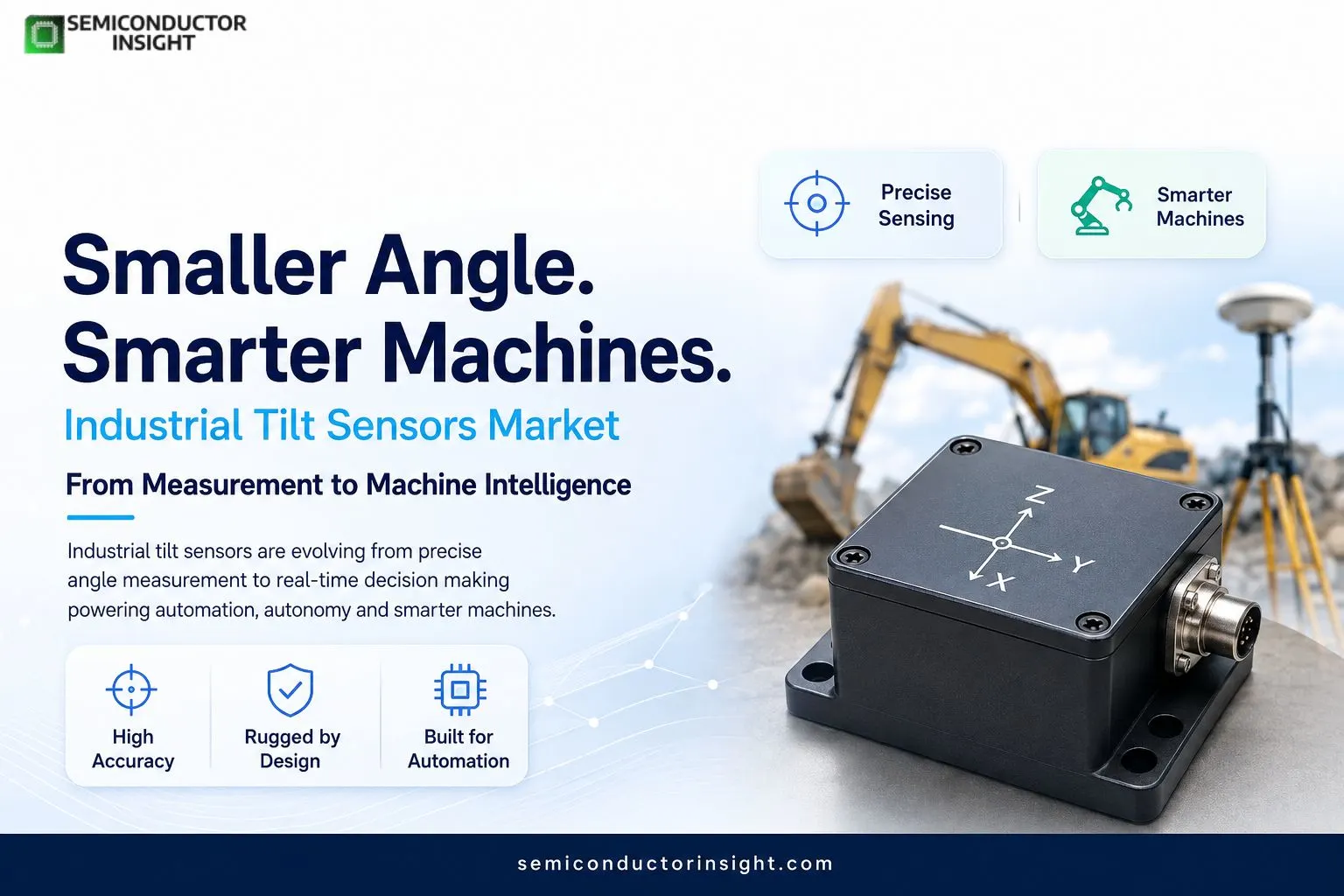
A machine does not need to move several meters to require highly precise sensing. Sometimes, a change of only a fraction of a degree can alter the position of a bucket, platform, robotic arm, antenna, agricultural implement or industrial structure. That is where industrial tilt sensors have become increasingly important.
Modern devices combine MEMS accelerometers, gyroscopes, inertial measurement units, temperature compensation and digital signal processing to translate physical inclination into usable machine data.
The technology is particularly relevant as industrial equipment moves from operator-controlled systems toward increasingly automated machines.
The Sensor Is Moving From Measurement to Decision-Making
Traditional inclination sensing largely answered one question: “How far is the machine tilted?”
Modern industrial systems increasingly ask something more useful: “What should the machine do because it is tilted?”
That distinction is changing sensor architecture.
Inclination detected → Motion interpreted → Controller receives data → Machine adjusts position → Operator or autonomous system verifies result
Analog Devices notes that tilt measurement becomes considerably more demanding when vibration, shock, temperature variation and dynamic movement are present. In industrial machinery, sensor selection therefore depends not only on nominal angular accuracy but also on bias stability, temperature drift, noise, repeatability and cross-axis sensitivity.
Why 0.1° Is Not an Ordinary Number?
- Tilt accuracy can become surprisingly difficult once the sensor is installed on moving equipment.
- Analog Devices states that achieving 0.1° tilt accuracy in dynamic environments is very difficult, while accuracy better than 1° is itself demanding under vibration.
- Its technical material also describes a MEMS accelerometer capable of tilt accuracy below 0.06°, with operation across approximately -40°C to +175°C for harsh-environment applications.
- This illustrates an important shift in industrial sensing. The headline specification is no longer enough.
- Engineers increasingly evaluate the complete measurement chain, including mounting, calibration, vibration rejection, thermal behavior and signal processing.
Three Axes Are Becoming More Useful Than One
Industrial machines rarely exist in perfectly controlled environments. Construction equipment can experience simultaneous pitch and roll, agricultural machinery operates across uneven terrain, and autonomous platforms continuously change orientation.
That is why multi-axis MEMS sensing is gaining importance. Bosch Sensortec’s current sensing portfolio, for example, combines accelerometers, gyroscopes and sensor-fusion technologies for applications involving orientation, motion tracking and tilt detection. Its BMA400 accelerometer is specifically identified for tilt detection and motion tracking.
The result is a move from isolated angle measurement toward continuous orientation awareness.
Our most recent updated related study is available for free at this link: https://semiconductorinsight.com/report/industrial-tilt-sensors-market/
Construction Equipment Is Becoming a Major Test Case
- The strongest real-world example is intelligent construction machinery.
- At CONEXPO-CON/AGG 2026, Caterpillar highlighted an expanding portfolio connecting machine sensing, grade control, AI-assisted information and autonomy.
- Its Grade systems use machine-position sensors and operator-defined depth and slope parameters to automate equipment functions.
- Its current excavator systems include Tilt Assist, which automatically maintains the desired bucket slope, alongside Grade Assist, Boom Assist, Bucket Assist and Swing Assist.
- Here, tilt sensing is no longer an isolated instrumentation function. It becomes part of a control loop that directly affects how a machine performs its task.
A 65-Tonne Machine Shows Where Sensing Is Heading
Caterpillar’s next-generation Cat 775 off-highway truck unveiled at bauma Munich 2025 carries a 65-tonne payload and was engineered with future fully autonomous operation in mind.
That development illustrates why industrial tilt sensing matters beyond today’s equipment. Autonomous machines need continuous information about their own orientation and movement before software can make reliable decisions.
The broader autonomy ecosystem is already moving into construction. Caterpillar says its autonomous solutions are expanding from mining into loaders, dozers, haul trucks, excavators and soil compactors.
The New Sensor Specification Is About the Environment
A tilt sensor destined for a laboratory and one installed on an excavator may measure the same physical quantity, but their engineering requirements are completely different.
Industrial designers increasingly need to consider:
- Vibration rejection during active machine operation
- Temperature drift across outdoor operating conditions
- Shock resistance during sudden movements
- Cross-axis sensitivity when multiple movements occur simultaneously
- Long-term stability for equipment that operates continuously
- Digital interfaces that can connect directly with machine controllers
Analog Devices’ ADXL357B, for example, provides selectable measurement ranges of ±10 g, ±20 g and ±40 g, alongside low noise and low offset drift, making this class of MEMS technology suitable for high-vibration tilt and industrial monitoring applications.
From Sensor Data to Machine Intelligence
The more interesting development is happening after the sensor itself.
A modern industrial tilt sensor can feed data into machine-control systems, condition monitoring, robotics, grade-control platforms and autonomous navigation architectures. Caterpillar’s current automation systems demonstrate how sensor information can ultimately influence machine movement rather than simply appear on an operator display.
MEMS sensing → Calibration → Sensor fusion → Industrial controller → Machine software → Automated correction → Recorded operating data
The industrial tilt sensor is therefore becoming less about displaying an angle and more about giving machines situational awareness.
Where the Semiconductor Story Becomes Stronger
For the semiconductor industry, the opportunity extends beyond the sensor die itself. Advanced industrial tilt solutions require MEMS structures, ASICs, ADCs, low-noise signal chains, embedded processing, temperature compensation and communication interfaces.
That combination makes tilt sensing a useful example of how semiconductor technology is quietly moving deeper into physical industrial infrastructure.
As construction machinery, robotics, agriculture, logistics equipment and autonomous platforms become more intelligent, the ability to continuously understand pitch, roll and orientation becomes foundational. The industrial tilt sensor may be a small component, but its data increasingly participates in decisions involving machines weighing several tonnes and operating in environments where even a small angular error can affect productivity, safety or precision.

Comments (0)