
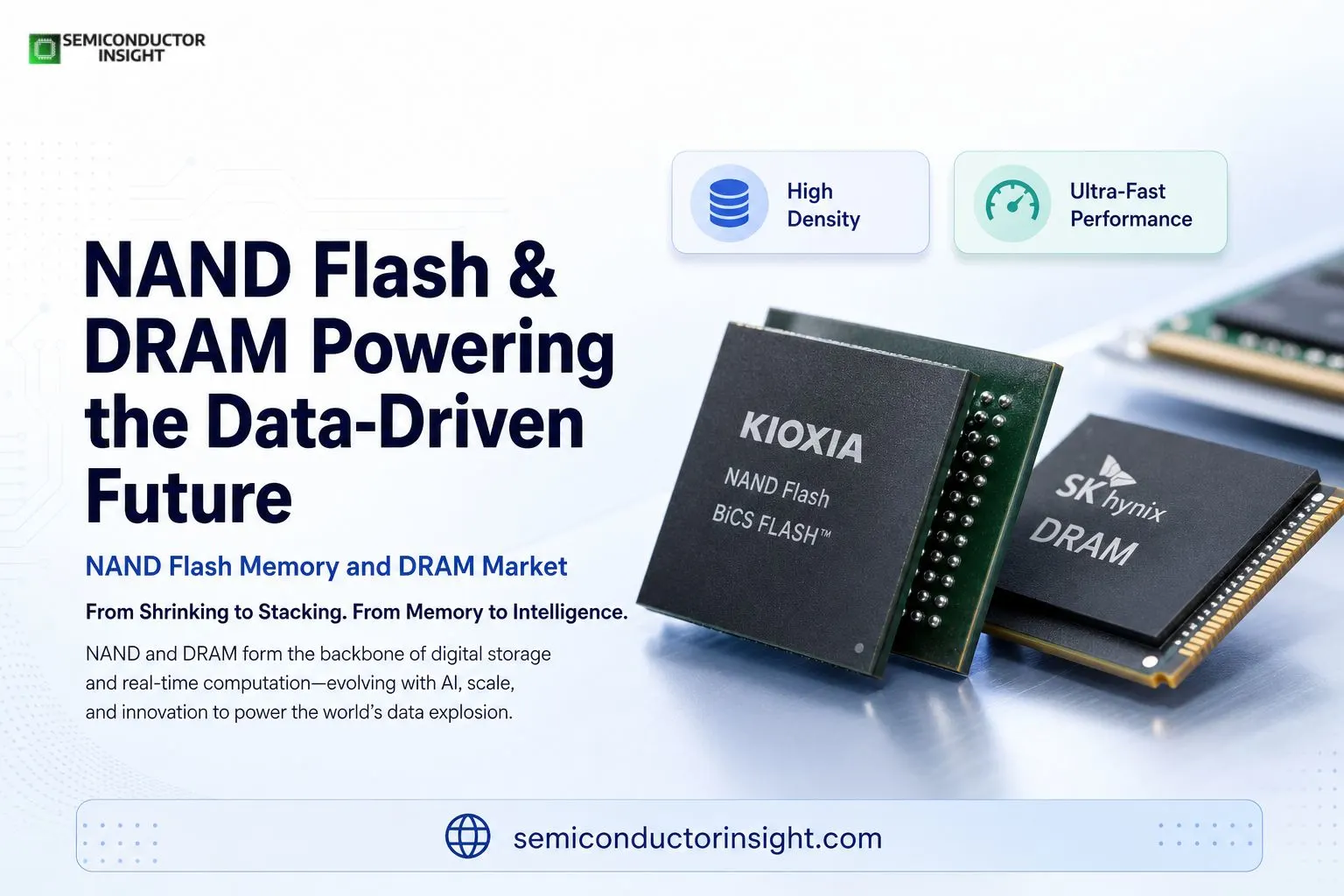
Memory at the Core of Digital Infrastructure NAND and DRAM Market Redefining Data-Centric Computing
The modern semiconductor ecosystem is increasingly shaped not by processors alone, but by the memory systems that feed them. NAND flash and DRAM together form the backbone of digital storage and real-time computation, enabling everything from hyperscale data centres to smartphones.
What makes this segment unique is its dual nature: NAND focuses on persistent storage with massive bit density, while DRAM delivers ultra-fast, volatile memory for active workloads.
Globally, memory production operates at immense scale. Semiconductor fabrication capacity has crossed roughly 33.7 million wafers per month across all chip types, with a significant portion dedicated to memory technologies. Within this, NAND and DRAM alone account for millions of wafers monthly, reflecting their dominance in volume-driven semiconductor manufacturing.
A Brief Look at Our Detailed Analysis Related Report: https://semiconductorinsight.com/report/nand-flash-memory-and-dram-market/
Bit Growth Economics and the Shift from Shrinking to Stacking
For decades, memory scaling followed transistor miniaturization. Today, NAND has fundamentally shifted toward vertical stacking. Instead of shrinking features, manufacturers now stack memory cells in layers exceeding 200-300 layers, with development roadmaps targeting 400+ layers. This architectural shift allows exponential increases in storage density without relying solely on lithography advancements.
DRAM, however, still depends on node scaling, moving through generations such as 1α, 1β, and beyond. But unlike NAND, DRAM faces physical and economic constraints in further shrinking, making each node transition significantly more complex and capital intensive.
Volume Reality Check Bits, Devices, and Data Explosion
- The scale of memory production is best understood in terms of data volume rather than units.
- In 2024, global shipments crossed over 120 billion gigabytes of DRAM and more than 400 billion gigabytes of NAND flash, illustrating the sheer magnitude of data being generated and stored worldwide.
- On a device level, the industry shipped billions of units annually.
- In 2023 alone, approximately 5.2 billion DRAM devices and 4.6 billion NAND units were produced, supporting ecosystems that include over 1.4 billion smartphones and hundreds of millions of PCs and servers.
- Another striking metric is total installed memory capacity, which has reached over 24 zettabits globally.
- To put that into perspective, one zettabit equals one sextillion bits, underscoring how memory is scaling faster than nearly any other semiconductor category.
AI Workloads Reshaping Memory Architecture and Allocation
A major structural shift is underway as artificial intelligence workloads redefine how memory is produced and consumed. High-bandwidth memory (HBM), a specialized form of DRAM, is now critical for AI accelerators due to its ability to deliver extremely high data throughput.
Recent developments show that memory manufacturers are reallocating production capacity toward AI-focused products, tightening supply across conventional DRAM and NAND segments. Some reports indicate that shortages could persist for years as demand from data centres continues to surge.
This shift is also visible in pricing dynamics. NAND and DRAM prices have seen increases of 15-20% in certain cycles due to constrained supply and rising enterprise demand.
Fabrication Intensity and Cost Structure of Memory Chips
Memory manufacturing is among the most capital-intensive segments in semiconductors. A single advanced fabrication facility can cost upwards of $10-20 billion, with cleanroom environments requiring extreme precision.
DRAM and NAND production together utilize millions of wafers per month. Estimates suggest around 3 million wafers monthly for NAND and over 2 million for DRAM, highlighting the scale of dedicated memory fabs.
Cost efficiency is often measured in price per gigabit. Commodity DRAM can reach approximately $0.12 per Gb, while NAND is lower at around $0.08 per Gb, reflecting its role as a high-volume storage medium.
However, advanced memory such as HBM consumes significantly more wafer resources per unit, making it both high-value and supply-constrained.
Latency vs. Density the Engineering Trade-Off
One of the defining technical tensions in memory design is the trade-off between speed and density. DRAM has improved capacity and bandwidth dramatically over the past two decades, but latency improvements have been minimal, creating a persistent bottleneck in computing systems.
NAND, on the other hand, offers massive storage density but operates at significantly higher latency compared to DRAM. This has led to hybrid architectures where NAND and DRAM are increasingly integrated in hierarchical memory systems, especially in data centres.
Emerging concepts such as in-memory computing and compute-in-flash are attempting to blur these boundaries by embedding processing capabilities directly within memory arrays.
Manufacturing Consolidation and Supply Discipline
The memory industry is extremely concentrated, with a few key manufacturers dominating global supply, in contrast to many semiconductor categories. Disciplined production techniques, where wafer output is modified to balance supply and pricing stability, have been brought about by this consolidation.
Historically, aggressive capacity expansion led to oversupply cycles, but recent strategies emphasize controlled growth and technological upgrades rather than sheer volume increases. This has stabilized long-term economics while maintaining high barriers to entry.

Comments (0)