
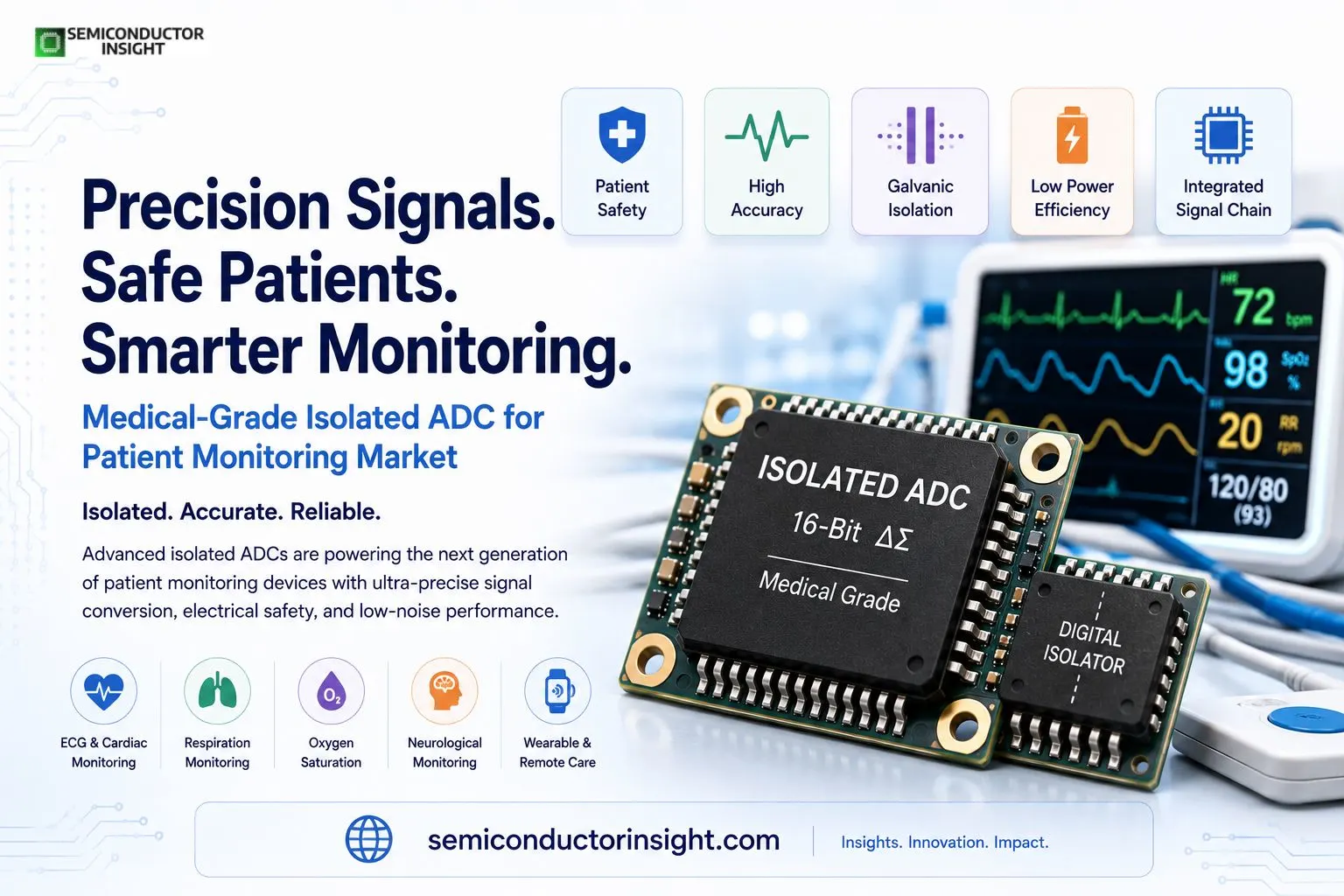
The market for medical-grade isolated ADCs for patient monitoring is being driven by precision signal chains.
Hospital monitoring systems are becoming smaller, smarter, and far more connected than traditional bedside devices used a decade ago. Behind every ECG waveform, oxygen saturation reading, respiration signal, and portable cardiac monitor sits a highly specialised semiconductor component responsible for converting fragile analogue bio-signals into reliable digital medical data. That component is the medical-grade isolated analogue-to-digital converter, commonly known as the isolated ADC.
In modern healthcare electronics, isolated ADCs are becoming essential because patient-connected devices must maintain electrical isolation while still delivering extremely accurate signal conversion. Even tiny electrical leakage or signal interference can compromise readings during cardiac monitoring, neurological testing, or ICU patient observation. This has pushed semiconductor manufacturers toward ultra-low-noise, high-precision isolated conversion architectures designed specifically for healthcare environments.
Why Isolation Is Becoming Non-Negotiable in Medical Electronics?
Patient monitoring equipment continuously processes low-voltage biological signals such as ECG, EEG, EMG, and blood oxygen measurements. These signals are often measured in microvolts and millivolts, making them highly vulnerable to electromagnetic interference and electrical noise from surrounding hospital equipment.
Medical isolated ADCs create a galvanic barrier between the patient-side analogue circuitry and the digital processing side of the system. This barrier protects patients from electrical faults while preserving signal accuracy during conversion.
The growing use of connected medical systems, wearable diagnostics, and portable ICU devices has increased demand for reinforced isolation technologies in semiconductors. Semiconductor engineers are now integrating:
- Sigma-delta conversion architectures
- Capacitive isolation barriers
- Integrated digital filtering
- Low-power CMOS fabrication
- Noise suppression layers
- Multi-channel biomedical signal acquisition
Healthcare-grade ADC platforms are increasingly designed to comply with strict medical electrical safety standards including IEC 60601 requirements for patient-connected equipment.
You Can Freely Surf Our Latest Updated Report Here: https://semiconductorinsight.com/report/medical-grade-isolated-adc-for-patient-monitoring-market/
Semiconductor Innovation Is Reshaping Portable Monitoring Systems
The most significant shift in the market is miniaturization, as hospitals and remote healthcare providers increasingly move toward compact monitoring systems that enable continuous wireless patient observation. Recent biomedical engineering research, including studies published in journals such as npj Biomedical Innovations, shows that next-generation healthcare monitoring is evolving toward wearable, bioelectric, and AI-assisted signal acquisition platforms.
This shift is directly influencing isolated ADC semiconductor design, with medical device companies now adopting integrated mixed-signal platforms instead of bulky discrete analog front-end systems. These advanced platforms bring together isolation amplifiers, precision ADC channels, power management ICs, digital signal processors, and embedded diagnostic controllers, resulting in reduced board space, lower heat generation, improved battery efficiency, and higher signal fidelity for portable medical devices.
Semiconductor Materials and Packaging Are Changing Rapidly
One of the most important developments in the industry is advanced semiconductor packaging. Traditional isolation systems occupied large PCB areas, but newer wafer-level packaging technologies are shrinking isolated ADC footprints significantly.
Modern semiconductor fabs are also focusing on:
- High-voltage tolerant substrates
- Advanced CMOS isolation structures
- Silicon-on-insulator technologies
- Low-leakage biomedical semiconductor layers
- High-speed serial medical data interfaces
These improvements are critical because healthcare monitoring systems increasingly require faster sampling rates without compromising patient safety.
Medical wearable devices capable of continuous monitoring now process large amounts of real-time physiological data every second. This demand has accelerated the shift toward higher-resolution isolated converters with lower power consumption.
Remote Patient Monitoring Is Expanding Semiconductor Demand
The quick development of infrastructure for remote patient monitoring is one of the biggest changes in the market. In order to allow doctors to monitor patients outside of traditional clinical settings, hospitals all over the world are implementing connected monitoring platforms. As healthcare systems boosted their investments in telehealth and digital patient management technologies, this momentum grew.
Portable ECG patches, wireless blood pressure monitors, smart pulse oximeters, AI-enabled respiratory monitors, home cardiac telemetry systems, and linked biosignal wearables are examples of contemporary remote monitoring technologies. For all of these devices to work properly, accurate semiconductor signal conversion and electrical isolation are essential. Additionally, wearable biosensors and linked monitoring systems are becoming more and more crucial for global chronic illness management and preventive treatment, according to recent studies on healthcare electronics.
Chipmakers Are Competing Through Accuracy and Power Efficiency
The semiconductor competition is no longer focused only on raw conversion speed. Medical OEMs now prioritize:
- Ultra-low input offset
- Higher common-mode rejection
- Reduced drift performance
- Longer battery runtime
- Electromagnetic immunity
- Multi-patient monitoring scalability
Major semiconductor companies including Texas Instruments, Analog Devices, STMicroelectronics, and Skyworks Solutions are actively expanding isolated signal chain portfolios targeting medical and industrial electronics.
At the same time, semiconductor supply chain resilience has become a major industry concern. Specialized medical-grade mixed-signal components require extensive validation, long certification cycles, and stable wafer sourcing, making healthcare semiconductors one of the most quality-sensitive segments in the electronics industry.
Intelligent Healthcare Electronics Are Defining the Next Semiconductor Cycle
Medical Grade Isolated ADC for Patient Monitoring Market is no longer limited to hospital bedside monitors. It is becoming a critical semiconductor segment powering AI-driven healthcare, connected diagnostics, wearable biosensors, and intelligent remote monitoring ecosystems.
As healthcare systems continue moving toward continuous digital patient observation, isolated ADC technologies are evolving from supporting components into core semiconductor building blocks that enable safer, smarter, and more accurate medical electronics worldwide.

Comments (0)