

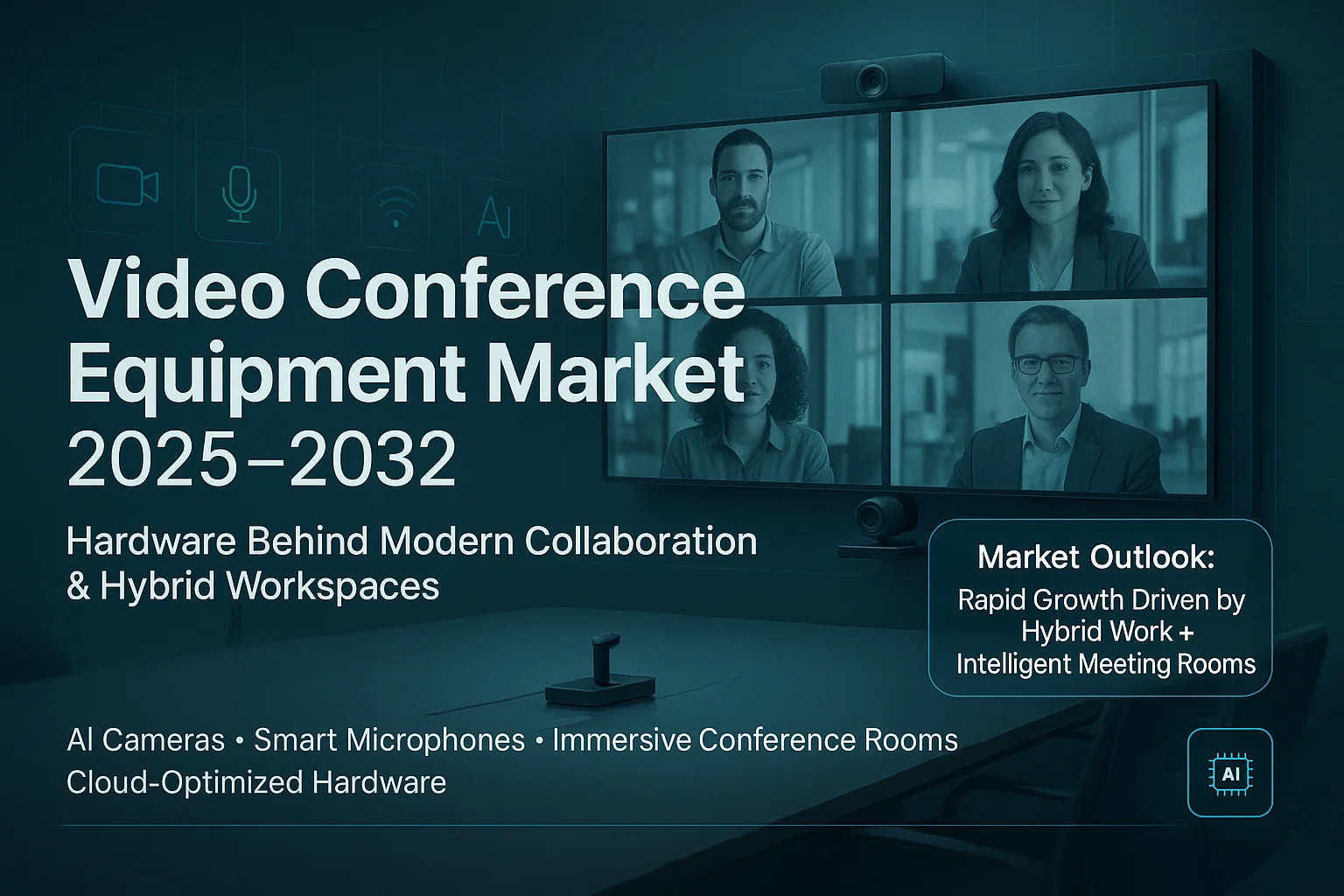
Market for Video Conference Equipment: The Hardware of Contemporary Cooperation
In a world where workforces shift between offices, homes, and hybrid hubs, video conferencing has become the central nervous system of global communication. And while software platforms get most of the spotlight, the hardware powering these interactions cameras, room systems, microphones, codecs, and immersive collaboration suites is quietly powering an ecosystem worth billions.
Video Conference Equipment Market is no longer just about seeing and hearing, but it’s about presence, clarity, intelligence, and seamless integration across every environment where decisions are made.
What This Blog Covers
A forward-looking take on how the video conference equipment market is evolving from intelligent meeting rooms to the new hardware standards shaping hybrid work.
The Experience Layer: Why Equipment Still Matters?
Even the smartest collaboration apps struggle without the right hardware.
High-resolution optics, deep-noise-suppression microphones, wide-angle sensors, smart speaker-tracking, and ultra-low-latency codecs together shape how real a meeting feels.
Organizations have learned that poor equipment leads to fatigue, unclear decision-making, and lost productivity. Today, hardware is being engineered to replicate in-room presence even when participants are continents apart.
Shifting Work Models Are Redefining Demand
Hybrid work has split the world into three distinct communication environments:
Home Offices → Compact Intelligent Kits
- USB plug-and-play conferencing bars, AI webcams, and noise-cancelling speakerphones are becoming standard for knowledge workers.
Corporate Rooms → Immersive Collaboration Suites
- Conference rooms are being rebuilt around dual displays, panoramic cameras, ceiling-array mics, and touch-control consoles that make meetings frictionless.
Remote & Distributed Teams → Cloud-Optimized Hardware
- Edge-optimized codecs, cloud registration, and instant firmware updates keep equipment running smoothly across thousands of endpoints.
- These transitions are fueling hardware upgrades globally as firms redesign how teams connect.
The Innovation Pulse: What’s Upcoming?
The next wave of video conferencing equipment is steering the industry toward immersive, context-aware collaboration environments where the technology feels almost invisible. Spatial audio engines paired with micro-location microphones now map voices to their actual positions in the room, creating conversations that sound natural and life-like. At the same time, new hardware-based real-time translation modules are enabling seamless multilingual discussions without relying on cloud latency.
Early prototypes of AR-enabled glass panels are adding another layer of intelligence transparent displays that overlay speaker identity, notes, and content prompts directly into the meeting space. High-density multi-feed LED presentation walls are also redefining visual clarity, offering studio-grade imagery for enterprise settings.
Behind the scenes, intelligent self-maintenance modules are evolving rapidly, giving devices the ability to diagnose performance issues, recalibrate lenses, and update firmware autonomously. Together, these advancements are transforming conference rooms from standard communication zones into fully intelligent, decision-ready collaboration hubs.
The Market’s Signature Innovations
- Multi-Camera Intelligence: Systems now stitch feeds from multiple lenses to create auto-framed, natural meeting views.
- Voice Isolation Engines: Advanced DSP filters separate human speech from background noise critical for hospitals, call centres, and manufacturing floors.
- One-Touch Ecosystems: Room devices sync with platforms like Zoom Rooms, Microsoft Teams Rooms, Cisco WebEx Rooms, or Google Meet hardware with effortless control.
- Energy-Efficient Architectures: Low-power chipsets and recycled-material housings are becoming essential as enterprises apply sustainability targets to meeting rooms.
A Unique Flow Sequence: How Adoption Accelerates
Workplace Transformation → Hardware Modernization → Collaboration Ease → Productivity Lift → Long-Term Enterprise Investment
Where the Market Finds Its Strength?
The video conference equipment market thrives on its ability to meet complex expectations clarity, compatibility, uptime, and simplicity. Adoption is strongest in industries where real-time conversations drive critical outcomes:
- Healthcare: Teleconsultation equipment enabling specialist connectivity.
- Education: Smart classrooms with lecture-capture systems.
- Corporate Enterprises: Global boardrooms integrating AI-driven meeting bars.
- Government & Defence: Encrypted, high-reliability room systems.
- Media & Broadcasting: Professional PTZ cameras enabling multi-angle streaming.
Market Confidence: Why Growth Continues?
As enterprises consolidate workforces, reduce travel costs, and adopt uniform digital workflows, the demand for robust meeting-room hardware is accelerating. Organizations see conferencing equipment not as an IT expense but as an infrastructure investment one that directly influences culture, connection, and collaboration quality.
Now, At Last, You Can Go Through Our In-Depth Insights Below: https://semiconductorinsight.com/report/video-conference-equipment-market/

Comments (0)