
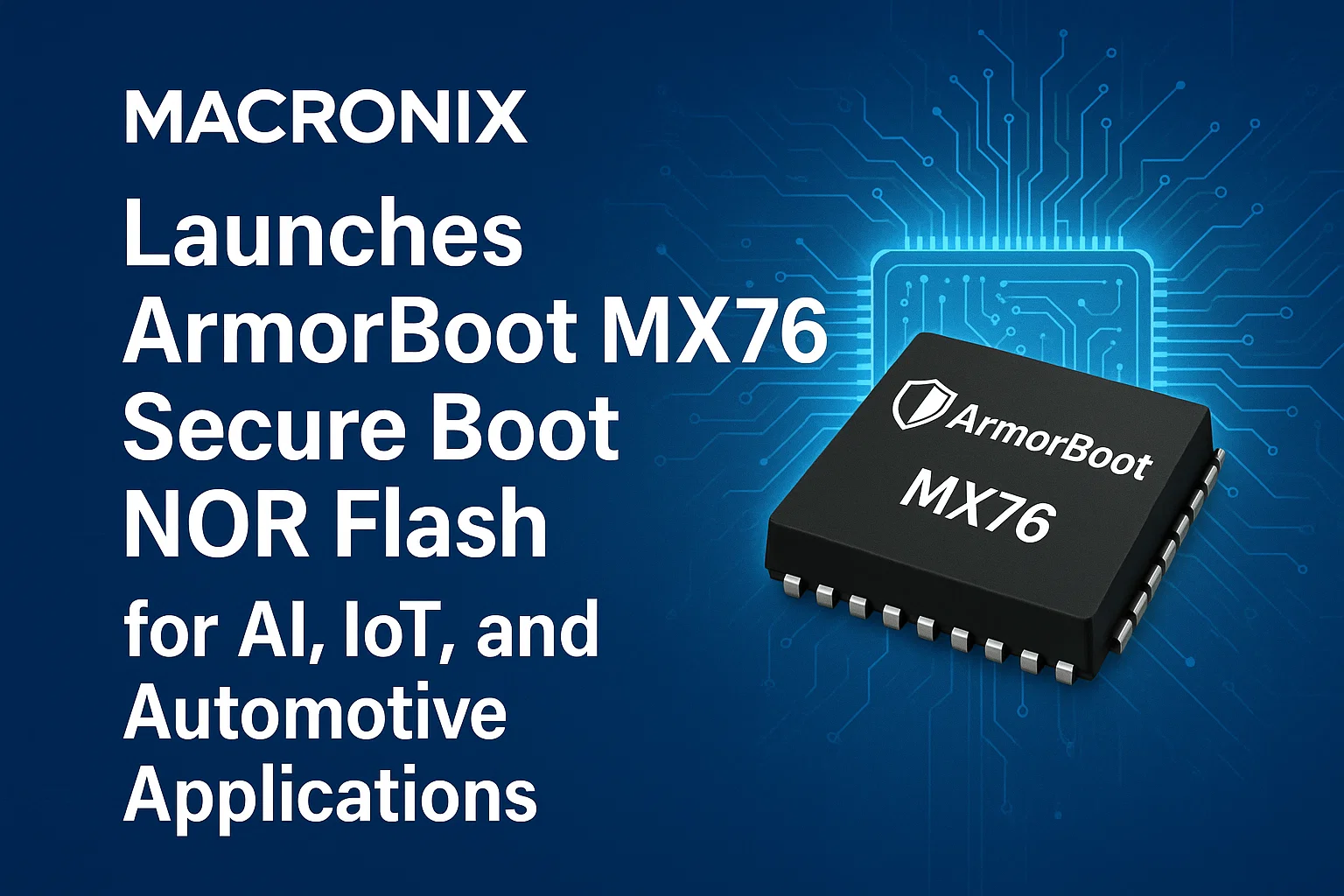
Macronix Launches ArmorBoot MX76 Secure Boot NOR Flash for AI, IoT, and Automotive Applications
The External NOR Flash market is undergoing a quiet yet significant transformation. Traditionally overshadowed by NAND flash in terms of storage capacity, NOR flash has long been prized for its fast random read capabilities, long endurance, and reliability—qualities that make it indispensable for code storage, embedded systems, automotive applications, and increasingly, secure IoT devices.
In 2024, the global external NOR flash market was valued at US$ 1,213 million. According to industry trends, the market is projected to grow steadily to US$ 1,597 million by 2032, expanding at a CAGR of 4.0% during the forecast period. This trajectory is driven by innovations such as secure boot flash, power-efficient low-voltage devices, and the groundbreaking shift toward 3D NOR architectures.
Access Your Free Sample Report- External NOR Flash Market
1. The Evolving Role of External NOR Flash
NOR flash memory is a non-volatile memory technology that provides direct execution of code (eXecute-in-Place, or XiP), making it especially suitable for embedded controllers, automotive ECUs, network devices, and IoT endpoints. Unlike NAND flash, which dominates in high-density storage (SSDs, smartphones, data centers), NOR flash is optimized for fast booting, reliable code storage, and long data retention.
While the global memory industry is often driven by NAND or DRAM, NOR flash persists as a niche yet critical technology. External NOR flash, in particular, remains essential because of its scalability, cost-effectiveness, and wide adoption in consumer electronics, automotive, aerospace, and industrial applications.
2. Market Forecast and Growth Drivers
- 2024 Market Value: US$ 1,213 million
- 2032 Market Projection: US$ 1,597 million
- CAGR (2025–2032): 4.0%
Growth Drivers
- Automotive Electronics Expansion: Modern vehicles require reliable code storage for infotainment, ADAS (Advanced Driver Assistance Systems), digital cockpits, and autonomous driving modules.
- IoT & Edge Devices: Billions of IoT devices depend on low-power NOR flash for fast boot and secure firmware updates.
- Functional Safety Requirements: ASIL-D and ISO26262 certifications have become crucial in automotive-grade memory, fueling adoption of certified NOR flash solutions.
- Security Concerns: With rising cyber risks, demand for secure boot NOR flash and hardware-embedded authentication features is accelerating.
- Power Efficiency: The shift toward low-voltage dual-supply NOR flash supports energy-sensitive devices in IoT and wearables.
3. Key Industry Developments
Recent announcements by leading manufacturers highlight how the NOR flash industry is innovating beyond its traditional boundaries.
3.1 Macronix’s Breakthrough in 3D NOR Flash
- In late 2024, Macronix International introduced what it called the world’s first 3D NOR flash chip, showcased at electronica 2024.
- Unlike 2D NOR, which has reached scaling bottlenecks around 4x nm processes, 3D NOR uses a multilayer AND-type stacking approach.
- Macronix’s 4 Gb single-chip device provides higher density, faster read performance, and improved reliability—targeting automotive, AI, and IoT applications.
- This innovation mirrors the 3D revolution seen in NAND flash and is expected to extend NOR flash’s lifespan and competitiveness well into the 2030s.
3.2 Macronix’s ArmorBoot MX76 Secure Boot NOR Flash (2025)
- Launched in August 2025, the ArmorBoot MX76 series is designed for security-sensitive markets.
- Capacities up to 1 Gb, supporting both 3 V and 1.8 V SPI interfaces.
- Enables secure boot, firmware authentication, and trusted updates, making it ideal for automotive ECUs, IoT endpoints, industrial automation, and AI accelerators.
- This marks a shift from NOR being a “passive code storage” solution to an active enabler of system-level cybersecurity.
3.3 Infineon’s SEMPER NOR Flash Achieves ASIL-D Certification
- Infineon announced that its SEMPER NOR Flash family received ASIL-D certification, the highest automotive functional safety level.
- Critical for autonomous driving and ADAS applications where memory failures could compromise safety.
- SEMPER NOR offers reliability, error-correction, and fail-safe redundancy, ensuring robust performance in automotive-grade systems.
3.4 GigaDevice’s Dual-Supply SPI NOR Flash (2025)
- GigaDevice unveiled a dual-supply NOR flash series supporting operation down to 2 V, reducing power consumption by nearly 50% compared to conventional devices.
- The GD25NE series targets battery-driven IoT nodes, portable medical devices, and green energy systems.
- As ultra-low-power designs become critical in wearables and connected devices, this innovation strengthens NOR’s relevance in next-gen electronics.
3.5 Winbond’s Automotive Security NOR Flash
- Winbond Electronics has been enhancing its automotive NOR flash portfolio with secure boot, tamper-resistance, and hardware authentication features.
- Automotive cybersecurity regulations (e.g., UNECE WP.29) make such features a must-have, driving demand from OEMs.
- Winbond’s emphasis on combining high-speed read performance with security-first design underscores how NOR flash is evolving for connected cars.
Download Sample Report PDF- External NOR Flash Market
3.6 Infineon’s Rad-Hard NOR Flash for Aerospace & Defense
- Infineon also released a 512 Mb radiation-hardened NOR flash, QML-qualified for space applications.
- Used for FPGA boot code storage in satellites and spacecraft.
- Offers long endurance, extended temperature operation, and resistance to cosmic radiation.
- This expands NOR flash beyond terrestrial industries, strengthening its foothold in aerospace and defense electronics.
4. Technology Trends Redefining the Market
4.1 From 2D to 3D NOR Flash
- Scaling limits in 2D NOR have hindered density growth.
- Macronix’s 3D NOR provides a path to higher-capacity solutions (4 Gb and beyond).
- This could make NOR competitive in markets where NAND had been the default for higher densities.
4.2 Secure Boot and Cybersecurity Integration
- With IoT, automotive, and industrial devices becoming connected, firmware integrity is critical.
- Secure boot NOR flash ensures only authenticated firmware can run, mitigating hacking risks.
- Macronix ArmorBoot MX76 and Winbond’s secure NOR exemplify this trend.
4.3 Functional Safety and Reliability
- Automotive-grade ASIL-D certification is becoming a baseline requirement.
- Infineon’s SEMPER NOR sets the standard, but competitors will likely follow suit.
- Safety features like ECC (Error Correction Code), redundancy, and robust wear-leveling are increasingly integrated.
4.4 Low-Voltage, Energy-Efficient Designs
- IoT devices often run on coin-cell or small Li-ion batteries.
- GigaDevice’s dual-supply NOR flash demonstrates the shift toward power-aware memory design.
- Expect 2 V or sub-1 V devices in the near future, aligning with next-gen microcontroller requirements.
4.5 Aerospace & Military Adoption
- With Infineon’s radiation-hardened NOR, NOR flash has entered critical space and defense applications.
- Long data retention, rad-hard operation, and stable performance make NOR uniquely suited for satellite firmware and secure mission systems.
5. Competitive Landscape
The external NOR flash market is moderately consolidated, dominated by a handful of players:
- Macronix International – pioneer in 3D NOR, secure boot ArmorBoot MX76.
- Infineon Technologies – SEMPER NOR ASIL-D certified, rad-hard NOR for space.
- GigaDevice Semiconductor – dual-supply ultra-low-power NOR for IoT.
- Winbond Electronics – automotive and secure NOR solutions.
- Cypress (now Infineon), Micron, and Eon Silicon – continue to serve traditional NOR markets.
Each player is differentiating through niche specialization—whether in security, automotive safety, space-grade reliability, or ultra-low power consumption.
6. Applications Across Industries
- Automotive – Boot code storage, ADAS, infotainment, digital cockpits, and autonomous driving.
- Consumer Electronics – Smart TVs, gaming consoles, routers, and wearables.
- IoT & Edge Devices – Sensors, gateways, and smart home products requiring fast boot and secure firmware updates.
- Aerospace & Defense – Rad-hard NOR for satellites, missiles, and military communications.
- Industrial Automation – PLCs, robotics, and smart factories relying on durable memory with long retention cycles.
7. Challenges Facing the Industry
- Capacity Limitations: Even with 3D NOR, NAND remains far ahead in density.
- Cost Pressures: NOR is more expensive per bit compared to NAND, limiting adoption in high-volume consumer storage.
- Market Consolidation: Fewer suppliers create supply chain risks and price volatility.
- Competition from Emerging NVMs: MRAM, FRAM, and ReRAM are being tested as alternatives in low-power embedded applications.
Click Here To Download Full Sample Report- External NOR Flash Market
8. Future Outlook (2025–2032)
Looking ahead, external NOR flash will continue to evolve along five key dimensions:
- 3D Scaling – Expect more vendors to follow Macronix into multilayer NOR, unlocking densities beyond 4 Gb.
- Security by Design – Hardware-based authentication and encryption will become standard in NOR solutions.
- Green Memory – Power efficiency will be central, with 1.0 V or sub-1 V flash solutions likely by 2028.
- Automotive Integration – Safety-certified NOR will remain integral to autonomous and electric vehicle platforms.
- Aerospace Adoption – NOR’s endurance and rad-hard capabilities will cement its position in space-grade electronics.
By 2032, with a steady CAGR of 4.0%, NOR flash will remain a vital, niche technology that underpins the reliability, security, and efficiency of billions of devices worldwide.
With steady market growth from US$ 1,213 million in 2024 to US$ 1,597 million by 2032, NOR flash is proving that in the world of memory technologies, sometimes reliability, security, and precision matter more than raw capacity.

Comments (0)