

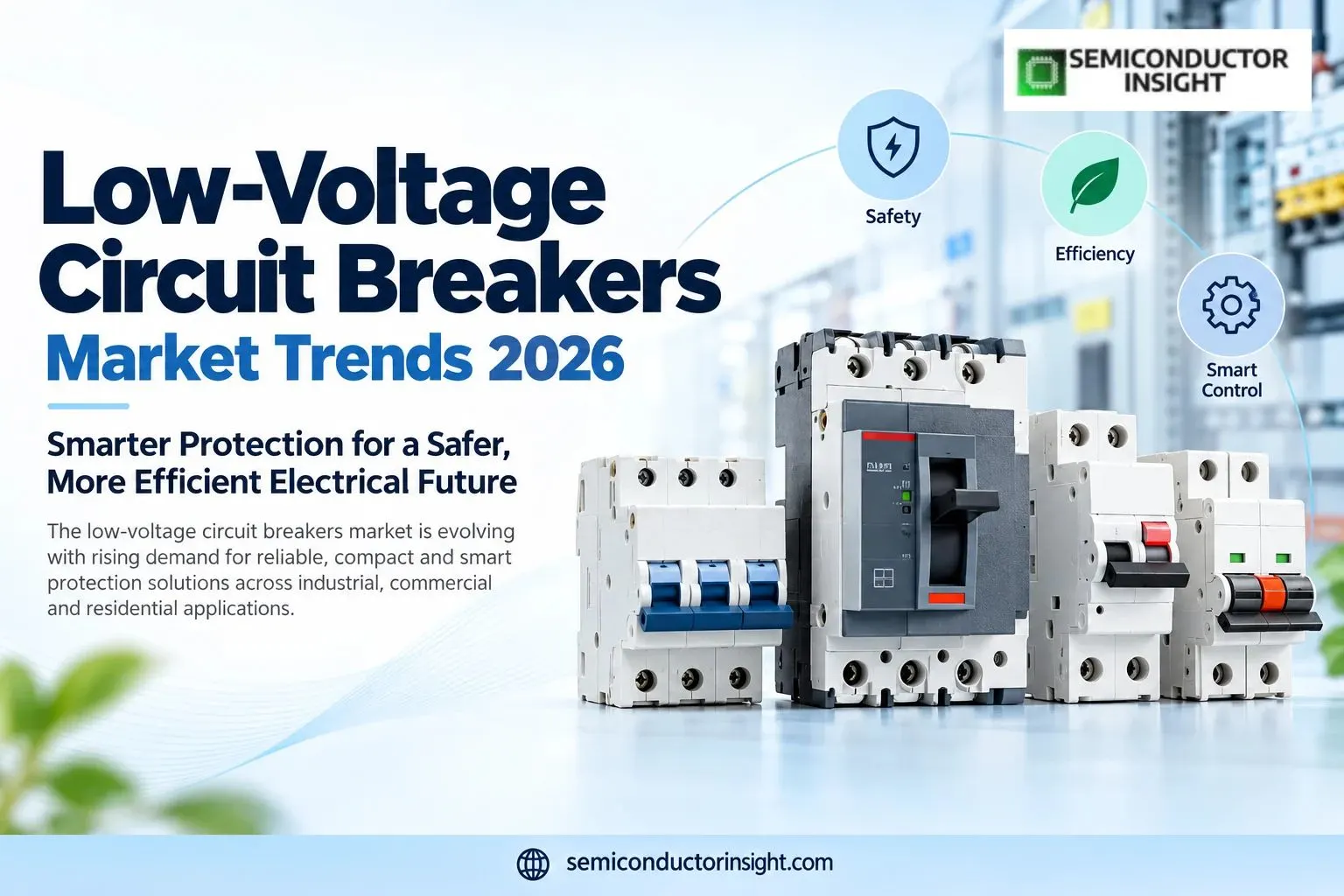
Low-Voltage Circuit Breakers Market Trends 2026: Smart Trip Units, Remote Monitoring, and High-Density Electrical Systems
Low-voltage circuit breakers are moving beyond their traditional role as devices that simply interrupt fault currents. Modern installations increasingly expect breakers to protect equipment, provide operational information, support energy management and communicate with wider electrical-control systems.
This shift is arriving as electricity becomes more important across buildings, manufacturing, transportation, renewable generation and digital infrastructure. The International Energy Agency reported that global electricity demand increased by around 3% in 2025, while data-center electricity consumption rose by about 17%.
For the low-voltage circuit breakers market, this means more electrical loads and more sophisticated distribution architectures to protect.
To find out more, feel free to browse our latest updated report: https://semiconductorinsight.com/report/low-voltage-circuit-breakers-market/
The New IEC Reference Point
- A significant development for manufacturers and electrical-system designers is IEC 60947-2:2024. The sixth edition applies to circuit breakers with rated voltages up to 1,000 V AC or 1,500 V DC and replaces the previous 2016 edition with a technical revision.
- The standard is particularly relevant as low-voltage systems become more diverse. Modern installations may combine conventional AC loads with photovoltaic systems, battery storage, power electronics, EV charging equipment and increasingly complex industrial machinery.
- This makes protection coordination and appropriate circuit-breaker selection increasingly important during electrical-system design.
Data Centers Are Creating a Different Kind of Demand
The rapid expansion of data infrastructure is putting electrical distribution under new pressure. In the United States, the Department of Energy estimated that data centers consumed 192 TWh of electricity in 2024, equivalent to 4.7% of total U.S. electricity consumption. Its reference case projects approximately 464 TWh by 2028. The Department of Energy’s Energy.gov
These facilities require highly dependable power distribution because an electrical fault can affect large numbers of servers and critical computing services.
Circuit breakers used in such environments increasingly incorporate electronic trip units, monitoring capabilities, selective coordination and remote operational functions. Eaton’s Power Defense SB, for example, combines electronic trip technology with monitoring of parameters such as energy usage, battery condition and breaker health. Eaton
From Breaker to Connected Device
- Digitalization is changing what users expect from low-voltage protection equipment. Siemens’ SENTRON 3VA2 plus and 3VA6 plus MCCBs incorporate electronic trip units and digital capabilities intended to improve system transparency, protection and integration with communication and software environments. The platform also supports more than 500 accessories.
- ABB’s SACE Tmax XT platform similarly extends from 16 A to 1,600 A in its IEC range and incorporates measurement, communication and energy-management functions. ABB also lists cloud connectivity and more than 50 upgradable functions for compatible electronic trip units. ABB Group
- These developments illustrate an important change in the market. The breaker is increasingly becoming a source of electrical information rather than an isolated protection component.
Why Current Ratings Are Getting More Attention?
Electrical designers must match a breaker to the expected load, installation conditions and prospective fault level. The range of available products illustrates how different applications require very different protection capacities.
For example, ABB’s IEC Tmax XT range spans 16 A to 1,600 A, while its platform can reach breaking capacities of up to 200 kA in specified configurations.
At the other end of the spectrum, smaller breakers remain essential throughout commercial buildings, residential distribution and machinery. This broad application base gives the low-voltage circuit breakers market a wide product landscape rather than a single technology pathway.
Renewable Power Is Expanding the Protection Conversation
Solar installations, battery energy storage and distributed generation are creating electrical configurations that differ from conventional one-directional grid supply.
IEC 60947-2 has already evolved to address changing application requirements. The previous 2016 edition introduced provisions including testing related to photovoltaic applications and requirements concerning DC circuit breakers.
As more distributed energy resources connect to electrical networks, circuit-breaker selection increasingly has to consider bidirectional power flows, DC protection, fault characteristics and coordination with other protective devices.
Arc Flash Protection Is Becoming More Intelligent
- Safety is another area where low-voltage breaker technology is evolving. Modern electronic protection systems can help identify abnormal conditions quickly and coordinate protection across different parts of a distribution network.
- Eaton’s Power Defense SB platform, for instance, includes Zone Selective Interlocking and an Arc Flash Reduction Maintenance System, alongside digital monitoring and breaker-health functions. Eaton
- The result is a move toward protection systems that not only disconnect faulty circuits but also help operators understand what happened and maintain the electrical system more effectively.
The Breaker Market Is Following the Electrification Curve
The broader electricity landscape points toward continued expansion of low-voltage protection requirements. Electrification is spreading across buildings, factories, transportation and digital infrastructure, while data centers and other high-load facilities are creating concentrated pockets of electricity demand.
This makes the next generation of circuit breakers increasingly defined by three capabilities: dependable interruption, intelligent monitoring and integration with wider electrical systems.
The low-voltage circuit breakers market is therefore evolving alongside the electrical network itself. What was once primarily a mechanical protection device is becoming an intelligent component within increasingly connected and power-intensive infrastructure.

Comments (0)