
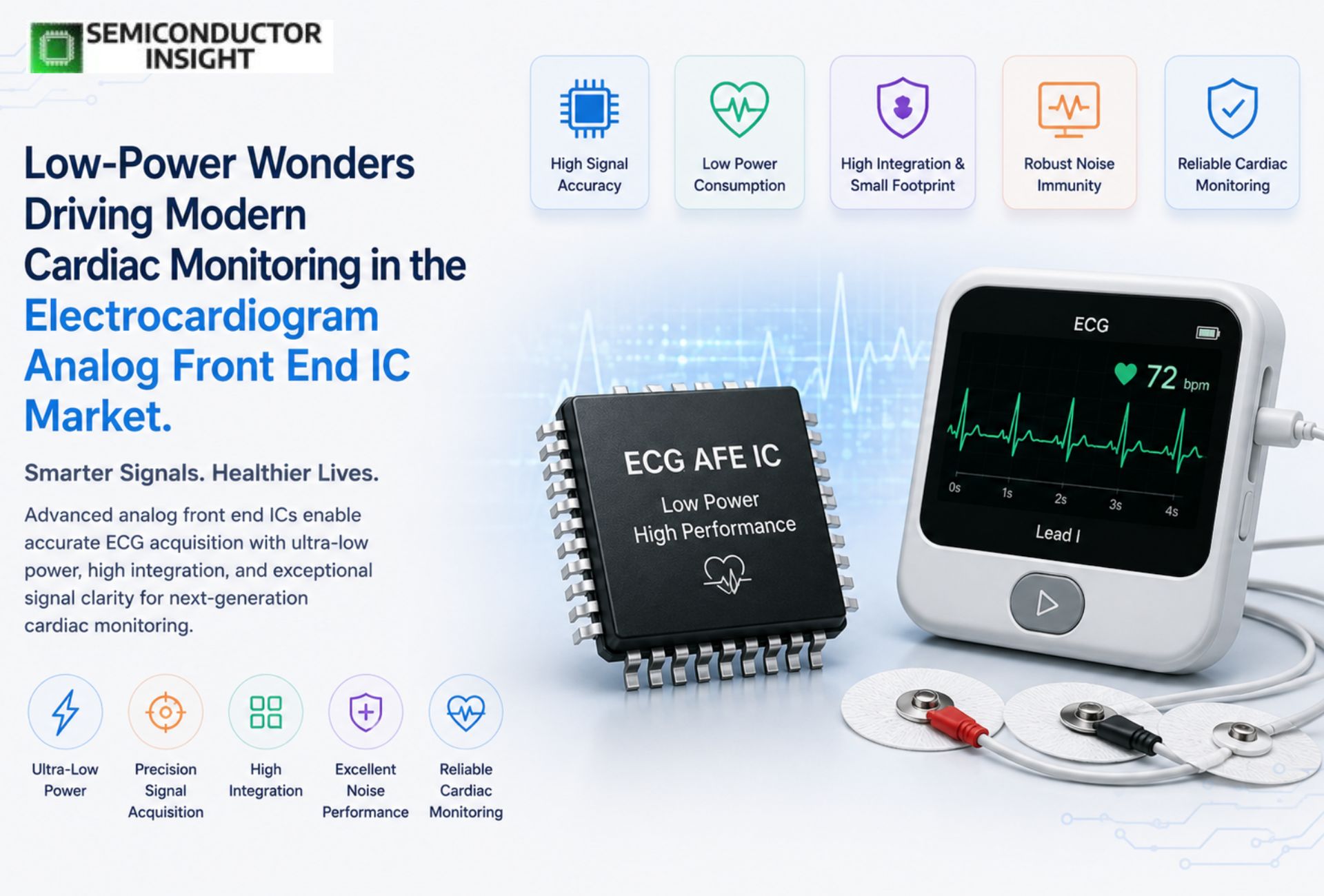
Low-Power Wonders Driving Modern Cardiac Monitoring in the Electrocardiogram Analog Front End IC Market
Low-Power Wonders Driving Modern Cardiac Monitoring in the Electrocardiogram Analog Front End IC Market
Electrocardiogram Analog Front End IC market refers to the global industry focused on the development, production, and integration of specialized integrated circuits designed to acquire, filter, amplify, and process weak electrical signals generated by the human heart during electrocardiogram monitoring.
Picture the gentle electrical pulses traveling through a human heart, translating into waveforms that doctors rely on for life-saving decisions. At the very beginning of that journey sits an advanced piece of semiconductor technology: the analog front end integrated circuit designed specifically for electrocardiogram readings. These specialized chips quietly handle the delicate task of amplifying, filtering, and digitizing tiny bio-signals while rejecting noise from movement, power lines, or nearby electronics.
ü Global cardiovascular health statistics paint a sobering picture that underscores the importance of this technology.
ü Cardiovascular diseases continue as a leading cause of mortality, claiming around 18 million lives each year according to public health data from organizations like the World Health Organization.
ü Hospitals and clinics worldwide perform millions of ECG procedures annually, with equipment ranging from standard 12-lead machines in cardiac units to compact single-lead devices used in ambulatory settings.
ü Many of these systems depend on advanced AFE ICs to ensure signal fidelity that supports accurate diagnosis.
The Art of Capturing Faint Electrical Whispers
Modern ECG analog front end ICs perform several critical functions in sequence. They first amplify microvolt-level signals from the body’s surface electrodes, often boosting them by factors of hundreds while maintaining extremely low noise floors. Built-in filtering removes unwanted interference, and high-resolution analog-to-digital conversion prepares the data for further processing. Features like right-leg drive circuits improve common-mode rejection, and lead-off detection alerts systems when electrode contact is lost.
Designers focus intensely on power efficiency because many applications now prioritize portability. Some ICs consume mere microwatts per channel, enabling weeks of continuous monitoring on small batteries in wearable patches or smartwatch-style devices. This capability has expanded ECG use beyond clinical walls into remote patient monitoring programs and consumer health tools.
You Can Freely Surf Our Latest Updated Report Here: https://semiconductorinsight.com/report/electrocardiogram-ecg-analog-front-end-ic-market/
Real-World Integration across Care Settings
In busy emergency departments, multi-channel AFE solutions feed data into bedside monitors that track patients in real time. During the COVID-19 period and beyond, healthcare systems accelerated adoption of wireless ECG patches for telemetry, reducing staff exposure while maintaining oversight. One notable deployment involved adhesive patches worn for up to two weeks, streaming data that helped detect arrhythmias earlier than traditional short-term Holter monitors.
On the consumer side, devices like certain smartwatches now incorporate single-lead ECG capabilities approved for detecting atrial fibrillation. These rely on compact AFE designs that balance accuracy with comfort and battery life. In specialized applications, such as fetal monitoring or stress testing equipment, higher channel counts and robust signal integrity become paramount. Manufacturers worldwide integrate chips from leaders like Texas Instruments and Analog Devices into systems shipped across continents.
Design Considerations That Shape Performance
- Noise Management: Achieving sub-microvolt noise levels remains essential when dealing with signals as small as 0.5 millivolts peak-to-peak.
- Power Optimization: Ultra-low current draw supports extended operation in battery-powered and implantable-adjacent scenarios.
- Integration Levels: Combining amplifiers, ADCs, and auxiliary functions on one die reduces board space and overall system cost.
- Patient Safety: Built-in isolation techniques and defibrillation protection circuits safeguard both patients and equipment.
Evolving Role in Connected Health Ecosystems
As healthcare shifts toward preventive and personalized models, ECG AFE ICs serve as foundational building blocks. They enable seamless data flow from body-worn sensors to cloud platforms where algorithms analyze patterns over time. This supports chronic disease management for conditions like heart failure or post-cardiac event recovery. In research settings, high-fidelity front ends contribute to large-scale studies collecting ECG data from diverse populations to refine diagnostic criteria.
ü Engineers continue pushing boundaries with features like dynamic power scaling and on-chip signal processing that reduce the load on downstream microcontrollers. Temperature stability and electromagnetic compatibility also receive attention, especially for devices used in varied environments from ambulances to home settings.
ü The technology’s impact extends to global supply chains, where semiconductor fabrication supports medical device production meeting international regulatory standards. Each generation of AFE ICs brings incremental improvements in resolution, power profile, and functionality that collectively make cardiac monitoring more accessible and reliable.
In essence, these unassuming integrated circuits form the critical interface between human physiology and digital health insights. By faithfully translating the heart’s electrical language, they help medical professionals and increasingly empowered individuals stay one step ahead of potential issues in an era where timely information can change outcomes. The ongoing refinement of ECG analog front end technology continues to support broader efforts in extending quality cardiac care worldwide.

Comments (0)