
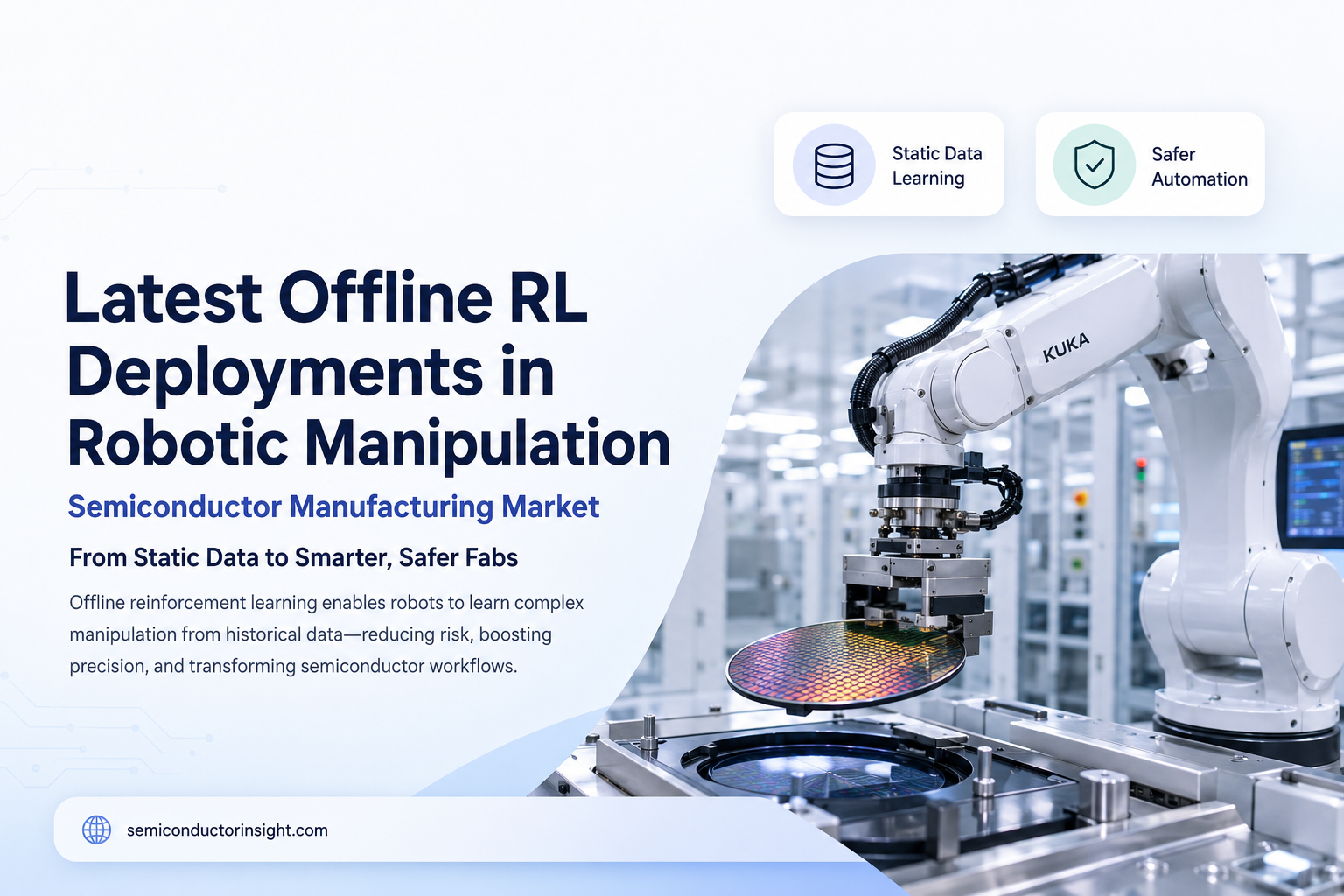
Latest Offline RL Deployments in Robotic Manipulation Reshaping Semiconductor Manufacturing Workflows
Offline reinforcement learning applied to robotic manipulation from static datasets stands out as a pivotal shift for semiconductor manufacturing.
This approach lets systems learn complex behaviours purely from existing recorded interactions, eliminating risky or costly real-time trial-and-error in ultra-clean, high-stakes fabrication environments.
Why Static Datasets Unlock New Potential in Chip Production Robotics?
Semiconductor fabs operate under extreme constraints where even minor contamination or downtime proves devastating. Traditional robotic programming struggles with the variability in wafer positioning, tool maintenance tasks, or handling irregular components during assembly and inspection. Offline RL addresses this by training policies on vast archives of past demonstrations and operational logs.
In practice, this means a robot arm can pre-train on historical data from wafer transfers or equipment servicing, then adapt quickly to new scenarios with minimal additional examples. One notable exploration used the Franka-Panda arm for table-top tasks, demonstrating how offline methods handle sub-optimal data while prioritising safety-critical applications.
Real-World Instances Reshaping Fabrication Lines
- Consider wafer handling robots from providers like FANUC or Brooks Automation, which already achieve nanometer precision in cleanrooms. Integrating offline RL elevates these systems beyond fixed scripts.
- For instance, press hardening case studies in manufacturing, adaptable to semiconductor thermal processes, show offline RL enabling adaptive control from batch data, reducing variability in stochastic environments.
- Collaborative robots (cobots) in assembly, such as those from Lam Research or KUKA, perform maintenance and cleaning while minimising human exposure to chemicals. Offline RL pre-training on static logs allows these cobots to learn nuanced manipulations, like inserting O-rings or adjusting fixtures, where human-like dexterity remains challenging.
- Google DeepMind and academic efforts with Q-Transformer or PTR frameworks further illustrate scalability. PTR pre-trains on diverse multi-task data, then fine-tunes with as few as 10 demonstrations, achieving strong results on real WidowX robots for tasks transferable to fab-like variability.
Technical Foundations Powering Progress
Offline RL treats learning as sequence modelling, often drawing parallels to language pre-training, even leveraging resources like Wikipedia for broader knowledge transfer in some experiments. Algorithms such as Conservative Q-Learning (CQL) or Implicit Q-Learning (IQL) mitigate distribution shift, ensuring policies avoid over-optimistic actions not supported by the dataset.
In semiconductor contexts, this pairs with vision-based systems for defect inspection or event-driven RL for long-horizon control in fabrication sequencing. Datasets for compositional RL further support combining skills, vital for multi-step processes like lithography preparation or packaging.
Current Global Scenarios and Adoption Patterns
- Across Asia-Pacific manufacturing hubs, including facilities in Taiwan and South Korea, automation investments emphasise reliability. TSMC’s automated systems already log massive daily travel distances for material handling; offline RL could optimise these further by learning from aggregated logs without halting production.
- In North America and Europe, research focuses on safety and generalisation. Real-robot studies with heterogeneous datasets outperform pure imitation learning for out-of-distribution tasks, aligning with the need for robots to handle novel maintenance in evolving process nodes.
- Government and academic sites highlight cleanroom robotics advancements, with ISO-certified mobile platforms enabling flexible wafer cassette transport. These efforts reduce skilled labour demands amid industry shortages while boosting yield through precise, adaptive handling.
Integration with Broader Semiconductor Automation Trends
Robotics in fabs increasingly incorporates AI for queue-time management and process optimisation. Deep RL variants already minimise violations in scheduling; extending to offline paradigms from static production data promises similar gains in manipulation without continuous online exploration.
Challenges like compounding errors in model-based approaches are seen through uncertainty-aware world models, enabling reliable long-horizon planning for complex assembly.
You Can Go Through Our Latest Updated Insights Here: https://semiconductorinsight.com/report/offline-reinforcement-learning-for-robotic-manipulation-from-static-datasets-market/
Measurable Impacts on Operations
Implementations show cycle time reductions of around 25% in wafer handling through optimised control, alongside lower defect risks. Broader robotics deployment in electronics has historically surged, with SCARA and articulated arms dominating for precision tasks. Offline RL amplifies this by making systems more adaptable across varying production runs.
Pathways Forward for Dexterous Intelligence
As process nodes shrink and 3D integration grows, robotic manipulation demands rise. Offline methods, leveraging ever-larger static datasets from fleet operations, position semiconductor makers to deploy more autonomous, generalist robots. This evolves from rigid automation toward embodied intelligence capable of handling uncertainty in real fabs.
Ongoing work in compositional datasets and hybrid simulation-real data fusion accelerates this, promising robots that learn new skills rapidly while maintaining the cleanliness and precision that fabs require. The fusion of offline RL with semiconductor robotics marks a foundational step toward resilient, high-throughput manufacturing ecosystems.

Comments (0)