
Hall Effect Joystick Encoders Market: The Contactless Technology Revolutionizing Gaming and Industry
The Joystick Encoder sits at the heart of countless control systems, quietly translating human intent into precise digital signals. From the subtle thumb movements on a gaming controller to the firm grips guiding heavy machinery, these compact devices rely heavily on semiconductor technology to deliver reliability and accuracy. As industries push for smarter interfaces, joystick encoders have evolved from simple mechanical potentiometers into advanced sensor packages built around Hall-effect chips, magnetic sensing, and integrated circuits.
Exploring the Mechanics of Joystick Encoder Systems
At its simplest, a joystick encoder converts the physical tilt or rotation of a control stick into electrical signals that machines or software can understand. Traditional designs used potentiometers variable resistors that change resistance as the stick moves. While effective for basic applications, these wear out over time due to physical contact between components.
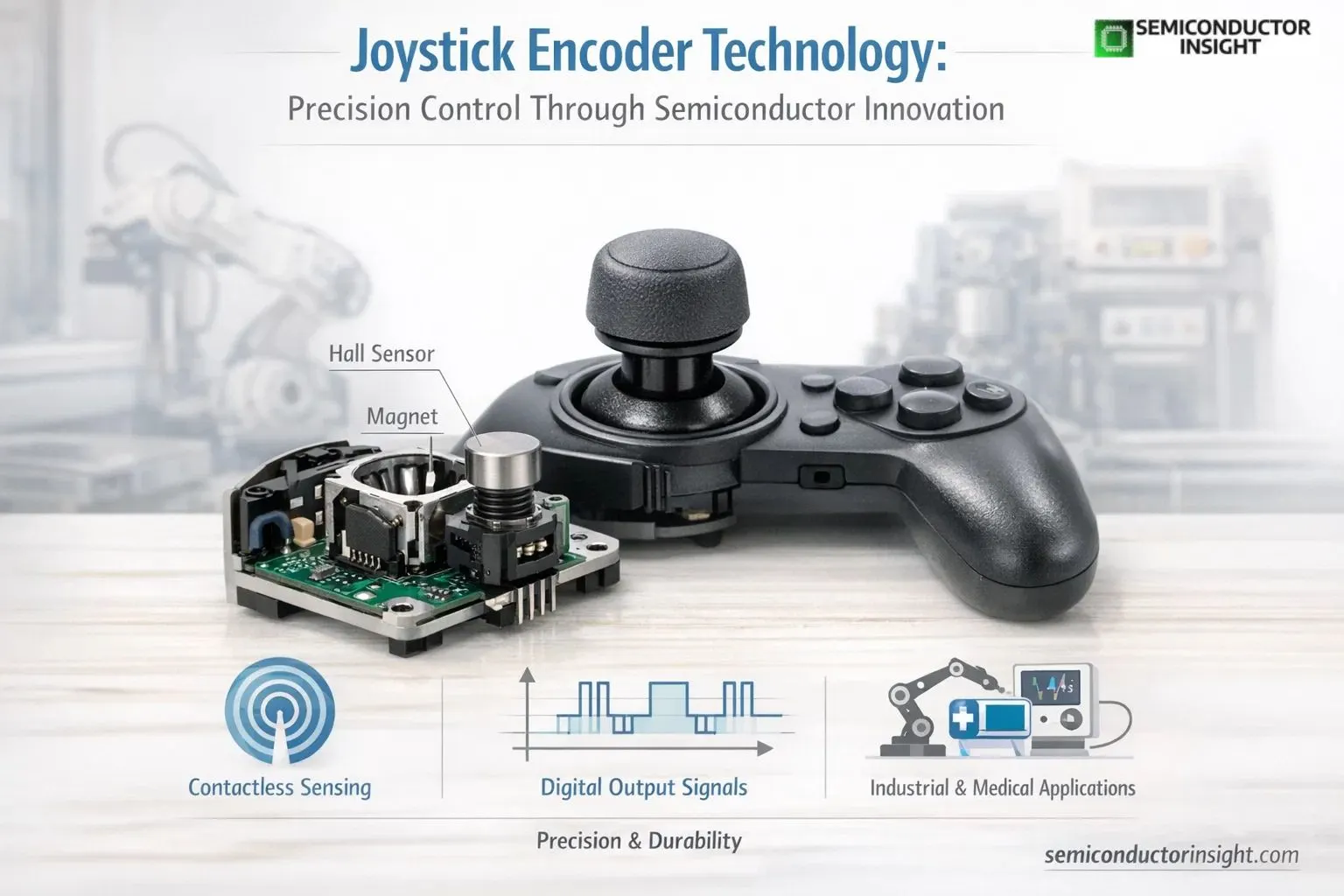
Modern versions integrate semiconductor-based sensors for contactless operation. Hall-effect sensors, which detect changes in magnetic fields without touching anything, now dominate many designs. A small magnet attached to the joystick shaft moves relative to a semiconductor Hall chip, producing a voltage proportional to the position. This approach eliminates mechanical wear, extends lifespan dramatically, and improves precision in environments with dust, vibration, or extreme temperatures.
Current studies describe rotary encoders (closely related to joystick variants) as devices that output digital pulses or absolute position data. In joystick form, they often combine directional sensing with additional features like push-button switches or miniature rotary encoders for scrolling and selection.
- Companies like Nidec Components offer integrated 3-in-1 units that pack a joystick, optical or magnetic encoder, and switch into one compact module, delivering smooth operation and long life in medical equipment or industrial panels.
Semiconductor Innovations Powering Precision Control
- Semiconductors form the backbone of today’s joystick encoders. Linear Hall-effect sensors, fabricated on standard CMOS processes, provide ratiometric analog outputs that remain stable across wide temperature ranges.
- Manufacturers embed these tiny chips directly into the encoder housing, often with built-in signal conditioning to reduce noise and improve resolution.
- Magnetic sensing has largely replaced older resistive methods in high-reliability applications. Hall-effect joysticks offer contactless measurement, resisting contamination and delivering consistent performance over millions of cycles.
- Recent articles highlight how these sensors enhance gaming controllers by minimizing drift the gradual loss of centering accuracy that plagues potentiometer-based sticks.
- In industrial settings, encoders integrate with microcontrollers for advanced features like programmable dead zones, customizable sensitivity, and digital interfaces such as USB or CAN bus.
- Some designs even incorporate TMR (tunnel magnetoresistance) sensors for higher sensitivity and better stray-field immunity, especially useful near electric motors or in automotive environments.
Gaming Controllers: Where Precision Meets Player Experience
The explosion of gaming has placed joystick encoders under intense scrutiny. Gamers demand zero-latency response and rock-solid centering, especially in competitive esports or immersive simulation titles. Hall-effect joysticks have gained traction here because they avoid the stick drift common in older designs. Articles from 2023 – 2024 note that major controller makers began shifting toward magnetic sensing for analog sticks, promising lifespans exceeding 3 – 5 million cycles compared to traditional potentiometers that might degrade after 1 – 2 million operations.
The global games market reached an estimated $197 billion in 2025, with strong growth in PC and console segments driving demand for better input devices. High-end flight simulators, racing wheels, and fighting game controllers increasingly use multi-axis joystick encoders with semiconductor feedback for realistic force simulation and precise movement tracking.
Thumbstick modules in gamepads often combine two-axis Hall sensors with push functions. This integration allows developers to map complex actions like camera control plus weapon selection without additional buttons. As cloud gaming and portable devices grow, compact, low-power semiconductor encoders help maintain battery life while delivering console-quality control.
Before wrapping up, check out our latest exclusive report for deeper insights: https://semiconductorinsight.com/report/joystick-encoder-market/
Industrial and Robotics Applications Driving Robust Designs
Beyond entertainment, joystick encoders play critical roles in heavy machinery, robotics, and automation. Operators of cranes, excavators, or material-handling equipment rely on rugged joysticks that withstand harsh conditions. Semiconductor-based magnetic encoders provide reliable position data even when exposed to oil, dirt, or vibration.
In robotics, these devices serve as intuitive human-machine interfaces for teleoperation or teaching pendant controls. A well-designed joystick encoder can translate subtle hand movements into smooth robotic arm motions, improving safety and productivity. Case studies in automation highlight how contactless Hall sensors reduce maintenance downtime compared to mechanical alternatives.
Medical equipment offers another demanding arena. Joysticks control surgical robots, patient beds, or mobility scooters, where precision and long-term reliability are non-negotiable. Integrated encoder modules with push switches allow single-handed operation, freeing medical staff to focus on the task. Temperature stability from -40°C to +85°C or higher, achieved through advanced semiconductor packaging, ensures performance in operating rooms or outdoor vehicles.
Semiconductor Supply Chain and Broader Encoder Ecosystem
- Joystick encoders are part of the larger encoder market, which supports motion control across industries.
- While exact standalone figures for joystick variants are specialized, the overall encoder sector reflects strong demand for precise feedback in automation and consumer electronics. Semiconductor fabs produce the Hall chips, ASICs for signal processing, and supporting components that make these devices possible.
- Advancements in CMOS fabrication have shrunk sensor die sizes while improving performance, allowing more features in smaller packages. This benefits portable gaming devices and compact industrial handsets alike.
- Government initiatives promoting domestic semiconductor manufacturing and automation indirectly support growth in encoder-related technologies by strengthening supply chains for critical components.
- Looking ahead, integration with wireless protocols and AI-driven adaptive sensitivity could further evolve these devices. Semiconductor progress in low-power design and edge processing will likely enable smarter joysticks that learn user preferences or compensate for environmental factors in real time.
Joystick encoders exemplify how semiconductor innovation turns simple mechanical gestures into reliable, high-performance control. Whether you’re piloting a virtual aircraft, directing a robotic arm, or operating heavy equipment, these unassuming components powered by tiny silicon sensors deliver the precision that modern applications demand. As gaming, automation, and human-machine interfaces continue advancing, expect even tighter integration between mechanical design and semiconductor intelligence to shape the next generation of control solutions.

Comments (0)