
Joystick Encoder Market Insights
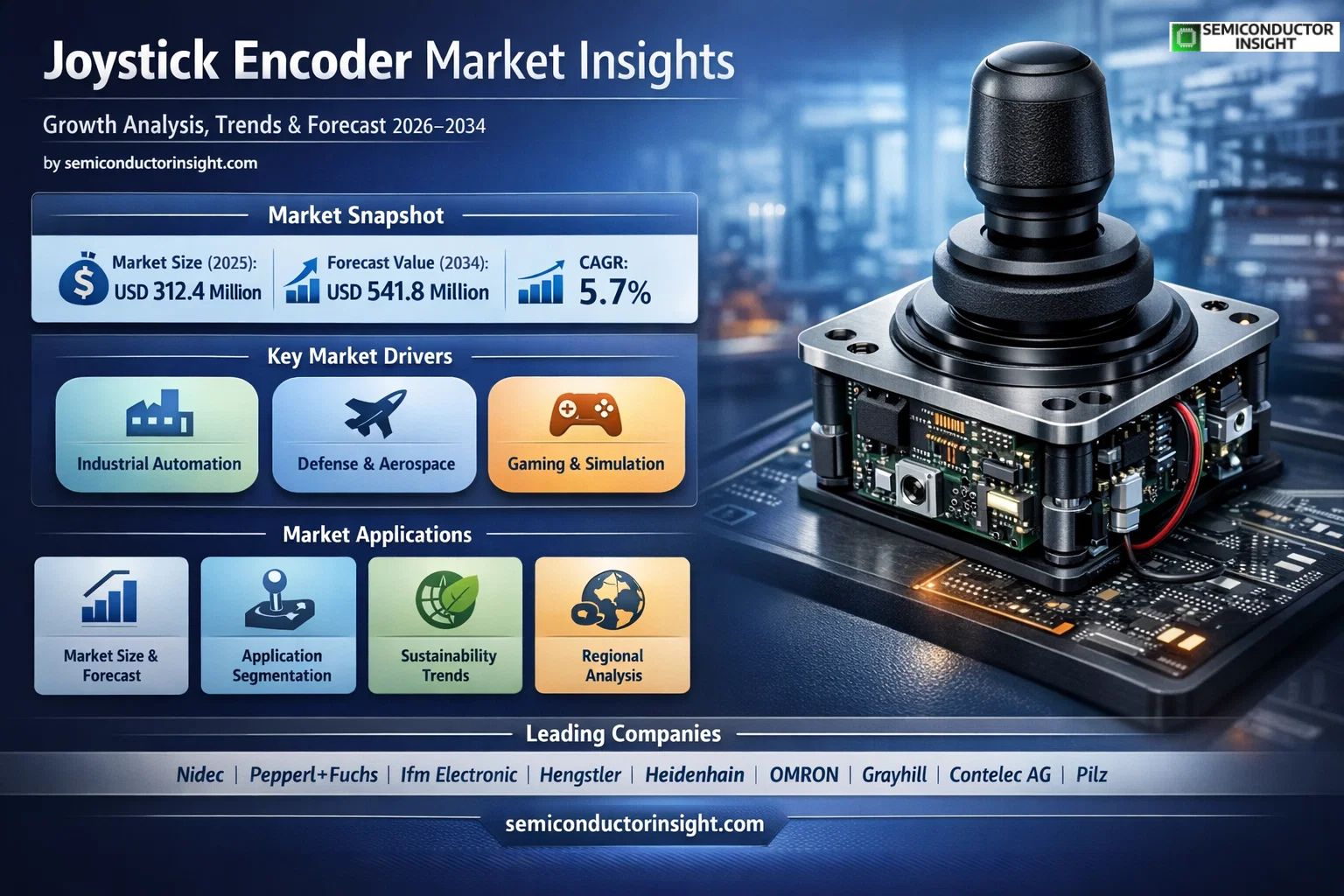
Global Joystick Encoder market size was valued at USD 312.4 million in 2025. The market is projected to grow from USD 328.6 million in 2026 to USD 541.8 million by 2034, exhibiting a CAGR of 5.7% during the forecast period.
A joystick encoder is an electronic component designed to accurately detect and convert the physical movements of a joystick — including rotation and tilt — into precise digital signals. These signals are transmitted to a control system or computer for further processing and operational control. The core function of the encoder is to translate the position or angular displacement of the joystick into a corresponding electronic signal, enabling precise positioning, directional guidance, and real-time motion control across a wide range of applications. Joystick encoders are broadly categorized into Analog Type, Digital Type, and other emerging variants, each tailored to specific performance and integration requirements.
The market is gaining considerable momentum, driven by expanding adoption across industrial automation, automotive systems, and advanced digital products. Growing demand for high-precision motion control in robotics, heavy machinery, and human-machine interface (HMI) applications continues to accelerate product development. Furthermore, the increasing integration of joystick encoders in next-generation automotive controls and medical devices is broadening the addressable market. Key manufacturers operating in this space include Nidec Corporation, Pepperl+Fuchs, Ifm electronic, Hengstler, Heidenhain, OMRON, Grayhill, Inc., JR Merritt, Contelec AG, and Pilz, among others, collectively maintaining a significant share of global revenue and continuing to invest in product innovation and strategic partnerships.
MARKET DRIVERS
Rising Demand from Industrial Automation and Robotics Applications
joystick encoder market is experiencing sustained growth driven by the accelerating adoption of industrial automation across manufacturing, logistics, and heavy machinery sectors. As factories and production facilities increasingly integrate programmable logic controllers (PLCs) and human-machine interfaces (HMIs), the need for precise motion control input devices has risen considerably. Joystick encoders serve as a critical interface component in these environments, translating operator movements into accurate digital signals that guide robotic arms, cranes, and automated guided vehicles (AGVs). The ongoing transition toward Industry 4.0 frameworks continues to reinforce the relevance of high-resolution encoder-based joystick systems in complex operational settings.
Expanding Use in Defense, Aerospace, and Simulation Systems
Defense modernization programs across North America, Europe, and the Asia-Pacific region are fueling substantial demand for ruggedized joystick encoders capable of withstanding extreme environmental conditions. Military ground vehicles, unmanned aerial vehicles (UAVs), naval control systems, and flight simulators all require encoders that deliver high precision, low latency, and long operational life. joystick encoder market benefits significantly from government procurement initiatives focused on upgrading legacy control systems with digitally enhanced alternatives. Additionally, the commercial aviation and space exploration sectors are investing in advanced simulation platforms that depend on encoder-integrated joystick assemblies for training and mission-critical applications.
➤ As industrial automation spending grows globally and defense modernization accelerates, joystick encoder manufacturers are well-positioned to capitalize on demand for precision, durability, and digital integration in motion control solutions.
The growth of the gaming and entertainment industry also plays a meaningful supporting role in shaping encoder technology innovation. While consumer-grade joysticks differ from industrial-grade encoders, technological cross-pollination between these segments has helped reduce production costs and improve sensor accuracy. Professional simulation centers, medical robotic surgery systems, and underwater remotely operated vehicles (ROVs) are among the diverse end-use applications continuously expanding the total addressable market for joystick encoder solutions worldwide.
MARKET CHALLENGES
Technical Complexity and Integration Barriers in Legacy Systems
One of the foremost challenges facing joystick encoder market is the technical difficulty associated with integrating modern encoder-based joystick systems into existing legacy infrastructure. Many industrial facilities operate aging control architectures that were not originally designed to accommodate high-resolution digital encoders, requiring costly retrofitting, firmware updates, and compatibility engineering. This integration burden can delay adoption timelines and increase total deployment costs, particularly for small and medium-sized enterprises (SMEs) with limited capital expenditure budgets. Engineers must often customize encoder signal outputs to match legacy communication protocols, adding complexity to procurement and installation processes.
Other Challenges
Supply Chain Disruptions and Component Shortages
Global semiconductor shortage that emerged in recent years has had a cascading effect on the precision components used in joystick encoder assemblies, including optical sensors, microcontrollers, and signal processing chips. Manufacturers in joystick encoder market have faced extended lead times, increased raw material costs, and inventory management difficulties that have strained production capacity and delivery schedules.
Intense Price Competition from Low-Cost Regional Manufacturers
Established encoder manufacturers operating in North America and Western Europe face mounting pricing pressure from lower-cost producers based in China and other parts of Asia. While quality differentials exist, budget-sensitive buyers in emerging markets often prioritize upfront cost over long-term durability, creating a competitive environment that can compress profit margins for premium joystick encoder brands.
Lack of Standardization Across Industries
The absence of universally accepted technical standards for joystick encoder interfaces, signal formats, and environmental ratings creates fragmentation across industry verticals. This lack of standardization forces manufacturers to maintain a broader and more costly product portfolio to address divergent customer requirements across defense, industrial, medical, and marine segments of joystick encoder market.
MARKET RESTRAINTS
High Development and Certification Costs Limiting Market Entry
The development of reliable, high-performance joystick encoders demands significant investment in research and development, precision manufacturing equipment, and rigorous quality assurance testing. For applications in regulated sectors such as aerospace, defense, and medical robotics, products must meet stringent certification requirements including MIL-SPEC standards, CE marking, and industry-specific safety compliance mandates. These certification processes are both time-intensive and financially demanding, creating substantial barriers to entry for new competitors and limiting the speed at which innovative encoder technologies can reach commercial markets. joystick encoder market thus remains partially consolidated among established players with the resources to navigate these regulatory hurdles.
Limited Awareness and Adoption in Price-Sensitive Emerging Markets
While industrial automation is gaining momentum in developing economies across Southeast Asia, Latin America, and parts of Africa, widespread adoption of precision joystick encoder technology remains constrained by cost sensitivity and a lack of technical awareness among end users. Many operators in these regions continue to rely on mechanical or lower-precision input devices, viewing encoder-based solutions as cost-prohibitive upgrades. The absence of robust local distribution networks and after-sales technical support infrastructure further slows penetration of joystick encoder market in these high-growth geographic territories, restraining what could otherwise be a significant expansion opportunity for global manufacturers.
MARKET OPPORTUNITIES
Growth Potential in Medical Robotics and Minimally Invasive Surgery Platforms
The rapid advancement of robotic-assisted surgical systems and minimally invasive medical devices represents a compelling growth frontier for joystick encoder market. Surgical robots require ultra-precise motion control inputs with sub-millimeter accuracy, zero signal drift, and highly responsive feedback mechanisms — characteristics that advanced joystick encoders are uniquely positioned to provide. As hospitals and surgical centers worldwide continue to invest in robotic surgery capabilities, demand for specialized medical-grade encoder components is projected to increase meaningfully over the coming years.
Emerging Opportunities in Autonomous Vehicles and Remote-Operated Machinery
Global push toward autonomous vehicle technology and remote-operated heavy equipment is creating new application avenues for joystick encoder manufacturers. Construction, mining, and agriculture sectors are increasingly deploying teleoperated and semi-autonomous machinery where precise remote control interfaces are essential for operational safety and efficiency. Joystick encoders embedded within operator control stations enable reliable command transmission over wireless and wired networks in these demanding field environments. joystick encoder market stands to benefit considerably as adoption of remote-operated systems accelerates, particularly in geographically hazardous or labor-scarce operational contexts where human-operated machinery is being supplemented or replaced by digitally controlled alternatives.
Technological Advancement Through Contactless and Magnetic Encoder Innovations
Innovations in contactless encoder technology, particularly magnetic and Hall-effect based sensing mechanisms, are unlocking new performance benchmarks for joystick encoder products in terms of longevity, resistance to contamination, and maintenance-free operation. Unlike optical encoders, contactless variants are inherently more resilient in environments exposed to dust, moisture, vibration, and temperature extremes — conditions common in industrial and outdoor applications. As these technologies mature and their production costs decline, manufacturers in joystick encoder market have an opportunity to differentiate their product portfolios and capture premium market segments where reliability and total cost of ownership are prioritized over initial acquisition price.
Trends
Growing Demand Across Industrial Automation and Digital Control Systems
joystick encoder market is witnessing notable growth driven by the rapid expansion of industrial automation, robotics, and precision control applications. Joystick encoders, which convert physical joystick movements such as rotation and tilt into digital signals, are increasingly being integrated into control systems that require high accuracy and real-time feedback. As manufacturing facilities and process industries continue to invest in automation infrastructure, the demand for reliable motion-sensing and position-detection components like joystick encoders continues to strengthen across global markets.
A key trend shaping joystick encoder market is the accelerating adoption of these components in the automotive sector. Modern vehicles, particularly those featuring advanced driver-assistance systems (ADAS) and in-cabin control interfaces, rely on precision input devices that can translate operator intent into actionable electronic signals. Joystick encoders fulfill this role effectively, making them a sought-after component among automotive electronics manufacturers. This trend is particularly evident in regions with strong automotive production bases, including Germany, Japan, South Korea, and the United States.
Other Trends
Shift Toward Digital Encoder Technology
Within joystick encoder market, there is a clear industry shift from analog to digital encoder configurations. Digital joystick encoders offer improved signal accuracy, reduced susceptibility to electrical noise, and greater compatibility with modern microcontroller and programmable logic controller (PLC) ecosystems. This technological transition is being embraced by sectors such as medical equipment manufacturing, aerospace, and heavy machinery, where precision and signal integrity are non-negotiable operational requirements.
Expansion in Digital Products and Consumer Electronics
The digital products application segment represents a growing avenue for joystick encoder deployment. Gaming peripherals, professional simulation equipment, and interactive consumer electronics are increasingly incorporating encoder-based joystick mechanisms to deliver enhanced user experiences. Manufacturers operating in this space are focusing on compact form factors, longer operational lifespans, and improved tactile feedback, all of which align with evolving end-user expectations in the consumer electronics ecosystem.
Regional Market Dynamics
Asia-Pacific, led by China, Japan, South Korea, and Southeast Asia, continues to represent a dominant production and consumption hub within joystick encoder market. The region benefits from a dense concentration of electronics manufacturers, cost-competitive supply chains, and strong government support for industrial modernization. North America, particularly the United States, maintains significant market activity driven by defense, aerospace, and industrial automation end-use sectors.
Competitive Landscape and Innovation Activity
The competitive environment within joystick encoder market is characterized by the presence of established global players such as Nidec Corporation, Pepperl+Fuchs, Ifm Electronic, Hengstler, Heidenhain, OMRON, and Grayhill, Inc., among others. These manufacturers are actively investing in product innovation, focusing on enhanced encoder resolution, ruggedized designs for harsh environments, and improved integration with digital communication protocols such as CANopen and EtherCAT. Strategic collaborations, product portfolio expansions, and geographic market penetration remain primary competitive strategies adopted across the industry.
COMPETITIVE LANDSCAPE
Key Industry Players
Global Joystick Encoder Market — Competitive Dynamics, Key Manufacturers, and Strategic Positioning
Global joystick encoder market is characterized by a moderately consolidated competitive landscape, with a handful of established players commanding a significant share of total revenues. Nidec Corporation stands out as one of the dominant forces in this space, leveraging its deep expertise in motion control and precision electronic components to offer highly reliable encoder solutions across industrial, automotive, and digital product applications. Alongside Nidec, companies such as Heidenhain and Pepperl+Fuchs have reinforced their market positions through continuous investment in R&D, technological innovation, and a broad portfolio of both analog and digital encoder types. The top five global players collectively accounted for a substantial portion of total market revenue in 2025, underscoring the competitive concentration that defines this sector. Market leaders differentiate themselves through product accuracy, signal resolution, environmental durability, and integration compatibility with modern control systems — factors that are increasingly critical as joystick encoders find wider adoption in robotics, heavy machinery, and advanced automotive platforms.
Beyond the top-tier manufacturers, a number of niche yet significant players contribute meaningfully to the joystick encoder ecosystem. OMRON and Ifm electronic have carved out strong positions in industrial automation segments, while Grayhill, Inc. and JR Merritt are well-regarded for ruggedized joystick encoder solutions suited to harsh-environment applications such as construction equipment and military systems. Contelec AG and Pilz bring specialized competencies in safety-rated encoder systems, addressing the growing regulatory demand for functional safety in industrial controls. Renishaw, known for its precision measurement technologies, and Yuheng Optics Co., Ltd., a key Asian manufacturer, add further depth to the competitive field. Adafruit caters to the prototyping and maker segment with accessible, low-cost encoder modules. The market continues to attract competition from regional manufacturers, particularly in Asia-Pacific, where cost-competitive production and expanding domestic demand are reshaping Global supply landscape. Strategic mergers, acquisitions, and technology partnerships are expected to further intensify competition through the forecast period to 2034.
List of Key Joystick Encoder Companies Profiled
- Nidec Corporation
- Pepperl+Fuchs
- Ifm Electronic
- Hengstler
- Heidenhain
- OMRON
- Grayhill, Inc.
- JR Merritt
- Contelec AG
- Pilz
- Renishaw
- Adafruit
- Yuheng Optics Co., Ltd.
Segment Analysis:
| Segment Category | Sub-Segments | Key Insights |
| By Type |
|
Analog Type continues to hold a prominent position in joystick encoder market, driven by its well-established compatibility with legacy industrial control systems and its inherent ability to deliver smooth, continuous positional feedback without signal latency.
|
| By Application |
|
Mechanics represents one of the most significant application segments for joystick encoders, encompassing industrial machinery, crane systems, and heavy equipment where precise motion control and positional feedback are indispensable for safe and efficient operations.
|
| By End User |
|
Industrial & Manufacturing end users constitute the dominant consumer base for joystick encoders globally, as the sector’s relentless push toward automation, robotics integration, and precision machine control continues to fuel sustained demand for reliable and durable encoder solutions.
|
| By Technology |
|
Optical Encoders are recognized as a leading technology segment within joystick encoder market, renowned for delivering exceptionally high resolution, accuracy, and repeatability in position sensing, making them the preferred choice for precision-critical applications in industrial automation and robotics.
|
| By Axis Configuration |
|
Dual-Axis Joystick Encoders represent the most widely adopted configuration across the majority of commercial and industrial applications, owing to their ability to simultaneously capture bidirectional positional data along both horizontal and vertical planes, enabling intuitive and comprehensive motion control for operators.
|
Regional Analysis: Joystick Encoder Market
North America
The United States defense sector remains one of the most significant end-users of joystick encoder technology in North America. Military unmanned aerial vehicles, combat simulation platforms, and naval control systems rely heavily on high-precision encoders to ensure reliable and accurate directional input. Ongoing defense modernization programs continue to generate consistent procurement demand, making this vertical a cornerstone of the regional joystick encoder market’s growth trajectory.
North America hosts a globally influential gaming and professional simulation industry that drives considerable demand for advanced joystick encoder components. Flight simulators, surgical training platforms, and immersive entertainment systems demand encoders capable of delivering seamless, low-latency positional feedback. The region’s concentration of leading simulation technology companies ensures a steady pipeline of innovation, sustaining long-term demand across both consumer and enterprise segments of joystick encoder market.
The rapid integration of automation solutions across North American manufacturing facilities has elevated the role of joystick encoders in process control and material handling applications. Factories adopting collaborative robotics and smart machinery increasingly depend on precise encoder feedback for safe and efficient human-machine interaction. This industrial shift, supported by government initiatives encouraging domestic manufacturing competitiveness, positions joystick encoder market for continued regional expansion well into the forecast period.
North America’s strong research and development culture fosters continuous improvement in joystick encoder design, including advancements in contactless sensing technology, miniaturization, and environmental ruggedization. Universities, national laboratories, and private sector R&D centers collaborate to push the boundaries of encoder performance. This innovation-driven environment enables North American manufacturers to maintain a competitive edge globally, offering differentiated joystick encoder solutions that command premium positioning across international markets.
Europe
Europe represents a highly significant region within Global joystick encoder market, underpinned by its well-established industrial machinery sector, precision engineering heritage, and progressive adoption of automation technologies. Germany, in particular, serves as a manufacturing powerhouse where joystick encoders are widely deployed across automotive production lines, robotics systems, and heavy industrial equipment. The region’s commitment to engineering excellence ensures that encoder components meet the highest quality and reliability standards. Scandinavia contributes notable demand through its maritime and offshore industries, where ruggedized joystick encoder systems are essential for vessel control and offshore platform management. European Union regulations promoting workplace safety and operational efficiency further accelerate encoder adoption across industrial settings. Additionally, the growing emphasis on renewable energy infrastructure, including wind turbine control systems, presents new application avenues for joystick encoder technology, reinforcing Europe’s sustained and diversified demand profile throughout the forecast period.
Asia-Pacific
Asia-Pacific is emerging as the fastest-growing regional market for joystick encoders, propelled by aggressive industrialization across China, Japan, South Korea, and India. China’s expansive manufacturing base and government-backed initiatives to modernize industrial processes have created substantial demand for motion-control components, including joystick encoders, across factory automation, construction equipment, and consumer electronics. Japan’s leadership in robotics and precision machinery development continues to generate sophisticated encoder requirements, while South Korea’s advanced electronics manufacturing sector drives demand for compact, high-performance encoder solutions. India’s infrastructure development boom and increasing defense modernization investments are further broadening the regional application landscape. The presence of a growing base of local encoder manufacturers, combined with strong technology transfer from global players establishing regional operations, positions Asia-Pacific as a pivotal arena in shaping the future trajectory of Global joystick encoder market over the coming decade.
South America
South America presents a developing yet increasingly relevant market for joystick encoders, with Brazil serving as the primary regional driver due to its sizeable industrial base encompassing agriculture, mining, and oil and gas extraction. In these sectors, joystick-controlled equipment is fundamental to operational efficiency, creating consistent demand for reliable encoder components capable of withstanding harsh environmental conditions. Argentina and Chile contribute incremental market activity through their mining and energy industries, where remote-controlled machinery and specialized industrial equipment rely on joystick encoder systems for precise operational control. While the region faces challenges related to economic volatility and infrastructure constraints that may temper market expansion, improving investment climates and growing foreign direct investment in industrial automation are gradually strengthening joystick encoder market’s foothold across South America, offering meaningful long-term growth potential as regional industries continue to modernize and mechanize their operations.
Middle East & Africa
The Middle East and Africa region occupies a nascent but progressively important position in Global joystick encoder market, with growth predominantly driven by the oil and gas industry, construction sector, and expanding defense modernization programs. Gulf Cooperation Council nations, particularly Saudi Arabia and the United Arab Emirates, are actively investing in industrial diversification initiatives that stimulate demand for advanced automation components, including joystick encoders used in drilling equipment, cranes, and process control systems. Africa’s growing mining industry, particularly in sub-Saharan nations, generates demand for ruggedized joystick encoder solutions suited to demanding operational environments. While market penetration remains comparatively limited relative to more mature regions, infrastructure development projects, rising foreign investment, and increasing awareness of automation benefits are collectively laying a favorable foundation for joystick encoder market to gain meaningful traction across the Middle East and Africa throughout the forecast horizon.
Report Scope
This market research report provides a comprehensive analysis of joystick encoder market, covering the forecast period 2026–2034. It offers detailed insights into market dynamics, technological advancements, competitive landscape, and key trends shaping the industry.
Key focus areas of the report include:
- Market Overview: The report begins with an overview outlining its current market scenario, key growth indicators, and industry transformation drivers. It discusses macroeconomic factors, demand–supply balance, regulatory landscape, and the strategic role of joystick encoders in powering advancements across industries such as automotive, digital products, mechanics, and industrial automation.
- Market Size & Forecast: Historical data and future projections for revenue, unit shipments, and market value across major regions and segments.
- Segmentation Analysis: Detailed breakdown by product type (Analog Type, Digital Type, Others), application (Digital Products, Automotive, Mechanics, Others), and end-user industry to identify high-growth segments and investment opportunities.
- Regional Insights: Insights into market performance across North America, Europe, Asia-Pacific, Latin America, and the Middle East & Africa, including country-level analysis where relevant.
- Competitive Landscape: Profiles of leading market participants, including their product offerings, R&D focus, manufacturing capacity, pricing strategies, and recent developments such as mergers, acquisitions, and partnerships.
- Technology Trends & Innovation: Assessment of emerging technologies, integration of AI/IoT, encoder design trends, fabrication techniques, and evolving industry standards.
- Market Drivers & Restraints: Evaluation of factors driving market growth along with challenges, supply chain constraints, regulatory issues, and market-entry barriers.
- Stakeholder Insights: Insights for component suppliers, OEMs, system integrators, investors, and policymakers regarding the evolving ecosystem and strategic opportunities.
Primary and secondary research methods are employed, including interviews with industry experts, data from verified sources, and real-time market intelligence to ensure the accuracy and reliability of the insights presented.
FREQUENTLY ASKED QUESTIONS:
What is the current market size of joystick encoder market?
-> Global Joystick Encoder Market was valued at USD million in 2025 and is expected to reach USD million by 2034, growing at a CAGR of % during the forecast period.
Which key companies operate in joystick encoder market?
-> Key players include Nidec Corporation, Pepperl Fuchs, Ifm electronic, Hengstler, Heidenhain, OMRON, Grayhill, Inc., JR Merritt, Contelec AG, Pilz, Renishaw, Adafruit, and Yuheng Optics Co., Ltd., among others. In 2025, Global top five players held a share of approximately % in terms of revenue.
What are the key growth drivers of joystick encoder market?
-> Key growth drivers include rising demand for precise motion control in industrial automation, growing adoption of joystick encoders in automotive and digital product applications, and increasing need for accurate position detection and digital signal conversion across control systems and computing platforms.
Which region dominates joystick encoder market?
-> Asia is a significant and fast-growing region in joystick encoder market, with China projected to reach USD million and the U.S. market estimated at USD million in 2025. The market is also well-established across North America and Europe.
What are the emerging trends in joystick encoder market?
-> Emerging trends include integration of digital encoder technologies, growing utilization of Analog Type encoders (projected to reach USD million by 2034 with a % CAGR), advancement in IoT-connected control systems, and expanding applications across automotive, mechanics, and digital product sectors.

Get Sample Report PDF for Exclusive Insights
Report Sample Includes
- Table of Contents
- List of Tables & Figures
- Charts, Research Methodology, and more...
 Download Sample Report PDF


