
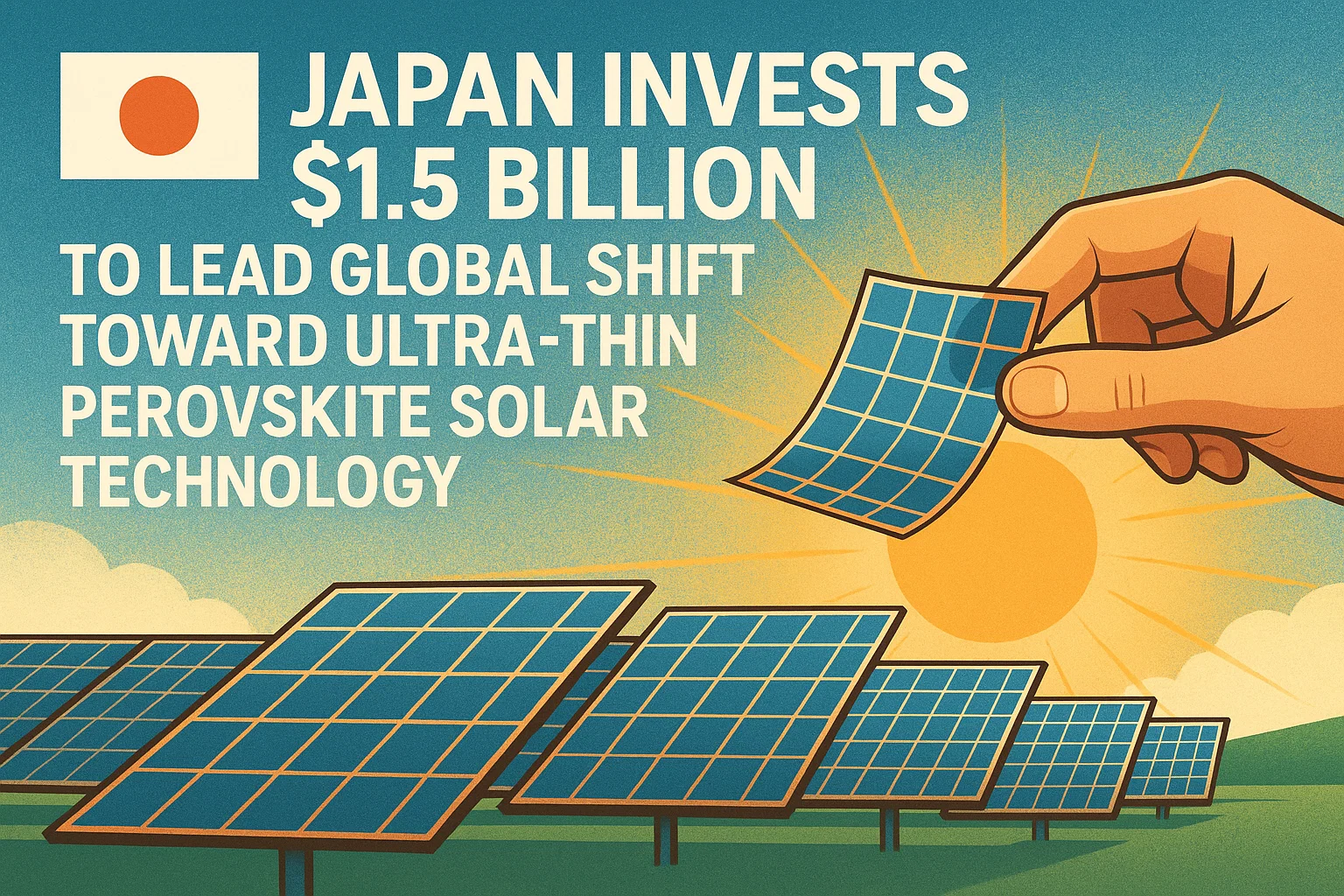
Japan Invests $1.5 Billion to Lead Global Shift Toward Ultra-Thin Perovskite Solar Technology
In an era marked by escalating climate concerns and the pressing need for renewable energy alternatives, perovskite photovoltaic (PV) cells have emerged as a transformative technology in the solar energy landscape. Known for their high efficiency, flexibility, and low manufacturing costs, perovskite solar cells are pushing the boundaries of what’s possible in solar power.
According to recent industry estimates, the Perovskite Photovoltaic Cell Market was valued at US$ 187 million in 2024. It is projected to skyrocket to US$ 2.84 billion by 2032, growing at a remarkable compound annual growth rate (CAGR) of 40.2% from 2025 to 2032. This unprecedented growth is fueled by a surge in research breakthroughs, government support, and commercialization efforts across Asia, Europe, and the Americas.
Access Your Free Sample Report- Perovskite Photovoltaic Cell Market
Understanding Perovskite Solar Cells
Before diving into market dynamics and news, it’s essential to understand what makes perovskite PV cells so revolutionary.
Perovskite materials are a class of compounds with the same crystal structure as the mineral calcium titanium oxide (CaTiO₃). Their photovoltaic efficiency, light absorption range, and manufacturing ease are the primary factors that make them ideal for solar technology. Perovskite PV cells can be:
- Printed using low-cost solution-based techniques
- Incorporated into flexible substrates
- Layered on top of existing silicon cells (tandem structures) for enhanced efficiency
Their potential to deliver twice the performance of traditional silicon cells—at a fraction of the cost—makes them game-changers in clean energy.
Japan’s $1.5 Billion Investment in Ultra-Thin Perovskite Solar Films
In one of the most ambitious national strategies for renewable energy, Japan has committed $1.5 billion to commercialize ultra-thin, flexible perovskite solar panels—an effort led by Sekisui Chemical and other domestic firms.
Key Highlights:
- Funding Allocation:
- ¥157 billion (~$1 billion) for Sekisui’s solar film commercialization
- ¥60 billion previously invested in perovskite R&D
- Product Specification:
- Films just a few microns thick
- Designed for non-flat surfaces, such as stadiums, buses, and buildings
- Energy Targets:
- Power generation equivalent to 20 nuclear reactors by 2040
- Contribution to Japan’s goal of a 50% renewable energy mix
Why It Matters:
Japan’s initiative could enable urban areas and vertical infrastructure—which are not viable for traditional panels—to become energy-generating surfaces. This fundamentally reshapes the solar deployment paradigm, making it far more ubiquitous and adaptive.
Anker Brings Perovskite to the Masses with Smart Solar Umbrella
In a surprising but telling sign of commercialization, Anker Innovations, a consumer tech brand, unveiled the Solix Solar Beach Umbrella—a product embedded with perovskite solar cells.
Features:
- Perovskite PV panels delivering up to 100W output
- USB-C and XT-60 ports for direct device charging
- Claimed 43% efficiency in optimal conditions
- Up to twice the performance of conventional cells in low-light environments
Implication:
While this might appear as a niche gadget, it signals a paradigm shift. Perovskite cells are now crossing into the consumer electronics space, offering portable, decentralized power sources for everyday use—camping, beach trips, and off-grid adventures.
India’s IIT-Bombay Spurs Local Innovation with Tandem Solar Cells
In India, the government is embracing academic innovation to drive domestic leadership in solar energy. At the forefront is IIT-Bombay, where researchers have developed a high-efficiency, low-cost silicon-perovskite tandem cell.
Government Action:
- Plans to invite private investors to fund a solar innovation hub
- Focus on scaling up indigenous technology for domestic and export use
- Potential for technology transfer to Indian solar manufacturers
Strategic Value:
India’s move aligns with its Make in India and Atmanirbhar Bharat (self-reliant India) vision. By backing local R&D and reducing dependence on foreign PV tech, India can simultaneously address climate goals and job creation.
Download Sample Report PDF- Perovskite Photovoltaic Cell Market
Global Research Breakthroughs & Industry Benchmarks
Beyond Japan, India, and consumer tech, major strides in materials science are accelerating commercialization timelines.
Notable Developments:
- Oxford PV (UK): Achieved a certified efficiency of 28.6% with tandem cells—among the highest in the world.
- MIT & NREL (USA): Working on stability-enhanced perovskites, tackling one of the last remaining commercialization hurdles.
- Saule Technologies (Poland): Deployed perovskite panels in commercial buildings, including on office windows and blinds.
- China’s Microquanta Semiconductor: Mass-producing glass-based perovskite modules, aiming to scale output to hundreds of megawatts
Addressing the Challenges
Despite its promise, the perovskite PV sector faces several challenges:
1. Stability & Longevity
- Unlike silicon, perovskites degrade under UV exposure and humidity.
- Current research is focused on encapsulation techniques and additive engineering to improve lifespan to 20+ years.
2. Toxicity Concerns
- Most perovskite cells contain lead, raising environmental and safety concerns.
- Solutions include:
- Lead-free alternatives (e.g., tin-based perovskites)
- Recycling and recovery mechanisms for lead-containing modules
3. Mass Production
- Scaling lab results to gigawatt-scale manufacturing remains a bottleneck.
- However, firms in Japan, China, and Poland are now prototyping roll-to-roll printing lines, similar to newspaper presses, for large-area production.
Key Industry Players and Innovators
| Company | Country | Focus Area |
| Sekisui Chemical | Japan | Ultra-thin flexible PV films |
| Oxford PV | UK | Silicon-perovskite tandem cells |
| Anker Innovations | China/USA | Consumer devices w/ perovskite |
| Saule Technologies | Poland | Wearable and building-integrated PV |
| Microquanta Semiconductor | China | Glass modules for commercial use |
| Tandem PV | USA | Pilot-scale perovskite solar farms |
| First Solar | USA | Exploring tandem integration |
Applications Beyond Rooftops
Perovskite PV cells are no longer limited to traditional rooftop installations. Here are emerging applications that are reshaping solar’s footprint:
- Building-integrated photovoltaics (BIPV): Glass façades and smart windows
- Automotive solar roofs: Powering auxiliary systems in EVs
- Wearables: Smartwatches and fitness gear with integrated solar charging
- Satellites and aerospace: Lightweight PV for space applications
- Agrivoltaics: Semi-transparent panels for dual-use on farmland
Future Outlook and What to Expect by 2032
With the confluence of government backing, technological breakthroughs, and growing climate urgency, perovskite PV cells are on track to become a main pillar of the global solar ecosystem.
By 2032, Expect:
- Mainstream consumer devices powered by flexible solar films
- Skyscrapers and stadiums wrapped in energy-harvesting skins
- Hybrid solar farms combining silicon and perovskite layers
- Global production capacity crossing multi-gigawatt levels
- Significant cost reductions bringing solar below $0.01/kWh in some regions
Click Here To Download Full Sample Report- Perovskite Photovoltaic Cell Market
The Future Is Flexible, Efficient, and Perovskite-Powered
As climate change accelerates the global transition to renewable energy, perovskite photovoltaic cells are poised to lead the next solar revolution. Their unmatched efficiency, versatility, and scalability position them as not just an alternative—but potentially the dominant solar technology of the future.
With the market projected to reach US$ 2.84 billion by 2032, perovskite PV is no longer a “next-gen” technology. It’s now, and it’s expanding across rooftops, gadgets, buildings, and beyond.

Comments (0)