

Is Semiconductor Innovation Fuelling AI Toothbrush with Real Time Brushing Zone Classification Market?
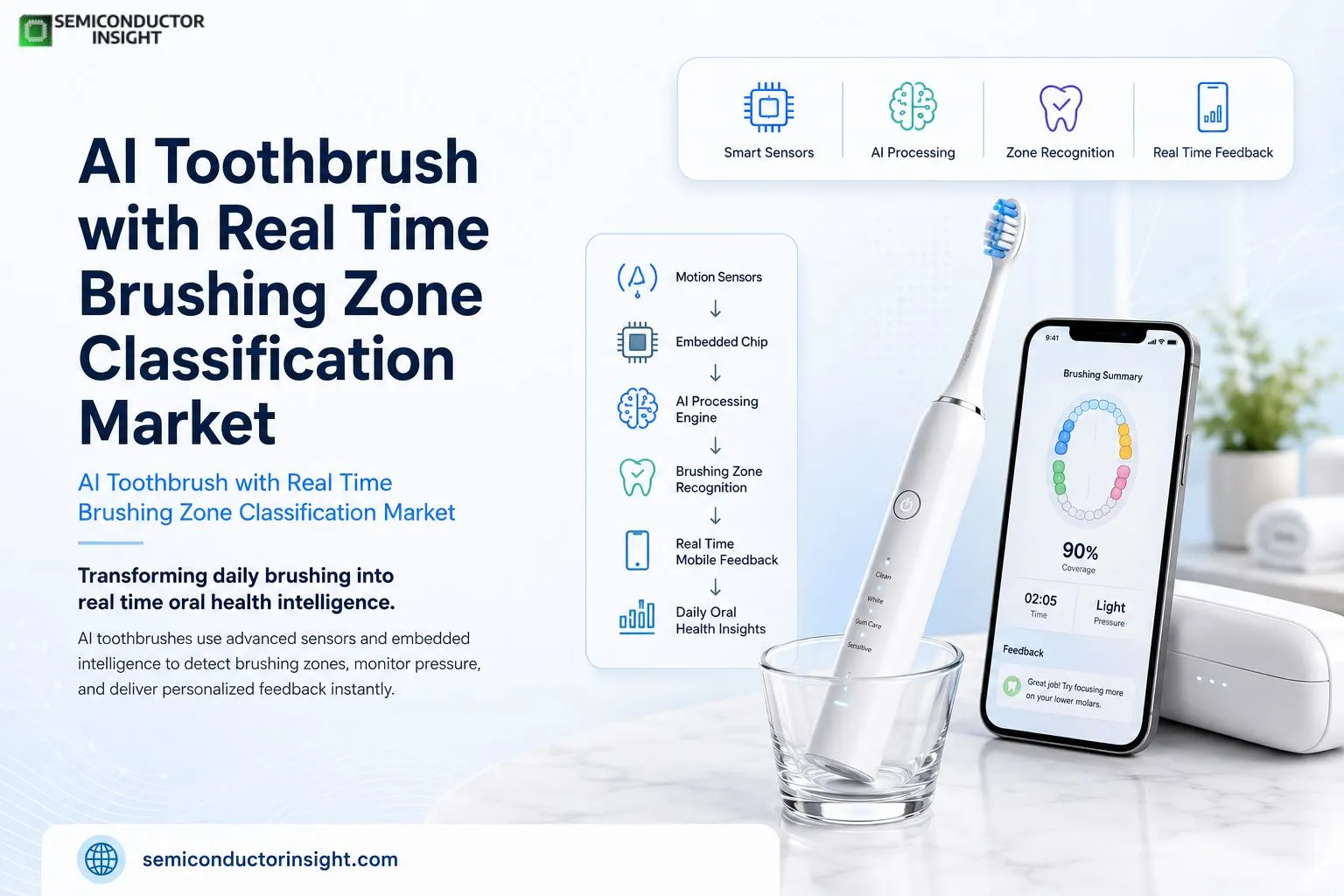
Artificial intelligence is steadily moving beyond smartphones and industrial automation into personal healthcare devices, and one of the most notable examples is AI Toothbrush with Real Time Brushing Zone Classification Market. These intelligent devices combine semiconductor sensors, embedded processors, motion tracking, pressure detection, Bluetooth connectivity, and machine learning algorithms to evaluate brushing patterns as they happen.
Rather than simply timing a brushing session, modern AI-powered toothbrushes identify individual areas of the mouth, recognize missed zones, monitor brushing pressure, and provide personalized feedback through companion mobile applications. This convergence of semiconductor technology and digital healthcare is creating a new category of connected wellness devices.
The technology relies heavily on miniature semiconductor components. Most premium AI toothbrushes integrate microcontrollers, six-axis inertial measurement units (IMUs) containing accelerometers and gyroscopes, pressure sensors, wireless communication chips, rechargeable battery management integrated circuits, and increasingly, low-power AI processors capable of performing edge inference without relying entirely on cloud computing.
- According to the World Health Organization (WHO), oral diseases affect nearly 5 billion people worldwide, while untreated dental caries in permanent teeth remains among the most common health conditions globally. These figures explain why preventive technologies are receiving growing attention from both healthcare providers and consumer electronics manufacturers.
Recent consumer adoption reflects broader digital health trends. Industry reports from Bluetooth SIG, government health agencies, and electronics publications indicate that billions of Bluetooth-enabled devices are shipped globally each year, creating a mature ecosystem for connected healthcare products. Meanwhile, the American Dental Association (ADA) continues recommending brushing twice daily for approximately two minutes, a guideline increasingly supported through AI-assisted coaching that improves brushing consistency rather than simply measuring duration.
Inside the Intelligence Engine
Motion Sensors
│
▼
Embedded Semiconductor Chip
│
▼
AI Processing Engine
│
▼
Brushing Zone Recognition
│
▼
Real Time Mobile Feedback
│
▼
Daily Oral Health Insights
Manufacturers are now moving beyond simple activity tracking toward real-time classification models capable of recognizing individual brushing zones with remarkable precision. Deep learning algorithms compare movement patterns against trained datasets, allowing the toothbrush to distinguish upper molars, lower incisors, front teeth, and gumline regions. Some premium devices can even detect excessive pressure that may contribute to gum recession and enamel wear, prompting users to adjust brushing technique immediately.
Another emerging trend is the integration of AI toothbrushes into broader digital health ecosystems. Companion applications increasingly synchronize brushing history with wellness dashboards, family healthcare accounts, and tele-dentistry platforms. During virtual consultations, dentists can review brushing frequency, coverage consistency, and long-term oral hygiene habits instead of relying solely on patient recollection. This data-driven approach supports more personalized preventive care while encouraging better daily habits.
Take a moment to check our latest report before moving forward: https://semiconductorinsight.com/report/ai-toothbrush-with-real-time-brushing-zone-classification-market/
Semiconductor Innovation Behind Every Brush
MEMS Sensors
│
├── Motion Detection
├── Orientation Tracking
├── Pressure Measurement
└── Battery Optimization
│
▼
Low Power AI Chip
│
▼
Real Time Decision Making
Research activity surrounding edge AI is also influencing product development. Instead of transmitting every movement to cloud servers, newer embedded processors perform classification directly on the device, reducing latency, conserving battery life, and improving user privacy. Semiconductor companies continue introducing ultra-low-power microcontrollers with dedicated neural processing capabilities, enabling sophisticated AI inference while maintaining weeks of operation from a single charge.
A parallel development can be observed in pediatric dentistry. AI-powered toothbrushes increasingly incorporate interactive coaching, animated rewards, and gamification techniques designed to encourage proper brushing among children. Healthcare professionals have highlighted that behavioral engagement remains one of the most effective methods for improving long-term oral hygiene compliance, making AI-assisted coaching particularly valuable for younger users.
Connected Living beyond the Bathroom
- Smart oral care devices are increasingly designed to operate within connected home ecosystems rather than as standalone electronics. Brands including Google through Google Home, Amazon through Alexa, Apple through Apple Health, and Samsung through SmartThings demonstrate how health-related devices can exchange data across broader smart-home environments.
- Although AI toothbrush integration remains limited compared with lighting or security systems, manufacturers are increasingly designing companion apps that synchronize with health platforms, voice assistants, wearable devices, and family wellness dashboards. This interoperability reflects a growing expectation that personal healthcare electronics should communicate seamlessly with other connected technologies in everyday life.
- Current product innovation also reflects sustainability priorities. Rechargeable lithium-ion batteries, replaceable brush heads, recyclable packaging, and energy-efficient semiconductor architectures are becoming common design objectives.
- By combining intelligent sensing, embedded AI, and cloud-connected analytics, manufacturers are reducing power consumption while delivering increasingly advanced healthcare insights.
AI Toothbrush with Real Time Brushing Zone Classification Market therefore represents more than an evolution of traditional oral care products. It illustrates how semiconductor miniaturization, embedded artificial intelligence, MEMS sensing technologies, and connected healthcare platforms are converging to transform a routine daily activity into a source of clinically useful, personalized health intelligence.
As digital dentistry continues to expand worldwide, these intelligent devices are expected to become an increasingly important part of preventive healthcare rather than simply another consumer gadget.

Comments (0)