
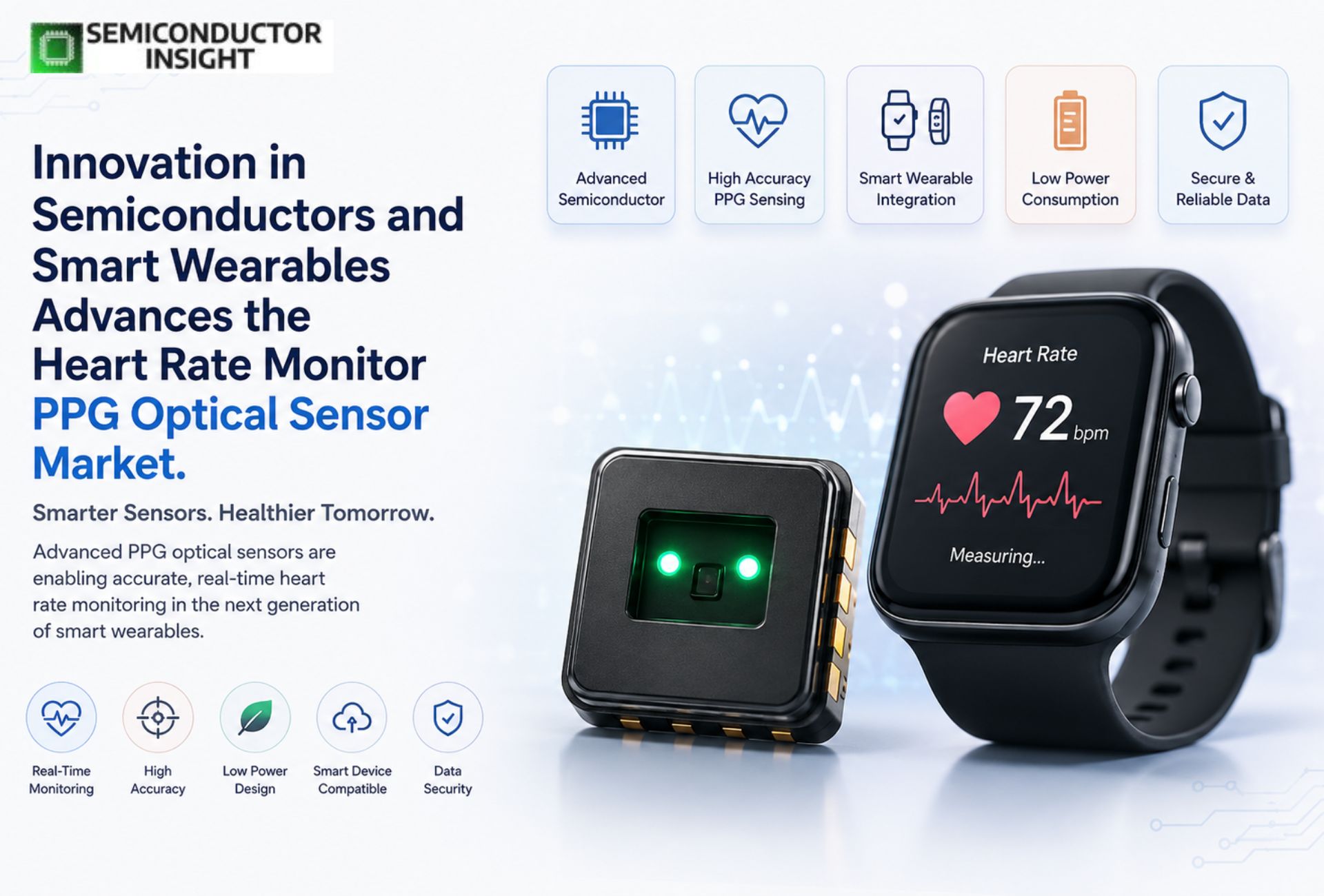
Innovation in Semiconductors and Smart Wearables Advances the Heart Rate Monitor PPG Optical Sensor Market
Innovation in Semiconductors and Smart Wearables Advances the Heart Rate Monitor PPG Optical Sensor Market
Heart Rate Monitor PPG Optical Sensor market is rapidly transforming from a fitness-focused niche into one of the most important semiconductor-enabled healthcare technologies in consumer electronics. Photoplethysmography, commonly known as PPG, uses light-based sensing technology to detect blood volume changes beneath the skin, allowing smart devices to continuously monitor heart activity in real time. What once appeared mainly in premium fitness bands has now become a standard feature in smartwatches, earbuds, healthcare patches, and even smart rings.
The growing integration of semiconductor miniaturization, AI-enabled signal processing, and low-power sensor architectures is significantly improving the precision and commercial value of PPG optical sensors. Companies are increasingly developing ultra-compact optical modules capable of functioning continuously without draining battery performance, a critical factor for wearable electronics.
According to industry device shipment data, global smartwatch shipments crossed 225 million units in recent years, while wearable health devices collectively surpassed 500 million active units worldwide. This expanding hardware ecosystem is directly strengthening the need for advanced optical sensing semiconductors.
Semiconductor Packaging Innovation Changes Sensor Performance Standards
- One of the most noticeable shifts in the industry is the rapid advancement in semiconductor packaging for optical biosensors. Traditional heart monitoring systems required bulky sensor arrangements and high energy consumption, limiting adoption in compact devices. Modern semiconductor fabrication techniques now allow manufacturers to integrate photodiodes, LEDs, analog front-end circuits, and signal processing units into highly compressed sensor packages.
- Green LEDs remain widely used in heart rate monitoring because hemoglobin absorbs green light efficiently, allowing clearer pulse signal detection during workouts and daily movement. However, newer devices are increasingly combining infrared and red LEDs to support additional health metrics such as blood oxygen estimation and stress tracking.
- Several consumer electronics companies introduced upgraded wearable devices in 2024 featuring multi-sensor PPG modules capable of generating continuous biometric data streams. Smart rings and wrist-based devices now monitor heart rate variability, sleep cycles, recovery patterns, and respiratory trends simultaneously, highlighting how semiconductor-level integration is reshaping wearable functionality.
For additional report info, feel free to view our most recent edition: https://semiconductorinsight.com/report/heart-rate-monitor-ppg-optical-sensor-market/
AI and Edge Computing Push Optical Monitoring Beyond Fitness Tracking
The role of PPG optical sensors is moving far beyond step counting and calorie tracking. Artificial intelligence and edge computing capabilities embedded directly into wearable chipsets are helping devices interpret complex cardiovascular signals more accurately without relying entirely on cloud processing.
- Modern semiconductor platforms can now filter motion noise, improve waveform clarity, and detect irregular heartbeat patterns during high physical activity. This capability has become especially important as wearable devices move into preventive healthcare and remote patient monitoring applications.
- For example, hospitals and telehealth providers increasingly use wearable biosensors to monitor cardiac patients outside clinical settings.
- During recent healthcare digitization initiatives across North America, Europe, and parts of Asia, remote patient monitoring systems gained wider institutional support due to rising pressure on hospital infrastructure. Some wearable health programs now distribute connected monitoring devices to cardiac-risk patients for continuous observation between physical consultations.
- This transition is creating a major semiconductor opportunity because every connected health device depends on low-power sensing chips, optical modules, wireless communication components, and embedded AI processors working together in real time.
Consumer Electronics Ecosystems Expand the Scope of PPG Sensors
The rapid diversification of consumer electronics is opening entirely new commercial pathways for PPG optical sensors. Smart earbuds equipped with biometric tracking capabilities are beginning to enter mainstream markets, while smart rings are becoming premium lifestyle devices for sleep and wellness monitoring.
Gaming and augmented reality sectors are also exploring optical biosensing integration to measure stress levels, emotional responses, and fatigue during immersive digital experiences. These emerging applications demonstrate how semiconductor-enabled biosensing is gradually blending into broader human-machine interaction systems.
Battery optimization remains one of the strongest innovation priorities in this market. Since wearable devices depend heavily on long operating cycles, semiconductor manufacturers are designing energy-efficient sensing architectures that balance continuous monitoring with minimal power consumption. This has increased investment in advanced CMOS fabrication technologies and ultra-low-power integrated circuits specifically optimized for wearable biosensors.
Major Companies Strengthening the Heart Rate Monitor PPG Optical Sensor Industry
- Ams-OSRAM
A leading semiconductor and optical technology company known for biosensing solutions used in smartwatches and fitness wearables. Its product portfolio includes optical PPG sensor modules, infrared emitters, ambient light sensors, and integrated biosensing platforms for wearable electronics.
- Analog Devices
The company develops advanced healthcare sensing semiconductors widely used in medical wearables and portable monitoring systems. Its portfolio includes biometric sensor front-end chips, optical measurement ICs, low-power signal processors, and health-monitoring semiconductor platforms.
- Texas Instruments
Texas Instruments supplies semiconductor components for wearable health devices and optical sensing applications. Its offerings include analog front-end solutions, low-power microcontrollers, integrated LED drivers, and sensor signal conditioning technologies for PPG monitoring systems.
- Maxim Integrated by Analog Devices
Known for highly integrated biometric sensing chipsets used in wearable healthcare products. Its portfolio includes optical heart-rate sensor ICs, pulse oximetry platforms, low-noise analog components, and integrated wearable health monitoring solutions.
As wearable healthcare becomes more connected, intelligent, and data-driven, PPG optical sensors are steadily evolving into one of the most commercially important semiconductor technologies powering the next generation of digital health ecosystems.

Comments (0)