

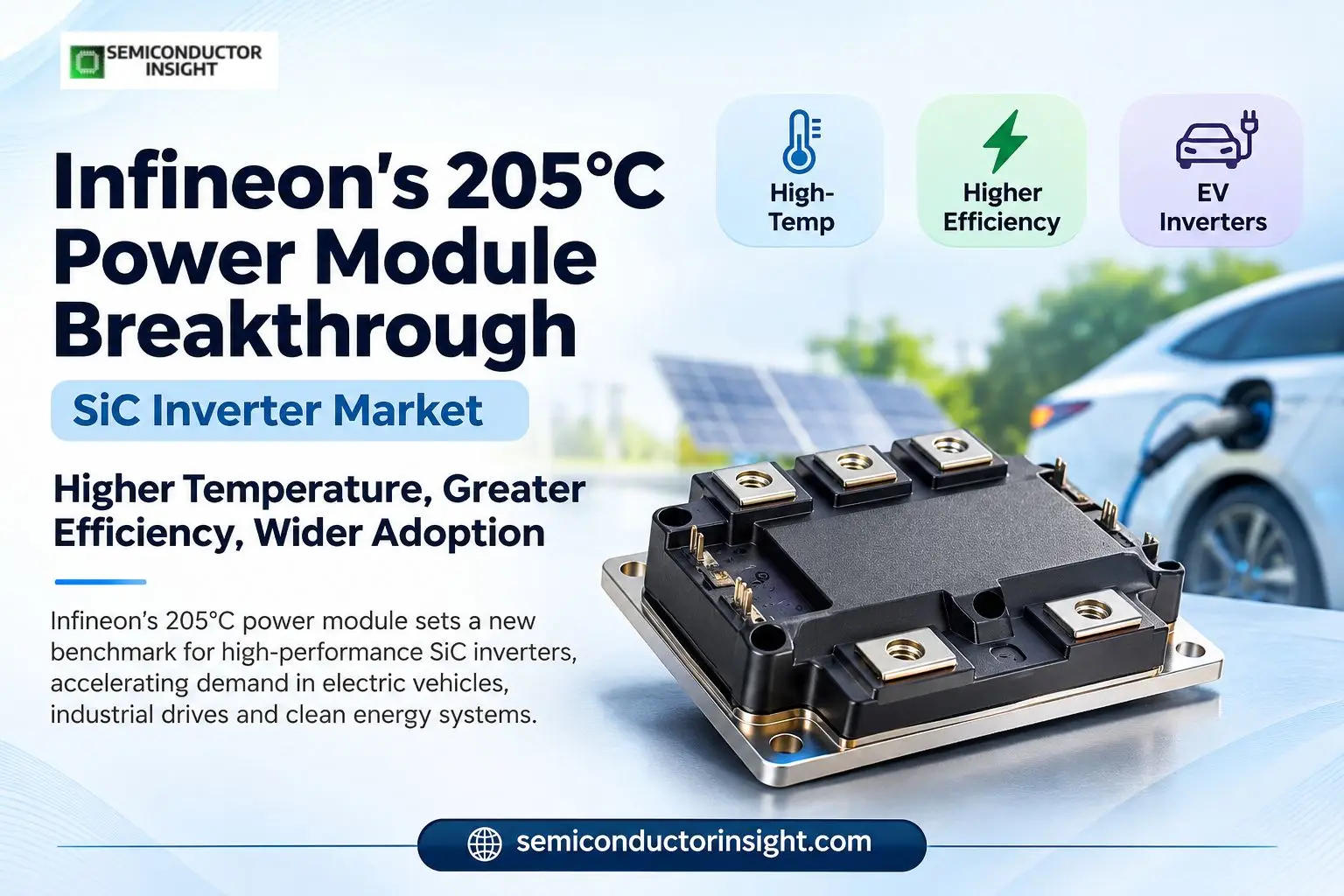
Infineon’s 205°C Power Module Breakthrough Puts New Attention on SiC inverter market
The transition towards high-voltage electric mobility is changing how automotive manufacturers design power conversion systems. Silicon carbide (SiC) inverters are becoming increasingly important because they support higher switching frequencies, reduced switching losses and improved thermal performance compared with conventional silicon-based power electronics in suitable operating conditions.
SiC inverter market is gaining industrial attention as manufacturers move towards 800V battery architectures, high-performance traction systems and compact electric drivetrains. Unlike conventional inverter designs, SiC-based architectures allow engineers to reconsider semiconductor packaging, cooling requirements and electrical system integration.
The 800V Architecture Is Changing Automotive Engineering Priorities
- One of the most significant developments is the growing adoption of 800V electric vehicle platforms. Higher operating voltage can reduce current for a given power level, helping engineers manage resistive losses and cable requirements.
- Valeo’s fifth-generation 800V SiC inverter illustrates this transition. Its published specifications include power ratings from 150 to 350 kW, operation up to 650 Arms and peak efficiency exceeding 99%. The platform is designed for multiple electric motor technologies and incorporates a 400V-to-800V DC booster option.
- This development demonstrates how inverter manufacturers are moving beyond semiconductor replacement towards complete powertrain optimisation.
Global Electric Vehicle Volumes Are Expanding the Application Base
According to the International Energy Agency’s Global EV Outlook 2026, worldwide electric car sales exceeded 20 million units in 2025, representing approximately one-quarter of new car sales. Global electric car production approached 22 million units during the same year, demonstrating the scale of the vehicle manufacturing ecosystem supporting advanced power electronics.
- This expansion creates a larger addressable application base for traction inverters, onboard chargers and high-voltage DC-DC converters. However, SiC adoption varies according to vehicle segment, inverter power rating, cost targets and manufacturer design priorities.
Semiconductor Packaging Is Becoming as Important as the Chip Itself
A major development in 2026 is the growing emphasis on thermal management and advanced power module construction.
On May 29, 2026, Infineon announced a 1,300V silicon carbide power module for electric vehicle inverters capable of continuous operation at temperatures up to 205°C, compared with 175°C for existing designs referenced in its announcement. The development is intended to support higher power output or reduced system complexity in future inverter architectures.
This advancement highlights an important engineering direction: inverter performance increasingly depends on the combined design of SiC dies, substrates, interconnections, cooling structures and gate drivers.
The New Generation of Inverters Is Being Tested Beyond Automotive Applications
- SiC inverter technology is also finding relevance in industrial motor drives, renewable energy conversion, railway traction and high-power energy systems.
- A January 2025 study published in Electronics by researchers from Graz University of Technology demonstrated a 3 kW all-SiC current-source inverter operating at switching frequencies of up to 100 kHz.
- The research examined passive-component optimisation, power losses and volumetric power density, demonstrating the potential for compact inverter configurations.
- Such research is relevant to industrial equipment manufacturers seeking smaller conversion systems and more flexible electrical architectures.
Automotive Supply Agreements Are Moving Towards Higher-Voltage Platforms
The commercial transition is also visible in supplier announcements. In August 2026, BorgWarner announced extensions of multiple inverter programmes with a major European automotive OEM, including 800V battery-electric vehicle applications using SiC-based power switches and dual-sided-cooled power modules. Production is planned to begin in 2029.
These developments show that SiC inverter adoption is increasingly connected to long-term automotive platform planning rather than isolated component upgrades.
What Engineers Are Reconsidering Inside the Inverter?
The next generation of inverter development involves a broader redesign of power electronics. Engineers are examining switching losses, electromagnetic interference, gate-drive protection, thermal cycling, DC-link capacitor sizing and motor compatibility.
Another important consideration is the balance between semiconductor cost and total system performance. Although SiC devices can offer considerable electrical advantages, their commercial suitability depends on operating conditions, system architecture and manufacturing economics.
As electric mobility and industrial electrification expand, SiC inverter market is becoming an important intersection of semiconductor innovation and practical power engineering. The next phase of development will be shaped not only by more advanced SiC chips but also by how effectively manufacturers integrate them into reliable, compact and high-performance inverter platforms.
For More Detailed Insights, You Can Surf Our Latest Report Here: https://semiconductorinsight.com/report/global-sic-inverter-market/
The architecture behind an 800V SiC traction inverter
Battery pack → DC-link capacitor → SiC power module → Three-phase AC output → Electric traction motor.

Comments (0)