
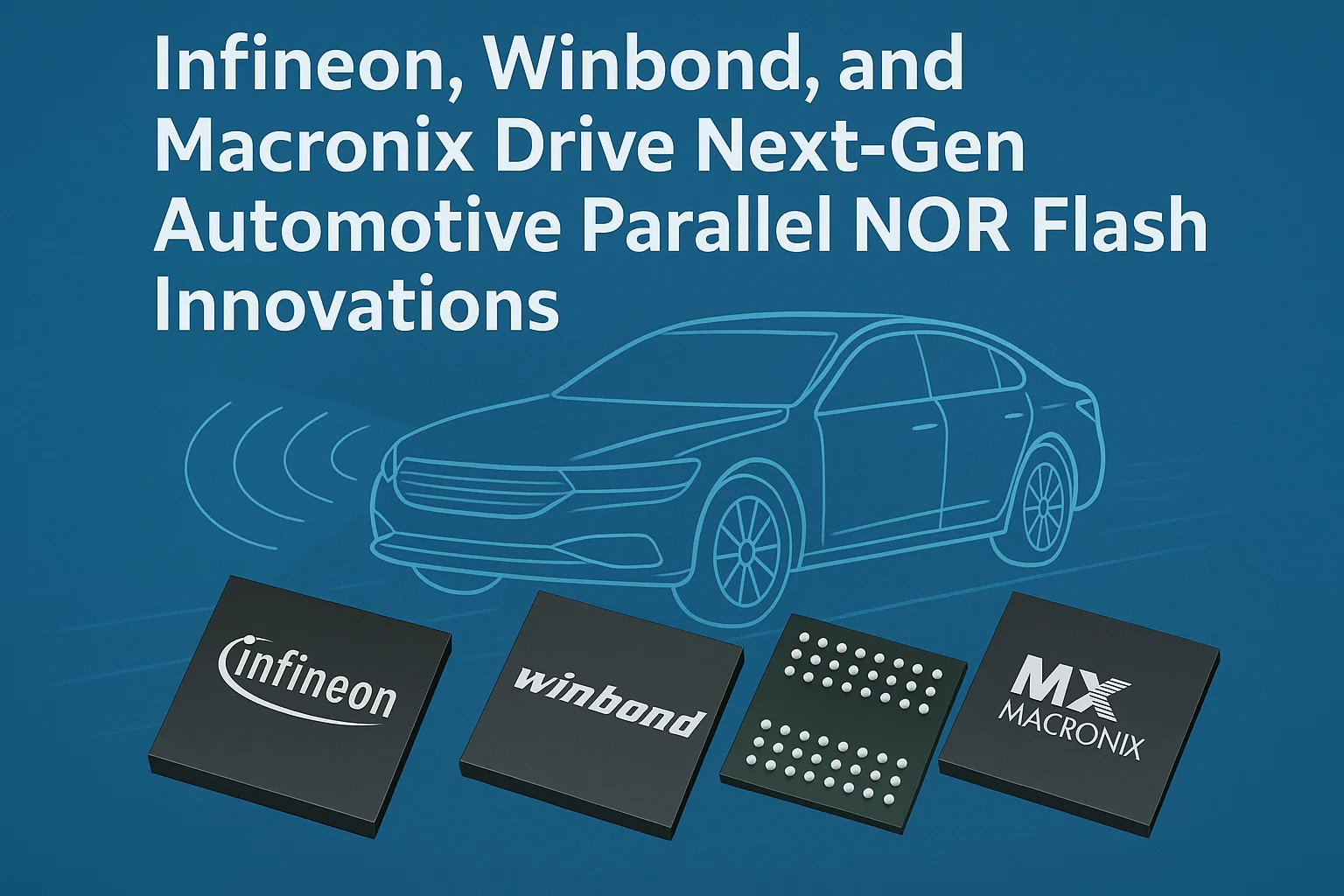
Infineon, Winbond, and Macronix Drive Next-Gen Automotive Parallel NOR Flash Innovations
The automotive industry is in the middle of a technological revolution. From self-driving cars to digital cockpits, the modern vehicle has transformed into a data-driven machine. Beneath the glossy displays and autonomous systems lies a critical component that makes it all possible: automotive-grade memory. Among these, Parallel NOR Flash has quietly become a cornerstone for boot code storage, fast system startup, and functional safety applications.
According to industry estimates, the automotive Parallel NOR Flash market was valued at $74 million in 2024 and is projected to reach $152 million by 2032, expanding at a CAGR of 11.4% during the forecast period. While these figures highlight the steady growth of this niche segment, the real story lies in the innovation being driven by semiconductor leaders such as Infineon, Winbond, and Macronix companies that are adapting their memory technologies for the highly demanding world of connected, electric, and autonomous vehicles.
Access Your Free Sample Report- Automotive Parallel NOR Flash Market
Why Parallel NOR Flash Matters in Automotives
Before examining recent news, it’s worth revisiting why automakers continue to rely on Parallel NOR Flash despite the availability of other memory types like NAND and Serial NOR Flash.
- Instant-on capability: In cars, boot time matters. Whether it’s an instrument cluster or an ADAS (Advanced Driver Assistance System), the system must be operational immediately when the ignition is turned on. Parallel NOR Flash enables microcontrollers to fetch code directly without delays.
- High reliability in harsh conditions: Automotive environments expose components to wide temperature ranges and continuous vibration. Parallel NOR Flash is specifically designed to withstand these stresses while maintaining data integrity.
- Support for functional safety standards: ISO 26262 compliance is non-negotiable for systems like braking, steering, and ADAS. Parallel NOR Flash plays a role in storing critical safety-related code that must not fail.
- Long product lifecycle support: Unlike consumer electronics, cars are expected to last 10–15 years. Memory vendors supporting long-term availability of Parallel NOR Flash ensure stability in design cycles.
These qualities make Parallel NOR Flash indispensable for safety-critical, real-time applications in modern cars.
Infineon Expands Its Automotive NOR Flash Portfolio
In 2024, Infineon Technologies announced an expansion of its automotive Parallel NOR Flash product family, targeting electronic control units (ECUs) and infotainment platforms.
Key highlights from Infineon’s development include:
- High-density chips capable of handling large operating system images.
- Optimized for ADAS and in-vehicle infotainment, two of the fastest-growing segments in automotive electronics.
- Compliance with ISO 26262 functional safety standards, ensuring reliability in mission-critical applications.
Infineon’s move is strategic. As the number of ECUs in a single vehicle continues to grow often exceeding 100 in advanced models memory requirements are multiplying. Booting complex OS images, such as QNX or Linux for infotainment, demands higher throughput and faster read performance, areas where Parallel NOR Flash excels.
With automakers pushing for centralized and zonal architectures, Infineon’s NOR Flash ensures that boot codes remain accessible even when other systems experience failures. This level of redundancy is crucial for future autonomous driving functions.
Winbond Introduces AEC-Q100 Qualified Parallel NOR Flash
Winbond Electronics, a memory vendor well-known in the automotive space, made headlines with the release of its AEC-Q100 qualified Parallel NOR Flash solutions in 2024. These chips are designed for instant-on digital clusters, HUDs (head-up displays), and infotainment systems.
The significance of Winbond’s update lies in:
- Low-power operation, addressing the needs of electric vehicles (EVs) where energy efficiency is paramount.
- Instant-on capability, ensuring digital displays light up as soon as the car starts, enhancing user experience.
- Robust endurance, supporting the long duty cycles demanded by automotive electronics.
Winbond’s focus on low power directly ties to the EV boom. Electric cars depend on efficient power management across all subsystems to maximize driving range. By optimizing NOR Flash for minimal power draw, Winbond is aligning with one of the industry’s top priorities.
Download Sample Report PDF- Automotive Parallel NOR Flash Market
Macronix Powers ADAS with High-Density Parallel NOR Flash
Another key player, Macronix International, has been making strides in supplying NOR Flash memory for ADAS platforms. These systems, which include adaptive cruise control, collision avoidance, and lane-keeping assistance, require:
- High-temperature endurance, as ADAS modules are often mounted close to heat-generating components.
- Fast random read access, enabling real-time decision-making by microcontrollers.
- Data integrity, ensuring stored firmware is reliable in life-critical situations.
Macronix’s NOR Flash has been highlighted in several industry reports as an enabler of real-time automotive decision-making, particularly in scenarios where latency cannot be tolerated. For instance, if a pedestrian suddenly crosses the road, the ADAS system cannot afford a millisecond’s delay in fetching code from memory.
As autonomous driving levels progress (moving from Level 2+ toward Level 4), the demand for reliable high-density NOR Flash is expected to rise sharply, positioning Macronix at the forefront of this growth.
The Market Dynamics: EVs and Autonomous Driving Fuel Demand
The rise of electric and autonomous vehicles is arguably the biggest growth driver for the automotive Parallel NOR Flash market.
- Electric Vehicles (EVs): With battery efficiency being central, every electronic component is scrutinized for power usage. Low-power NOR Flash helps minimize parasitic energy draw while ensuring fast boot times for digital dashboards.
- Autonomous Vehicles: These rely heavily on ADAS and AI-driven platforms that demand instant, reliable code execution. Parallel NOR Flash ensures system software is accessible without bottlenecks.
- Connected Vehicles: Cars are becoming rolling data centers with OTA (over-the-air) updates. NOR Flash supports secure and reliable firmware storage for frequent updates.
These factors collectively explain why the market is expected to more than double from $74 million in 2024 to $152 million by 2032.
Industry Consolidation and Supply Chain Stabilization
The global chip shortage of 2021–22 disrupted automotive production, shining a spotlight on the fragility of semiconductor supply chains. Since then:
- Companies like Infineon and Winbond have reallocated production capacity to stabilize supply for automotive NOR Flash.
- Long-term supply agreements between automakers and semiconductor vendors have become more common to avoid future bottlenecks.
- The niche but stable demand for Parallel NOR Flash ensures it remains profitable for manufacturers, even as other memory markets experience volatility.
As vehicles become more software-defined, ensuring secure and reliable memory availability is no longer optional but essential.
Challenges Ahead for Parallel NOR Flash
Despite its advantages, Parallel NOR Flash faces certain challenges:
- Cost pressures: Automotive OEMs are constantly pushing for cost reductions, making it difficult for vendors to balance advanced features with price competitiveness.
- Competition from Serial NOR Flash and NAND: For some applications, higher-density NAND solutions are preferred, particularly when cost per bit is prioritized.
- Technology scaling: Keeping NOR Flash competitive in terms of density and performance requires continuous innovation.
However, the strong alignment of Parallel NOR Flash with safety-critical and instant-on applications means it will likely remain irreplaceable in specific automotive domains.
Click Here To Download Full Sample Report- Automotive Parallel NOR Flash Market
Looking Ahead: The Future of Automotive Parallel NOR Flash
By 2032, the Parallel NOR Flash market will play an even greater role in shaping the next generation of cars:
- Zonal architectures will drive the need for memory that supports consolidated software storage for multiple subsystems.
- Over-the-air updates will demand secure, reliable, and fast code storage solutions, further strengthening NOR Flash’s role.
- ADAS evolution toward full autonomy will increase demand for real-time code execution from memory.
- Green mobility trends will reward vendors who can optimize for low-power consumption in EVs.
The trajectory suggests that Parallel NOR Flash will transition from being a supporting memory technology to a core enabler of automotive digital transformation.
The automotive Parallel NOR Flash industry may not grab headlines like AI chips or high-bandwidth DRAM, but its impact is undeniable. As cars become smarter, safer, and more connected, the demand for fast, reliable, and power-efficient memory solutions is rising sharply.
With Infineon, Winbond, and Macronix leading the charge in innovation, coupled with the broader trends of EV adoption and autonomous driving, Parallel NOR Flash is carving out a crucial role in the future of mobility. The market’s expected growth from $74 million in 2024 to $152 million in 2032 underscores its importance in this evolving ecosystem.

Comments (0)