
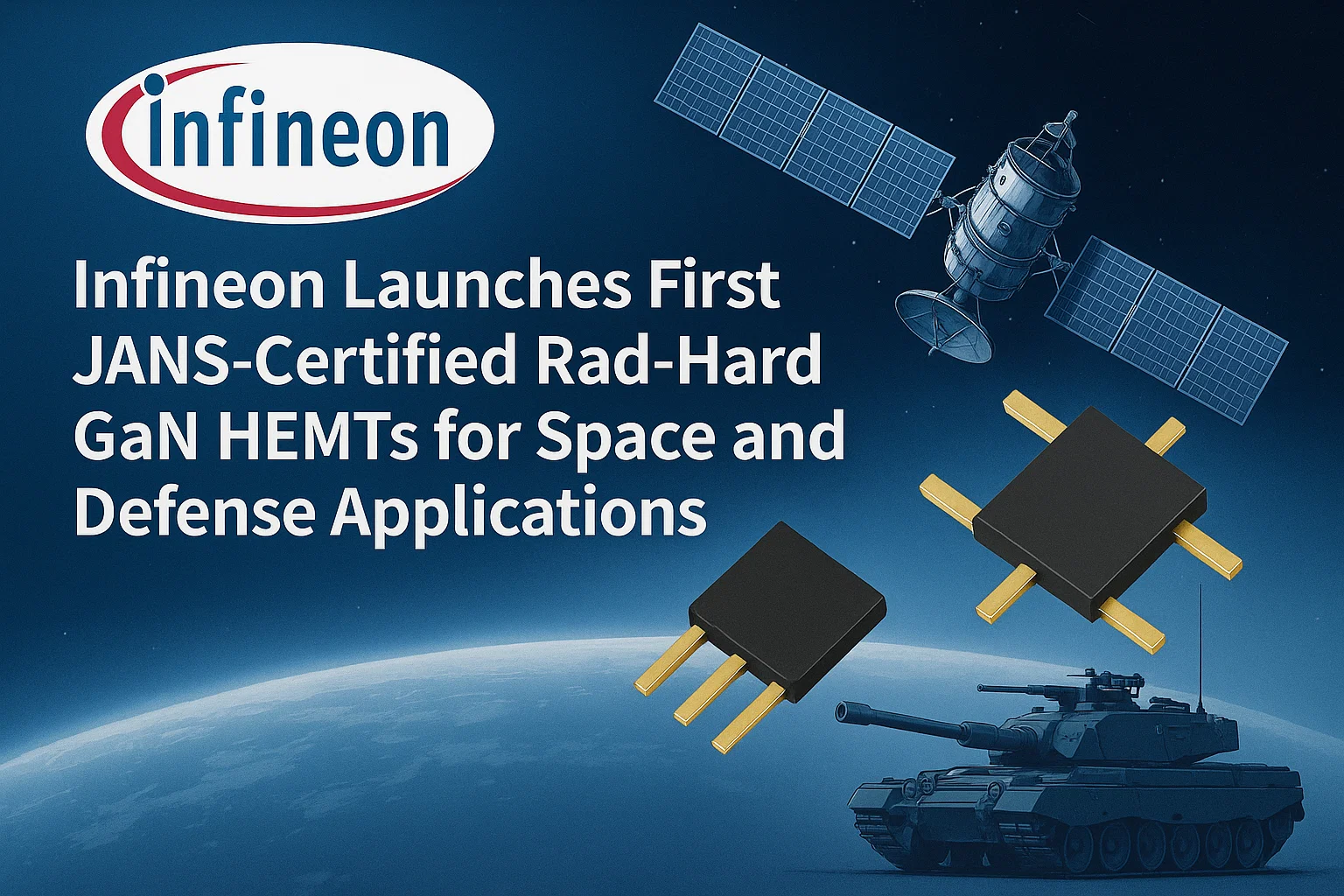
Infineon Launches First JANS-Certified Rad-Hard GaN HEMTs for Space and Defense Applications
The world of space electronics is undergoing a profound transformation. With satellites becoming smaller, more affordable, and increasingly numerous, there is unprecedented demand for electronic components that can survive the punishing radiation environments of space. At the heart of this revolution lies a niche but vital category of power management devices radiation-hardened (rad-hard) voltage regulators.
These specialized components ensure that spacecraft, satellites, and defense systems operate reliably even when bombarded by cosmic rays, solar storms, and high-energy particles in orbit. Unlike commercial off-the-shelf (COTS) regulators, rad-hard regulators are carefully designed and tested to withstand total ionizing dose (TID), displacement damage, and single-event effects (SEE).
The market itself reflects this growing importance. The Rad-Hard Voltage Regulator market was valued at US$302 million in 2024 and is projected to reach US$401 million by 2032, growing at a steady CAGR of 4.2%. This trajectory is shaped by rising investments in satellite constellations, national security systems, deep-space exploration, and commercial “New Space” ventures.
In 2025, two groundbreaking developments have captured industry attention: STMicroelectronics’ LEOPOL1 radiation-hardened point-of-load converters and Infineon Technologies’ JANS-certified radiation-hardened GaN HEMTs. These milestones underscore how innovation in power management is enabling safer, more efficient, and longer-lasting space missions.
Access Your Free Sample Report- Rad-Hard Voltage Regulator Market
The Strategic Importance of Rad-Hard Voltage Regulators
Before diving into the latest product developments, it’s worth emphasizing why rad-hard voltage regulators are so crucial.
- Mission Reliability: Voltage regulators ensure spacecraft electronics receive stable power, regardless of fluctuating supply voltages or harsh external conditions. A single power failure in orbit can mean mission loss.
- Radiation Tolerance: Space is a hostile environment. Cosmic rays, solar protons, and Van Allen belt electrons can disrupt semiconductor behavior, causing bit flips, latch-up events, or permanent device degradation. Rad-hard regulators prevent these phenomena from derailing operations.
- Growing Satellite Demand: With thousands of satellites projected to be deployed in the next decade covering communications, Earth observation, defense, and scientific exploration the need for affordable yet highly reliable power management ICs has never been higher.
- Defense & Aerospace Applications: Beyond commercial space, rad-hard regulators are also critical in defense avionics, nuclear applications, and high-altitude aircraft electronics, where radiation levels exceed terrestrial norms.
In short, rad-hard regulators are the invisible backbone that makes modern space missions possible. The latest announcements from STMicroelectronics and Infineon Technologies represent a major leap forward in addressing these challenges.
STMicroelectronics’ LEOPOL1: A Game-Changer for Low Earth Orbit Satellites
Over the last decade, the satellite industry has shifted from large, expensive geostationary satellites to swarms of smaller, more affordable Low Earth Orbit (LEO) satellites. Companies like SpaceX, OneWeb, and Amazon’s Project Kuiper are racing to deploy mega-constellations to deliver global broadband, Earth monitoring, and secure communications.
However, LEO satellites while cheaper to launch must still endure intense radiation exposure. The challenge is delivering cost-effective yet robust power regulation that can survive in orbit for years.
This is the niche that STMicroelectronics’ LEOPOL1 point-of-load converter aims to fill.
Key Features of LEOPOL1
Unveiled in July 2025, ST’s LEOPOL1 is designed as a high-reliability, radiation-hardened step-down converter optimized for LEO missions. Its standout characteristics include:
- Radiation Hardness:
- Total Ionizing Dose (TID): Withstands up to 50 krad(Si).
- Proton Irradiation Resistance: Tolerates up to 3 × 10¹¹ protons/cm² TNID.
- Single-Event Effect (SEE) Immunity: Qualified up to 62 MeV·cm²/mg.
These figures demonstrate resilience against both cumulative and single-event radiation threats.
- Output Performance:
- Provides up to 7 A output current.
- Tested to sustain 5 A at 6 V under extreme radiation conditions.
- Advanced Functionality:
- Features synchronization and out-of-phase current sharing, critical for distributed satellite power systems.
- Comes with a Certificate of Conformance, easing procurement and qualification for aerospace contractors.
- Technology Platform:
- Built on ST’s BCD6-SOI (Silicon-On-Insulator) technology, which inherently enhances tolerance to latch-up and radiation effects.
Why It Matters
LEOPOL1 is more than just another regulator; it is a product purpose-built for the New Space economy. Unlike legacy rad-hard solutions which are often bulky and costly LEOPOL1 balances radiation tolerance, power efficiency, and cost-effectiveness.
This enables small-satellite designers to:
- Shorten design cycles with pre-qualified regulators.
- Deploy larger constellations without prohibitive cost barriers.
- Ensure reliable operations even in the dense radiation environment of LEO.
In effect, STMicroelectronics has delivered a device that brings “big satellite reliability” to “small satellite economics.”
Download Sample Report PDF- Rad-Hard Voltage Regulator Market
Infineon Technologies’ JANS-Certified Rad-Hard GaN HEMTs: A Milestone in Power Density
Context: Why GaN Matters
Gallium Nitride (GaN) has emerged as a transformative semiconductor material for power electronics. Compared to silicon, GaN offers:
- Higher electron mobility and breakdown voltage.
- Lower conduction and switching losses.
- Higher power density in smaller footprints.
For space and defense systems, these advantages translate into lighter, more efficient power electronics a critical factor where every gram of weight and every watt of power counts.
Infineon’s Breakthrough
In May–June 2025, Infineon Technologies announced the industry’s first radiation-hardened GaN HEMTs manufactured entirely in-house and certified to the stringent JANS (Joint Army-Navy Standard) by the U.S. Defense Logistics Agency.
This certification, under MIL-PRF-19500/794, represents the highest level of reliability qualification for semiconductors intended for space and defense.
Product Specifications
The first devices in this family include:
- Voltage & Current: 100 V, 52 A HEMTs.
- Electrical Performance:
- On-resistance: 4 mΩ.
- Total gate charge: 8 nC.
- Radiation Hardness:
- Single-Event Effects: Immune up to LET = 70 MeV·cm²/mg.
- Total Ionizing Dose (TID): Screened up to 500 krad(Si).
- Packaging: Hermetically sealed to ensure durability in space conditions.
Strategic Significance
Infineon’s announcement is notable for several reasons:
- First JANS-Certified GaN Devices: Establishes GaN as not just a laboratory curiosity but a fully qualified technology for mission-critical space and defense applications.
- In-House Manufacturing: Guarantees full control over quality, supply chain security, and compliance with defense requirements.
- Efficiency Leap: GaN regulators can deliver higher efficiency and smaller form factors compared to silicon rad-hard counterparts critical for next-generation spacecraft and military systems.
- Defense Readiness: With rising geopolitical tensions, defense contractors now have access to state-of-the-art power transistors that meet the most demanding standards.
Comparative Analysis: ST vs. Infineon Approaches
While both announcements target the space power electronics market, their approaches differ:
- STMicroelectronics (LEOPOL1): Focuses on cost-effective, radiation-hardened point-of-load regulators optimized for commercial LEO satellites and constellations.
- Infineon Technologies (GaN HEMTs): Focuses on ultra-high-reliability, defense-grade power devices aimed at deep-space missions, crewed spacecraft, and strategic defense platforms.
In essence, ST is democratizing access to rad-hard regulators for New Space, while Infineon is pushing the technological ceiling for high-performance defense and exploration missions.
Together, these developments highlight the dual-track evolution of the market: affordability for commercial ventures and uncompromising reliability for defense and exploration.
Market Outlook: 2024–2032
Market Size & Growth
- 2024 Valuation: US$302 million.
- 2032 Projection: US$401 million.
- CAGR: 4.2%.
This steady growth reflects both commercial expansion in satellite constellations and sustained government/defense investments.
Growth Drivers
- Proliferation of LEO Satellites
- Companies are launching thousands of satellites for internet, IoT, and Earth observation.
- Each requires multiple rad-hard voltage regulators.
- Government Space Programs
- NASA, ESA, ISRO, and CNSA continue investing in deep-space exploration where rad-hard components are non-negotiable.
- Defense Modernization
- Military satellites, missile systems, and high-altitude aircraft require rad-hard power systems for operational security.
- Wide-Bandgap Materials
- Adoption of GaN and SiC will enhance performance and efficiency, opening new application frontiers.
Challenges
- High Costs: Rad-hard qualification is expensive, limiting access for some startups.
- Supply Chain Bottlenecks: Semiconductor shortages could impact availability.
- Design Complexity: Balancing efficiency, radiation hardness, and miniaturization remains a technical challenge.
Future Trends
- Hybrid Approaches: Combining COTS components with shielding and selective rad-hard parts for cost optimization.
- Increased Standardization: Certification programs like JANS are setting benchmarks for reliability.
- AI & Digital Twins: Advanced modeling will accelerate testing and qualification of new rad-hard designs.
- Miniaturization: Ongoing push to reduce regulator size while maintaining radiation tolerance.
Click Here To Download Full Sample Report- Rad-Hard Voltage Regulator Market
Powering the Next Frontier
The rad-hard voltage regulator industry is entering a pivotal phase. As satellites proliferate, deep-space missions advance, and defense systems evolve, demand for reliable, radiation-tolerant power solutions will only intensify.
- STMicroelectronics’ LEOPOL1 represents a breakthrough for the commercial satellite sector, delivering cost-effective, radiation-hardened regulators tailored for the booming LEO market.
- Infineon Technologies’ JANS-certified GaN HEMTs mark a watershed moment for defense and deep-space missions, proving that wide-bandgap materials can meet the strictest reliability standards.
With the market projected to expand from US$302 million in 2024 to US$401 million in 2032, at a CAGR of 4.2%, these innovations will play a decisive role in shaping the future of space power electronics.

Comments (0)