MARKET INSIGHTS
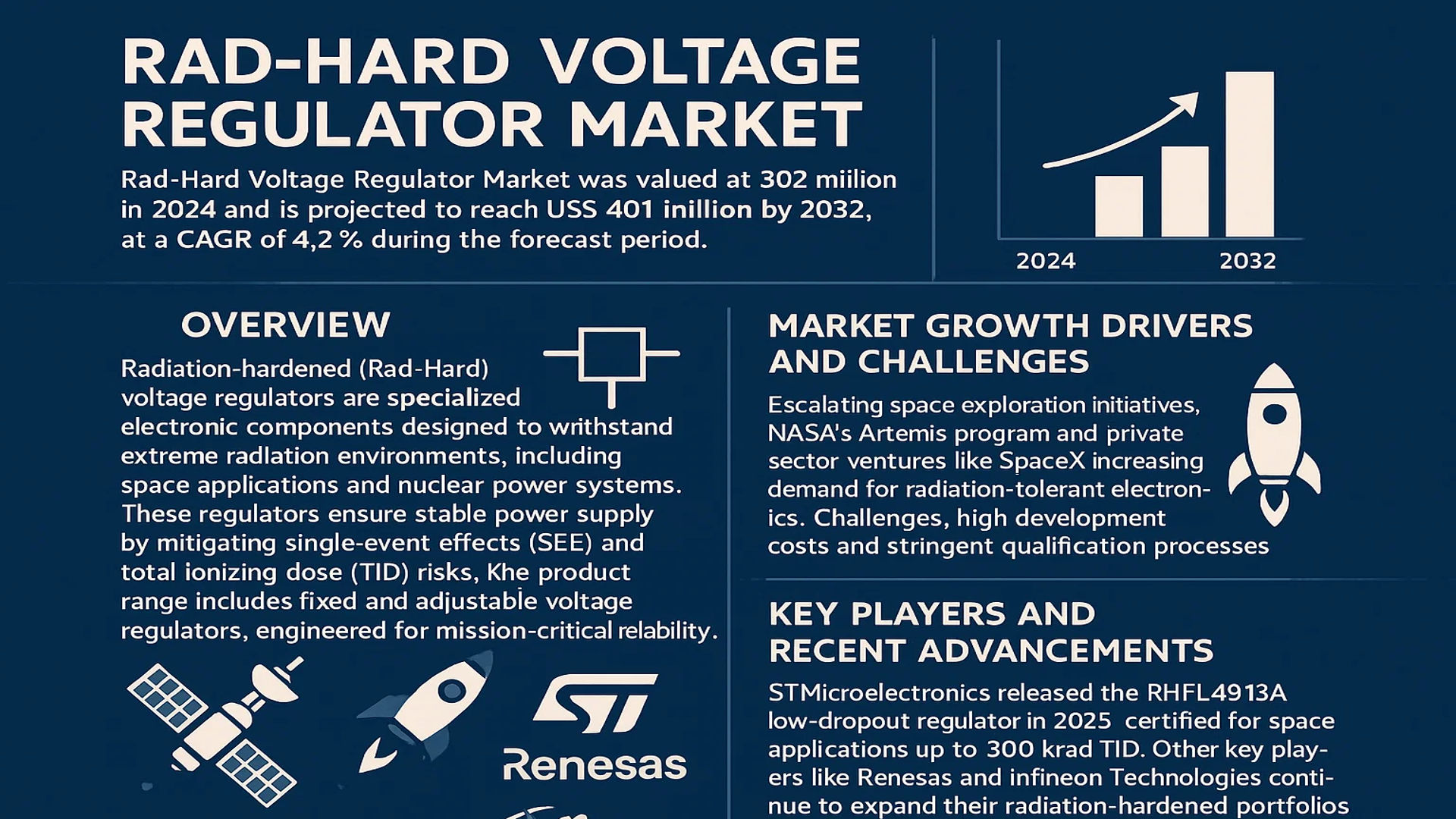
The global Rad-Hard Voltage Regulator Market was valued at 302 million in 2024 and is projected to reach US$ 401 million by 2032, at a CAGR of 4.2% during the forecast period.
Radiation-hardened (Rad-Hard) voltage regulators are specialized electronic components designed to withstand extreme radiation environments, including space applications and nuclear power systems. These regulators ensure stable power supply by mitigating single-event effects (SEE) and total ionizing dose (TID) risks, making them critical for satellites, launch vehicles, and defense systems. The product range includes fixed and adjustable voltage regulators, each engineered for mission-critical reliability.
The market growth is driven by escalating space exploration initiatives, with NASA’s Artemis program and private sector ventures like SpaceX increasing demand for radiation-tolerant electronics. However, high development costs and stringent qualification processes pose challenges. Recent advancements include STMicroelectronics’ release of the RHFL4913A low-dropout regulator in 2023, certified for space applications up to 300 krad TID. Other key players like Renesas and Infineon Technologies continue to expand their radiation-hardened portfolios to address growing aerospace and defense requirements.
MARKET DYNAMICS
MARKET DRIVERS
Growing Space Exploration Activities to Fuel Demand for Rad-Hard Voltage Regulators
The global space economy has been expanding at an unprecedented rate, with over 1,800 active satellites currently in orbit as of 2024. This rapid growth in satellite deployments, coupled with ambitious deep-space missions from both government agencies and private companies, is creating sustained demand for radiation-hardened electronic components. Rad-Hard voltage regulators play a critical role in ensuring power system reliability in these harsh environments where standard electronics would fail within hours or days. The market is further stimulated by increasing investments in national space programs, evidenced by the 15% year-over-year increase in government space budgets across major economies.
Military Modernization Programs Driving Adoption in Defense Applications
Defense applications account for approximately 35% of the total Rad-Hard voltage regulator market, driven by global military modernization initiatives. Modern warfare systems increasingly rely on radiation-hardened electronics for missiles, UAVs, and other strategic assets that must operate in nuclear or high-altitude radiation environments. The development of hypersonic weapons systems, which generate plasma sheaths that can interfere with electronics, has created new requirements for robust power management solutions. Strategic defense partnerships between governments and private manufacturers are accelerating technology development in this sector.
➤ For instance, recent contracts for next-generation satellite constellations include stringent requirements for single-event effect (SEE) immunity, directly benefiting Rad-Hard component manufacturers.
Furthermore, the miniaturization of satellites and the CubeSat revolution have introduced new optimization challenges that Rad-Hard voltage regulators are uniquely positioned to address.
MARKET RESTRAINTS
High Development Costs and Long Certification Cycles Limiting Market Expansion
Rad-Hard components require specialized design approaches and testing procedures that significantly increase development costs. The total cost of developing a qualified Rad-Hard voltage regulator can be four to six times higher than commercial-grade equivalents. These components must undergo rigorous radiation testing, including total ionizing dose (TID) and single-event effects (SEE) characterization, which requires access to expensive particle accelerator facilities. The qualification process for space applications often extends beyond 24 months, creating cash flow challenges for suppliers and delaying product availability for mission planners.
Other Constraints
Supply Chain Vulnerabilities
The specialized materials and fabrication processes used in Rad-Hard components create dependencies on a limited number of suppliers. Recent geopolitical tensions have exposed vulnerabilities in the supply of radiation-hardened semiconductors, with lead times for certain components extending beyond 52 weeks.
Technology Migration Challenges
The transition to advanced process nodes below 28nm for Rad-Hard designs presents significant technical hurdles. While commercial semiconductor manufacturing has progressed to 3nm nodes, most radiation-hardened designs remain at 90nm or larger feature sizes due to radiation susceptibility concerns.
MARKET CHALLENGES
Balancing Performance and Radiation Hardness in Advanced Applications
The market faces increasing pressure to deliver higher power efficiency and smaller form factors while maintaining radiation hardness specifications. Modern satellite payloads demand voltage regulators with efficiency above 95%, but radiation-hardening techniques typically degrade performance parameters. This performance gap has led some mission planners to consider alternative approaches such as system-level radiation mitigation, creating competitive pressure on component manufacturers. The challenge is particularly acute for Low Earth Orbit (LEO) constellations where both radiation tolerance and power efficiency are critical for mission success.
Specialized Workforce Shortages
The niche nature of radiation-hardened electronics has created a skills gap in the workforce. Universities rarely offer specialized programs in radiation effects on electronics, forcing companies to invest heavily in internal training programs. The average age of Rad-Hard design engineers is increasing, with fewer young engineers entering this specialized field. This demographic challenge threatens to constrain market growth just as demand for qualified personnel is peaking.
MARKET OPPORTUNITIES
Emerging Commercial Space Sector Opening New Growth Avenues
The commercial space sector is projected to account for 40% of the total Rad-Hard voltage regulator market by 2030, up from just 15% a decade earlier. This shift is driven by private space stations, lunar landers, and broadband constellations requiring radiation-tolerant power management solutions. The cost sensitivity of commercial operators is pushing manufacturers to develop innovative approaches that reduce system costs without compromising reliability. Several industry leaders have recently introduced modular Rad-Hard power architectures that simplify integration while maintaining required radiation performance.
Advancements in Radiation-Hardening-by-Design (RHBD) Techniques
New RHBD methodologies are enabling performance improvements while reducing development timelines. Techniques such as selective hardening and 3D chip stacking are showing particular promise, with some designs achieving SEE immunity levels below 1E-15 errors/bit-day for critical functions. These advances could potentially reduce radiation qualification timelines by 30-40% while improving power density metrics. The industry is also exploring AI-assisted design tools to accelerate the development of Rad-Hard IP blocks for next-generation power management ICs.
RAD-HARD VOLTAGE REGULATOR MARKET TRENDS
Increasing Space Exploration Activities Driving Market Expansion
The global rad-hard voltage regulator market is experiencing robust growth, fueled by escalating investments in space exploration programs. With the global market valuation reaching $302 million in 2024, projections indicate a steady climb to $401 million by 2032, reflecting a 4.2% CAGR. This upward trajectory is primarily attributed to rising satellite deployments, deep-space missions, and military satellite communications. Recent advancements in radiation-hardened low-dropout regulators (LDOs) have enabled superior performance in extreme environments, ensuring stable power supply for onboard electronics in spacecraft, launch vehicles, and satellite constellations.
Other Trends
Defense and Aerospace Applications
Beyond space applications, rad-hard voltage regulators are seeing heightened demand in defense systems requiring radiation-tolerant components. Modern electronic warfare systems, missile guidance technologies, and avionics increasingly rely on these regulators due to their resilience against single-event effects (SEE) and total ionizing dose (TID). The growing complexity of military electronics and push for autonomous defense solutions are accelerating adoption across this sector, with product innovation focusing on higher efficiency and miniaturization for next-generation systems.
Technological Advancements in Semiconductor Design
Manufacturers are making significant strides in semiconductor hardening techniques, developing voltage regulators with enhanced radiation tolerance and lower power consumption. Recent innovations include monolithic IC designs that integrate protection mechanisms against latch-up events while maintaining sub-1V operation capabilities. Key industry players are also adopting advanced packaging technologies to improve thermal management in space-constrained applications. These technological leaps are critical for supporting emerging satellite mega-constellations that require thousands of reliable power regulation units per deployment.
COMPETITIVE LANDSCAPE
Key Industry Players
Semiconductor Giants and Aerospace Specialists Drive Market Innovation
The competitive landscape of the Rad-Hard Voltage Regulator market is moderately consolidated, with established semiconductor manufacturers and niche aerospace component suppliers dominating the space. STMicroelectronics leads the market with a 22% revenue share in 2024, leveraging its expertise in radiation-hardened analog ICs and strategic partnerships with space agencies. The company’s recent launch of the RHR0V series, featuring single-event burnout immunity up to 100 MeV·cm²/mg, has strengthened its position in satellite power management applications.
Infineon Technologies and Microsemi (now part of Microchip Technology) collectively account for 34% of the global market, with their extensive portfolios of radiation-tolerant voltage regulators. These companies benefit from long-term contracts with defense organizations and the increasing demand for reliable power solutions in Low Earth Orbit (LEO) satellite constellations. Their recent investments in silicon carbide (SiC) based Rad-Hard regulators demonstrate the industry’s shift toward higher efficiency solutions for deep space missions.
Meanwhile, specialized players like BAE Systems and API Technologies are carving out strong positions in high-reliability military applications. BAE’s Rad-Hard Power Management ICs, developed through NASA-funded research programs, are now being adopted in next-generation lunar landers. The company’s vertically integrated manufacturing approach allows tighter quality control—a critical factor for mission-critical aerospace applications where component failure is not an option.
List of Key Rad-Hard Voltage Regulator Companies Profiled
- STMicroelectronics (Switzerland)
- Renesas Electronics Corporation (Japan)
- Microsemi (U.S.)
- Infineon Technologies AG (Germany)
- International Rectifier (U.S.)
- API Technologies Corp. (U.S.)
- Analog Devices, Inc. (U.S.)
- BAE Systems (U.K.)
- Solitron Devices, Inc. (U.S.)
Smaller innovators are also making waves, with Solitron Devices recently securing a $12 million contract for radiation-hardened voltage references in missile guidance systems. The industry is witnessing increased collaboration between commercial semiconductor firms and government space programs—a trend accelerated by the commercialization of space technologies. As private space ventures multiply, companies offering cost-optimized Rad-Hard solutions without compromising reliability are gaining traction among NewSpace operators.
All major players are actively expanding their radiation testing capabilities, with heavy ion testing facilities becoming a strategic differentiator. The ability to validate components against single-event effects (SEE) and total ionizing dose (TID) requirements in-house provides a competitive edge in meeting the stringent qualification timelines of aerospace programs.
Segment Analysis:
By Type
Fixed Voltage Regulators Lead the Market Due to High Reliability in Mission-Critical Space Applications
The market is segmented based on type into:
- Fixed Voltage Regulators
- Subtypes: Positive & Negative Fixed Regulators
- Adjustable Voltage Regulators
- Low Dropout (LDO) Regulators
- Switching Regulators
- Others
By Application
Satellite Segment Dominates with Increasing Deployment of Next-Generation Communication Satellites
The market is segmented based on application into:
- Satellites
- Launch Vehicles
- Spacecraft Power Systems
- Military & Defense Electronics
- Nuclear Power Plants
- Others
By End User
Aerospace & Defense Sector Accounts for Major Share Due to Space Program Investments
The market is segmented based on end user into:
- Aerospace & Defense
- Space Agencies
- Telecommunications
- Government Research Organizations
- Commercial Space Companies
By Radiation Hardness Level
High-Radiation Environments Demand Advanced Radiation-Hardened Solutions
The market is segmented based on radiation hardness level into:
- Rad-Tolerant (100-300 krad)
- Rad-Hard (300-500 krad)
- Extreme Rad-Hard (>500 krad)
Regional Analysis: Rad-Hard Voltage Regulator Market
North America
North America leads the global Rad-Hard voltage regulator market, accounting for over 38% of the total market share, driven by substantial investments in space exploration and defense applications. The U.S. government’s $25 billion allocation for NASA’s Artemis program and private sector initiatives like SpaceX’s Starlink projects are accelerating demand for radiation-hardened components. Key industry players such as Microsemi and Analog Devices maintain strong R&D facilities in the region, focusing on Single-Event Effect (SEE) mitigation and ultra-low-power solutions. While the market is mature, stringent qualification standards for aerospace applications create high barriers to entry for new suppliers.
Europe
Europe’s market growth is propelled by the European Space Agency’s (ESA) €16.9 billion budget for space programs and collaborative projects like Galileo and Copernicus. Countries such as France and Germany dominate with specialized manufacturers like STMicroelectronics developing adjustable voltage regulators for satellite power management systems. However, long product certification cycles and dependence on U.S. export-controlled technologies pose challenges. The region shows increasing demand for miniaturized, high-efficiency regulators compatible with CubeSat architectures, reflecting the trend toward smaller satellite constellations.
Asia-Pacific
The APAC market is the fastest-growing, projected to achieve a 5.6% CAGR through 2032, led by China’s expanding space ambitions through CNSA (China National Space Administration) and India’s ISRO satellite launches. Local manufacturers benefit from government-backed semiconductor initiatives, though they lag in proprietary radiation-hardening technologies compared to Western counterparts. Japan remains a key innovator, with Renesas supplying regulators for JAXA’s lunar exploration missions. While cost sensitivity drives demand for commercial-off-the-shelf (COTS) components, geopolitical tensions are prompting regional players to develop indigenous Rad-Hard solutions.
South America
South America’s market remains nascent but shows potential with Brazil’s Alcântara Launch Center expansion and Argentina’s focus on small-satellite development. Limited local manufacturing capabilities result in heavy reliance on imports from North America and Europe, often at premium prices. Regulatory hurdles and funding inconsistencies delay large-scale projects, though partnerships with global aerospace firms are gradually strengthening the supply chain for Rad-Hard components in niche applications.
Middle East & Africa
The MEA region is emerging as a growth pocket, with the UAE’s Hope Mars Mission and Saudi Arabia’s investments in space infrastructure creating demand for radiation-resistant electronics. Israel’s robust defense sector leverages Rad-Hard regulators for military satellites, while African nations explore partnerships for earth observation satellites. The lack of localized testing facilities for Total Ionizing Dose (TID) validation remains a bottleneck, but increasing collaborations with ESA and NASA aim to bridge this gap over the next decade.
Report Scope
This market research report provides a comprehensive analysis of the Global Rad-Hard Voltage Regulator market, covering the forecast period 2025–2032. It offers detailed insights into market dynamics, technological advancements, competitive landscape, and key trends shaping the industry.
Key focus areas of the report include:
- Market Size & Forecast: Historical data and future projections for revenue, unit shipments, and market value across major regions and segments. The Global Rad-Hard Voltage Regulator market was valued at USD 302 million in 2024 and is projected to reach USD 401 million by 2032, growing at a CAGR of 4.2%.
- Segmentation Analysis: Detailed breakdown by product type (Fixed Voltage Regulator, Adjustable Voltage Regulator), application (Satellite, Launch Vehicle), and end-user industry to identify high-growth segments and investment opportunities.
- Regional Outlook: Insights into market performance across North America, Europe, Asia-Pacific, Latin America, and the Middle East & Africa, including country-level analysis where relevant. North America currently dominates due to strong aerospace and defense sectors.
- Competitive Landscape: Profiles of leading market participants, including their product offerings, R&D focus, manufacturing capacity, pricing strategies, and recent developments such as mergers, acquisitions, and partnerships.
- Technology Trends & Innovation: Assessment of emerging technologies in radiation-hardened semiconductors, integration with space-grade electronics, and evolving industry standards for extreme environments.
- Market Drivers & Restraints: Evaluation of factors driving market growth (increasing space exploration, satellite deployments) along with challenges (high development costs, stringent qualification requirements).
- Stakeholder Analysis: Insights for component suppliers, aerospace OEMs, defense contractors, investors, and policymakers regarding the evolving ecosystem and strategic opportunities.
Primary and secondary research methods are employed, including interviews with industry experts, data from verified sources, and real-time market intelligence to ensure the accuracy and reliability of the insights presented.
FREQUENTLY ASKED QUESTIONS:
What is the current market size of Global Rad-Hard Voltage Regulator Market?
-> Rad-Hard Voltage Regulator Market was valued at 302 million in 2024 and is projected to reach US$ 401 million by 2032, at a CAGR of 4.2% .
Which key companies operate in Global Rad-Hard Voltage Regulator Market?
-> Key players include STMicroelectronics, Renesas, Microsemi, Infineon Technologies, International Rectifier, API Technologies, Analog Devices, BAE Systems, and Solitron Devices, among others.
What are the key growth drivers?
-> Key growth drivers include increasing space exploration missions, growing satellite deployments, and rising defense spending on radiation-hardened electronics.
Which region dominates the market?
-> North America currently leads the market, while Asia-Pacific is emerging as the fastest-growing region due to expanding space programs.
What are the emerging trends?
-> Emerging trends include development of more efficient radiation-hardened ICs, integration with advanced spacecraft power systems, and miniaturization of components for space applications.

Get Sample Report PDF for Exclusive Insights
Report Sample Includes
- Table of Contents
- List of Tables & Figures
- Charts, Research Methodology, and more...
 Download Sample Report PDF