
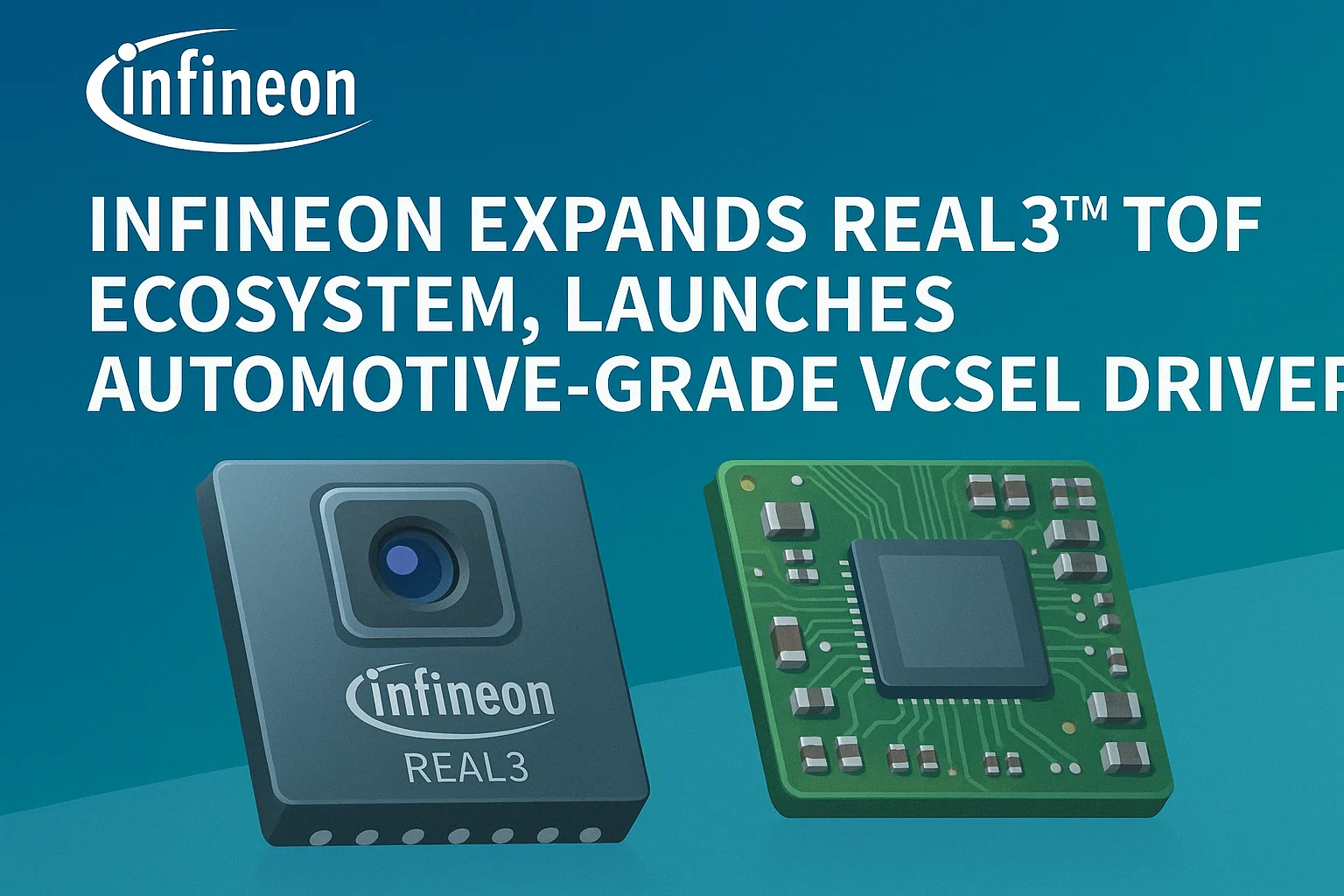
Infineon Expands REAL3™ ToF Ecosystem, Launches Automotive-Grade VCSEL Driver
The automotive industry is in the middle of a technological revolution. From autonomous driving to enhanced safety systems, advanced sensing technologies are the backbone of this transformation. Among them, Time-of-Flight (ToF) 3D image sensors are emerging as one of the most critical enablers of next-generation automotive applications. These sensors offer precise depth perception, enabling features like advanced driver assistance systems (ADAS), in-cabin monitoring, and gesture-based user interfaces.
According to recent estimates, the Automotive ToF 3D Image Sensor Market was valued at USD 188 million in 2024 and is projected to reach USD 721 million by 2032, registering a CAGR of 21.7% during the forecast period (2025-2032). This exponential growth reflects not just market momentum but also the technological advancements, regulatory push, and strategic collaborations shaping the landscape.
Access Your Free Sample Report- Automotive ToF 3D Image Sensor Market
Understanding Automotive ToF 3D Image Sensors
What is ToF Technology?
Time-of-Flight (ToF) is a depth-sensing technology that measures the time taken by light pulses to travel from a source to an object and back to the sensor. Unlike stereo vision or structured light, ToF delivers accurate 3D depth maps in real time with high efficiency and compact form factors, making it ideal for automotive environments.
Why ToF for Automotive?
- High accuracy in diverse lighting conditions
- Compact size for in-cabin and external integration
- Cost-effectiveness compared to LiDAR for short-range sensing
- Support for multiple use cases:
- Driver and Occupant Monitoring Systems (DMS/OMS)
- Gesture control
- Child Presence Detection (CPD)
- ADAS support and LiDAR systems
Market Overview and Growth Drivers
The market is witnessing a massive surge in demand, driven by factors such as:
- Stringent safety regulations: Euro NCAP protocols for CPD in 2025 mandate reliable in-cabin monitoring solutions.
- OEM push for premium features: Gesture-based infotainment controls and smart airbags.
- Rise of autonomous driving: LiDAR-based perception systems increasingly use ToF technology for depth sensing.
- Miniaturization and integration: Smaller sensors with integrated depth capabilities reduce cost and space constraints.
Market Projection:
- 2024: USD 188 million
- 2032: USD 721 million
- CAGR: 7%
The growth curve reflects how ToF sensors are evolving from luxury car features to mainstream requirements, driven by regulatory compliance and cost reductions.
Latest Industry Developments (2024-2025)
This is where we dive into the recent, verified news updates:
Sony Enters Automotive LiDAR with SPAD-based ToF Sensor
Sony Semiconductor Solutions has introduced the IMX479 stacked SPAD (Single-Photon Avalanche Diode) sensor, optimized for direct ToF (dToF) LiDAR applications in automotive.
- Significance: Sony’s entry strengthens the supply ecosystem for LiDAR receivers—key for autonomous driving systems.
- Features: High-resolution, high-speed ranging; sample shipments start in Autumn 2025.
- Impact: Expands Tier-1 supplier choices and accelerates LiDAR adoption.
Infineon Expands REAL3™ ToF Ecosystem
Infineon launched the IRS9103A automotive-grade VCSEL driver to complement its REAL3™ ToF sensor series. The company also showcased new compact ToF camera modules at CES 2025, designed for space-constrained cockpits.
- Advantage: Enables integration of ToF into compact in-cabin modules for DMS/OMS and gesture recognition.
- Why it matters: Reduces overall system cost and complexity for OEMs.
Download Sample Report PDF- Automotive ToF 3D Image Sensor Market
ToF for In-Cabin Monitoring Gets a Boost with Euro NCAP 2025
Euro NCAP’s 2025 protocols mandate Child Presence Detection (CPD) for top safety ratings. ToF cameras are emerging as the preferred technology for detecting unattended children in vehicles.
- Requirement: High reliability under all lighting conditions, including dark interiors.
- Result: OEMs are racing to integrate ToF sensors to meet compliance and avoid penalties.
Seeing Machines + Airy3D Launch Hybrid 2D+3D Camera
In May 2025, Seeing Machines and Airy3D introduced a 5MP RGB-IR camera with diffractive optics, offering 2D + depth capabilities in a single module.
- Implication: Competes with ToF for cost-sensitive models, but validates the trend toward 3D perception inside the cabin.
Melexis + emotion3D Demonstrate Multi-Function ToF Camera
The collaboration integrates DMS and OMS in a single ToF-based camera, showcased at CES and referenced in 2025 deployments.
- Value: One sensor for multiple monitoring functions reduces BOM cost and wiring complexity.
Key Application Areas of ToF Sensors in Automotive
- In-Cabin Safety and Monitoring:
- Child Presence Detection (CPD)
- Occupant classification for airbag deployment
- Driver drowsiness and attention monitoring
- Gesture-Based Controls:
- Infotainment and HVAC control without physical touch
- ADAS and Autonomous Driving:
- Short- to mid-range depth sensing
- Complements LiDAR and radar for enhanced environment mapping
Competitive Landscape
Major players include:
- Sony Semiconductor Solutions
- Infineon Technologies AG
- Melexis NV
- STMicroelectronics
- OMNIVISION Technologies
- Seeing Machines (in partnership with Airy3D)
Each player is investing in miniaturization, cost reduction, and automotive-grade certifications (AEC-Q100) to meet OEM demands.
Challenges and Opportunities
-
Challenges:
- High system cost compared to legacy IR sensors
- Harsh automotive environment (temperature, vibration)
- Need for robust cybersecurity for connected sensors
-
Opportunities:
- Integration with AI for predictive safety features
- Expanding beyond premium to mid-segment vehicles
- Use in electric and autonomous vehicle platforms
Click Here To Download Full Sample Report- Automotive ToF 3D Image Sensor Market
Future Outlook
By 2032, automotive ToF sensors will move from feature differentiators to regulatory-driven essentials, particularly for in-cabin safety. LiDAR integration will further boost demand as Level 3 autonomy becomes widespread. Combined with AI-driven analytics, ToF will become a core enabler of vehicle intelligence.
The automotive industry’s race toward autonomy, safety, and premium UX is accelerating ToF adoption. With major players like Sony and Infineon innovating and regulatory bodies setting strict safety mandates, ToF 3D image sensors are positioned for massive growth—from USD 188 million in 2024 to USD 721 million by 2032.

Comments (0)