

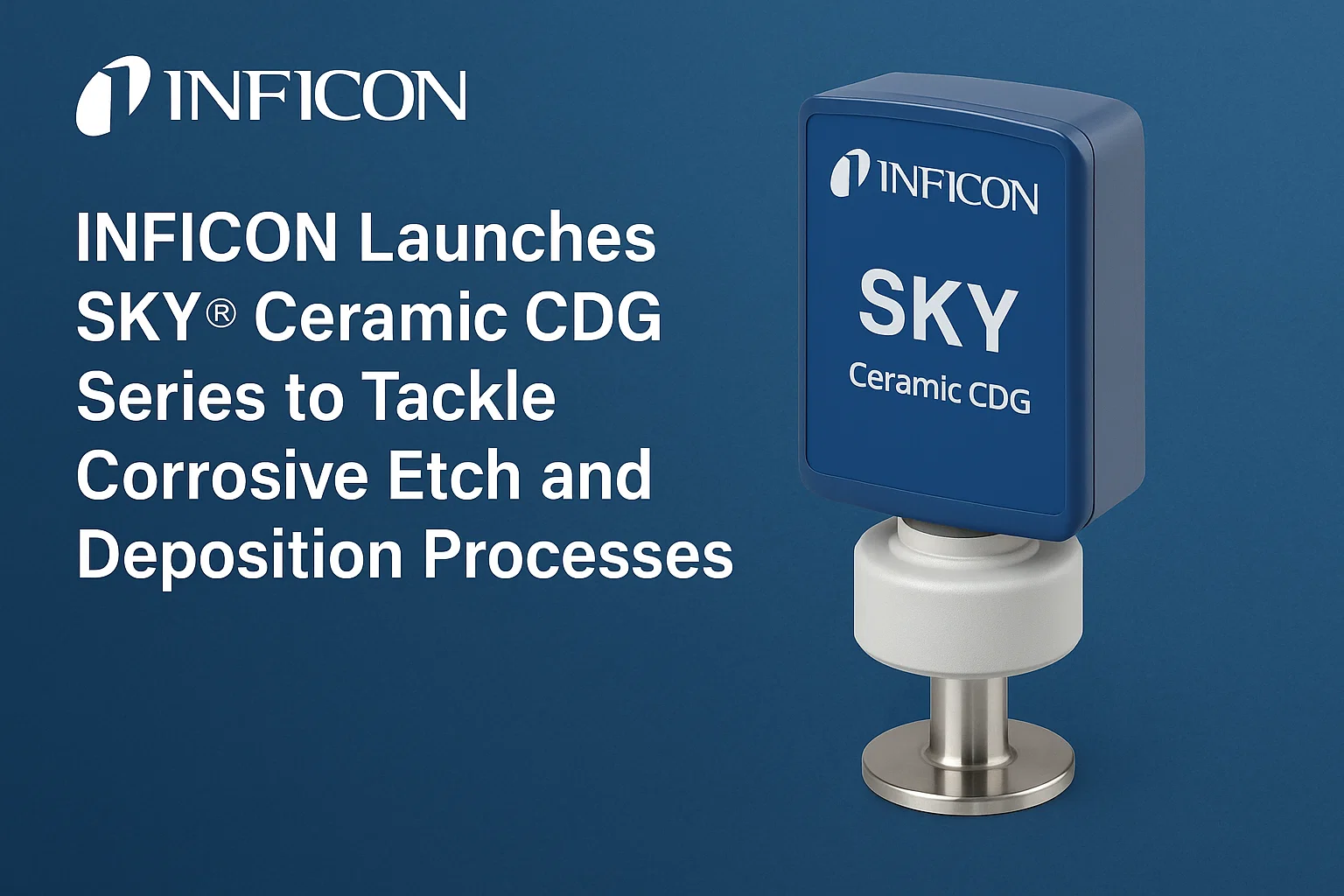
INFICON Launches SKY® Ceramic CDG Series to Tackle Corrosive Etch and Deposition Processes
The semiconductor industry is an intricate ecosystem where even the smallest measurement can have far-reaching consequences. Among the many technologies that enable wafer fabrication, deposition, etching, and packaging, Capacitance Diaphragm Gauges (CDGs) hold a special place. These gauges deliver ultra-precise vacuum and pressure measurements, ensuring that complex semiconductor manufacturing processes remain stable and reliable.
In 2024, the Semiconductor Capacitance Diaphragm Gauge market was valued at US$ 68.2 million. With growing reliance on advanced node manufacturing, expansion of foundry capacity, and demand for contamination-free process control, the market is expected to reach US$ 133 million by 2032, expanding at a CAGR of 10.1%. This steady growth reflects both the technological advancements being introduced by leading gauge manufacturers and the increasing adoption of high-performance CDGs in semiconductor fabs worldwide.
Access Your Free Sample Report- Semiconductor Capacitance Diaphragm Gauge (CDG) Market
Why CDGs Are Indispensable in Semiconductor Manufacturing
Before diving into the latest news, it’s essential to understand the unique value proposition of CDGs:
- Unparalleled Accuracy: CDGs provide pressure readings that are independent of gas type, unlike thermal-based sensors such as Pirani gauges. This makes them critical for processes involving exotic or corrosive gases.
- Stability Across Environments: Heated CDGs mitigate contamination and condensation, ensuring consistent performance even in chemically aggressive or high-deposition environments.
- Wide Dynamic Range: They measure from ultra-high vacuum up to several Torr, covering multiple process stages.
- Process Control Backbone: In applications like chemical vapor deposition (CVD), atomic layer deposition (ALD), and plasma etching, even slight pressure deviations can ruin wafer batches. CDGs provide the stability fabs demand.
In short, semiconductor fabs depend on CDGs for yield optimization, contamination control, and throughput efficiency.
Recent Developments in the Semiconductor CDG Industry
1. Pfeiffer Vacuum Expands Its CenterLine Family with CNR Series
Pfeiffer Vacuum, a long-standing leader in vacuum technology, recently introduced the CenterLine CNR series of analog capacitance gauges.
- Key Features:
- Covers a wide pressure range (0.1–1000 Torr).
- Available in both heated and unheated versions.
- Built to handle harsh semiconductor fab environments.
- Impact on the Market:
The introduction addresses the need for robust gauges in ALD and CVD processes, where temperature and contamination are major hurdles. By improving stability and offering enhanced analog output for tool integration, Pfeiffer is strengthening its foothold among fab OEMs.
This launch reflects a trend toward high-precision, environment-resistant gauges, tailored for cutting-edge semiconductor manufacturing.
2. INFICON SKY® Series: Ceramic Diaphragms for Harsh Processes
INFICON has consistently been one of the most innovative players in vacuum measurement. The company’s SKY® CDG family, including the CDG025D and X3 variants, has drawn attention for its ceramic diaphragm design.
- Advantages of Ceramic Over Metal Diaphragms:
- Superior resistance to corrosion from aggressive etching gases like chlorine and fluorine.
- Better long-term zero stability.
- Reduced drift at elevated process temperatures.
- Applications:
Primarily deployed in etch and deposition tools where plasma-based processes and corrosive chemistries demand reliability.
By offering ceramic diaphragms, INFICON directly responds to fab requirements for longevity, reduced maintenance downtime, and better process yields.
3. Industry-Wide Trend: Heated and Contamination-Resistant CDGs
A recurring theme across all major CDG suppliers is the introduction of heated capacitance manometers. These gauges prevent deposition of byproducts on the diaphragm, which could otherwise cause drift or signal errors.
- Why This Matters:
In deposition-heavy environments, like ALD of high-k dielectrics or CVD of metal layers, contamination on sensor diaphragms can shorten sensor life. Heated CDGs extend uptime and minimize recalibration needs. - Market Relevance:
As fabs continue to push 24/7 high-volume manufacturing, minimizing unscheduled downtime has become as critical as wafer yields. Heated CDGs represent a cost-saving measure as well as a process safeguard.
Download Sample Report PDF- Semiconductor Capacitance Diaphragm Gauge (CDG) Market
4. Hybrid Sensing Approaches: Combining CDGs with Other Technologies
Another noteworthy development is the industry’s exploration of hybrid gauges. These combine capacitance diaphragm sensing with Pirani or piezoelectric methods to extend dynamic range.
- Example: While CDGs excel in precision at low-to-medium vacuum ranges, they can be complemented with Pirani gauges for broader coverage in pump-down cycles.
- Emerging Research: Some academic projects and R&D centers are working on integrated sensor modules that use a single interface for multi-range vacuum control.
This signals a push toward smarter, compact, and modular sensor solutions that equipment OEMs can more easily integrate into next-gen process tools.
5. Patent Activity and Legal Developments
The semiconductor sensor industry is also seeing patent filings and litigation activity. Although not widely reported in mainstream financial press, trade journals and court filings suggest ongoing disputes between established vacuum gauge manufacturers and smaller firms over design patents and diaphragm innovations.
- Impact on Innovation:
These legal battles, while potentially slowing smaller players, also highlight the competitive nature of CDG design. Intellectual property around temperature compensation, diaphragm materials, and digital communication interfaces is seen as increasingly valuable.
This adds a layer of strategic maneuvering to an otherwise technology-driven market.
Market Dynamics Driving CDG Growth
The strong 10.1% CAGR from 2024 to 2032 is fueled by several interlinked factors:
- Advanced Node Manufacturing (3nm, 2nm, and beyond)
As device geometries shrink, the tolerance for process variation narrows. Pressure measurement precision offered by CDGs becomes mission-critical. - Rise of Compound Semiconductors
GaN, SiC, and other compound semiconductors require specialized etching and deposition processes where CDGs outperform alternatives. - Global Fab Expansion
The U.S., Europe, and Asia are investing billions into new fabs. Every fab tool that requires vacuum process control is a potential CDG installation. - Move Toward Green Manufacturing
CDGs help optimize gas flows and reduce waste, aligning with the semiconductor industry’s push for sustainability.
Challenges the Industry Faces
Despite the growth outlook, the CDG market is not without challenges:
- High Cost of Precision Gauges: Advanced heated CDGs can be expensive, limiting adoption among smaller fabs.
- Maintenance and Calibration: Even with improvements, periodic recalibration is essential. This can cause downtime.
- Competition from Alternative Technologies: MEMS-based vacuum sensors and hybrid solutions pose a potential challenge if they achieve comparable precision at lower cost.
- Geopolitical Supply Chain Risks: The semiconductor supply chain is highly globalized. Restrictions on technology exports or rare material supplies could disrupt CDG availability.
Click Here To Download Full Sample Report- Semiconductor Capacitance Diaphragm Gauge (CDG) Market
The Road Ahead: What to Expect by 2032
Looking at current innovations and fab investments, here’s what the future may hold:
- Wider Adoption of Ceramic Diaphragms: Given their durability, ceramic-based CDGs may become the industry standard.
- Smart Connected Gauges: Integration with IoT platforms for real-time diagnostics and predictive maintenance will gain traction.
- Miniaturized Multi-Sensor Modules: Equipment OEMs may prefer modular sensor blocks that combine CDG precision with broad-range sensing.
- Sustainability as a Differentiator: Gauges that reduce gas consumption or minimize recalibration waste could attract greater market share.
The Semiconductor Capacitance Diaphragm Gauge market is poised for strong growth, nearly doubling in size by 2032. With major players like Pfeiffer Vacuum and INFICON leading innovations in heated, ceramic, and hybrid gauges, the industry is evolving to meet the rigorous demands of advanced fabs.

Comments (0)