
Industry Trends, Trade Structures, and Regulatory Environment for Fusion Vision Computing Chips Market
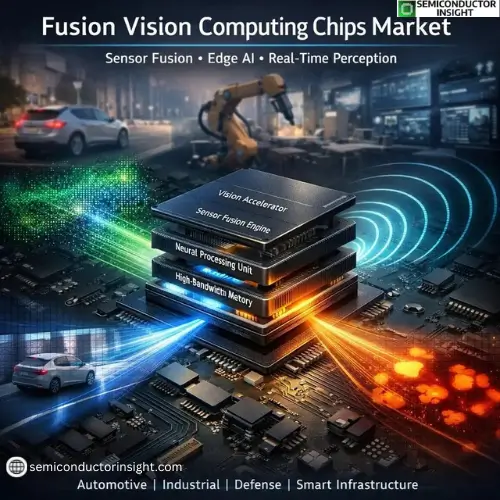
Fusion vision computing chips are advanced semiconductor devices designed to process and combine visual data from multiple sensor sources such as cameras, LiDAR, radar, infrared, and depth sensors into a unified, real-time understanding of an environment. Rather than treating visual inputs independently, these chips integrate perception layers directly at the silicon level, enabling faster decisions, lower latency, and reduced reliance on cloud processing.
Fusion Vision Computing Chips Market sits at the intersection of computer vision, edge AI, and sensor fusion, making it a foundational technology for autonomous systems and intelligent machines.
Why This Market Is Gaining Strategic Importance?
Modern machines no longer rely on a single set of eyes. Autonomous vehicles, industrial robots, defence platforms, and smart infrastructure require contextual awareness under varying conditions low light, fog, motion blur, or electromagnetic interference. Fusion vision chips address these challenges by correlating multiple data streams simultaneously, improving accuracy and operational reliability.
This shift has transformed vision processing from a software-heavy task into a hardware-accelerated function, directly expanding market demand for specialized chips.
Application Landscape Shaping Market Demand
- Fusion vision computing chips are increasingly embedded where real-time perception is mission-critical.
- Automotive manufacturers integrate them into advanced driver-assistance systems and autonomous driving stacks.
- Industrial automation uses them for precision robotics, defect detection, and safety monitoring.
- Defence and aerospace applications rely on fused vision for surveillance, navigation, and threat assessment.
- Beyond these, logistics automation, smart cities, and medical imaging platforms are emerging demand pockets, expanding the market beyond its initial early-adopter base.
How Fusion Vision Computing Works?
Multi-Sensor Input → Data Synchronization → Vision Fusion Engine → AI Inference Layer → Real-Time Action Output
This processing architecture allows systems to interpret scenes holistically rather than sequentially, significantly improving reaction speed and decision confidence.
Import Export Dynamics Influencing Supply Chains
The trade landscape for fusion vision computing chips reflects the broader semiconductor ecosystem, with design, fabrication, and integration often distributed across regions. Advanced chip design and architecture development are concentrated in technology-driven economies, while fabrication depends heavily on specialized foundries with advanced process nodes.
Export controls and trade compliance requirements influence cross-border shipments, particularly for chips used in defence, autonomous mobility, or surveillance applications. As a result, companies increasingly diversify sourcing strategies, establish regional assembly hubs, and invest in supply chain transparency to ensure uninterrupted access to critical components.
Take a Quick Glance at Our In-Depth Analysis Report:
https://semiconductorinsight.com/report/fusion-vision-computing-chips-market/
Regulatory Frameworks Guiding Market Adoption
Regulatory oversight plays a defining role in this market, especially because fusion vision chips power systems that interact directly with people and public infrastructure. Safety certification standards in automotive, aviation, and industrial robotics dictate performance validation, redundancy requirements, and fault tolerance thresholds.
Data protection and AI governance regulations also shape chip design, encouraging on-device processing to limit raw data transmission. In parallel, national semiconductor policies promote domestic chip development to reduce reliance on imports for strategic technologies. These frameworks collectively influence design priorities, market entry timelines, and regional adoption patterns.
Technology Differentiation at the Silicon Level
Competition within the fusion vision computing chips market centres on processing efficiency, thermal performance, and scalability. Leading solutions integrate dedicated vision accelerators, neural processing units, and memory architectures optimized for parallel data handling.
Rather than pursuing raw compute power alone, manufacturers focus on balancing performance with energy efficiency, particularly for edge deployments where power budgets are constrained. This emphasis has accelerated innovation in heterogeneous computing architectures.
Market Structure and Commercial Relationships
This market favors long-term partnerships over transactional sales. End users typically engage chip vendors early in system design phases, co-developing solutions tailored to specific use cases. Qualification cycles are extensive, especially in regulated industries, reinforcing supplier stickiness once a platform is approved.
As a result, market expansion depends as much on design wins and platform adoption as on overall semiconductor volume growth.
Regional Adoption Patterns in Practical Terms
Developed manufacturing regions lead early adoption due to established automation ecosystems and strong R&D investments. Meanwhile, fast-industrializing economies are integrating fusion vision technologies into smart factories, urban infrastructure, and logistics hubs, gradually expanding global demand.
Rather than rapid spikes, adoption progresses through phased deployment, pilot programs, and scaled rollouts, supporting steady market expansion.
Forward-Looking Market Signals
The future of the fusion vision computing chips market is closely tied to the evolution of intelligent machines. As systems become more autonomous and context-aware, reliance on multi-sensor perception hardware will intensify.
Lastly, the key momentum drivers in the aimed market includes; the expansion of edge AI deployments, the growing complexity of autonomous platforms, and the increased emphasis on on-device intelligence for enhanced data security.

Comments (0)