
MARKET INSIGHTS
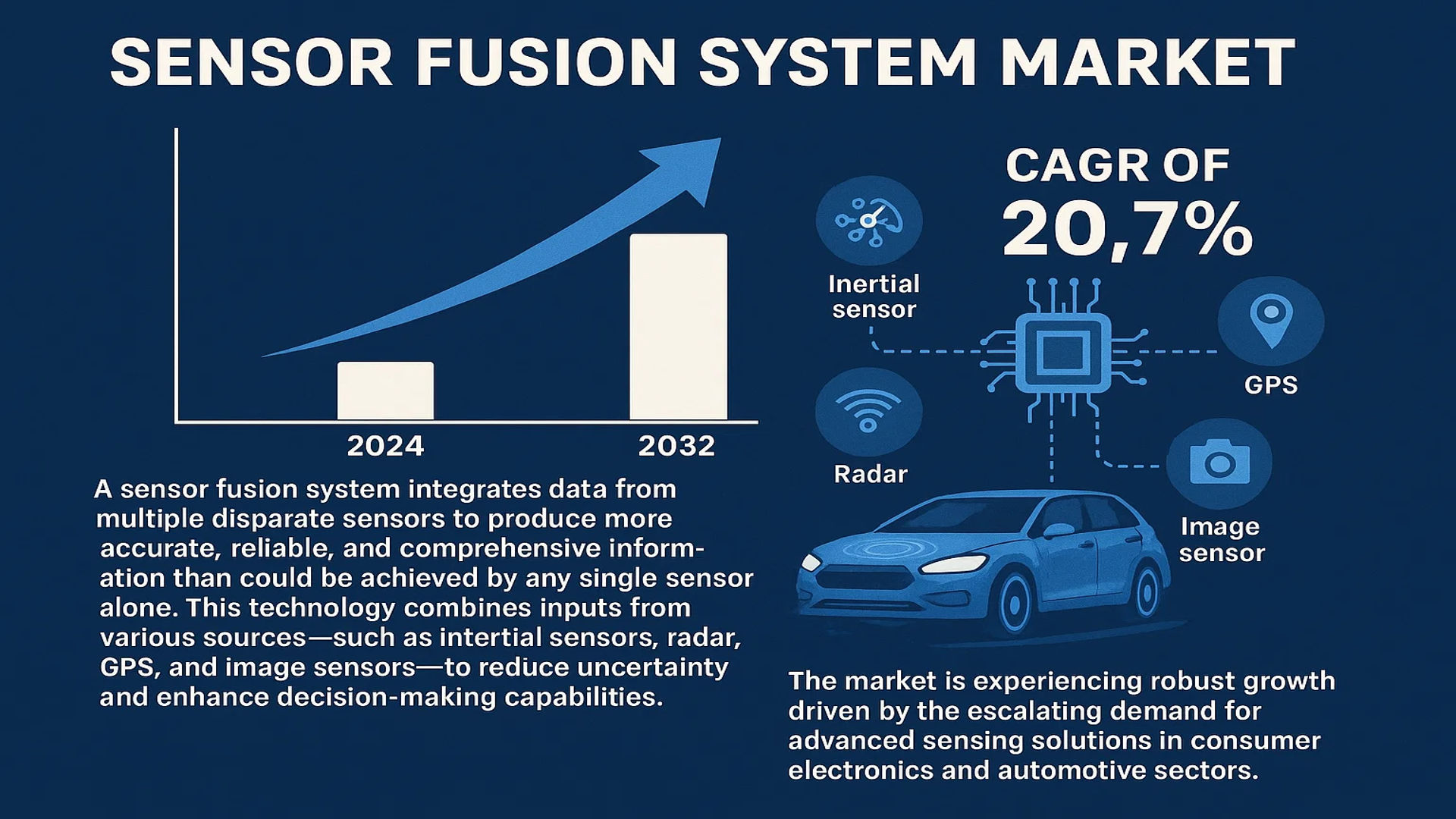
The global Sensor Fusion System Market was valued at 4998 million in 2024 and is projected to reach US$ 18100 million by 2032, at a CAGR of 20.7% during the forecast period.
A Sensor Fusion System integrates data from multiple disparate sensors to produce more accurate, reliable, and comprehensive information than could be achieved by any single sensor alone. This technology combines inputs from various sources—such as inertial sensors, radar, GPS, and image sensors—to reduce uncertainty and enhance decision-making capabilities. These systems are critical components in applications requiring high precision and contextual awareness.
The market is experiencing robust growth driven by the escalating demand for advanced sensing solutions in consumer electronics and automotive sectors. The proliferation of Internet of Things (IoT) devices and the push towards autonomous vehicles are significant contributors, because they rely heavily on fused sensor data for navigation and environmental interaction. Furthermore, increasing investments in robotics and smart infrastructure are propelling market expansion. Key players, including Invensense, STMicroelectronics, and NXP Semiconductors, collectively hold approximately 50% of the market share, underscoring a concentrated competitive landscape. These companies are continuously innovating to enhance system integration and performance, further fueling market advancement.
MARKET DYNAMICS
MARKET DRIVERS
Proliferation of Smart Devices and IoT Ecosystems to Accelerate Market Expansion
The exponential growth in smart devices and Internet of Things (IoT) applications is a primary catalyst for the sensor fusion system market. Modern smartphones, wearables, smart home devices, and industrial IoT solutions increasingly rely on multiple sensors—such as accelerometers, gyroscopes, magnetometers, and environmental sensors—to deliver enhanced user experiences and operational efficiency. Sensor fusion algorithms integrate data from these disparate sources to provide more accurate, reliable, and context-aware information. The consumer electronics segment, which accounts for over 40% of the market, continues to drive demand as manufacturers integrate advanced features like augmented reality, gesture recognition, and improved navigation. Shipments of IoT devices are projected to exceed 30 billion units globally by 2030, further underscoring the critical role of sensor fusion in enabling seamless and intelligent functionality across connected ecosystems.
Rising Adoption of Autonomous and Electric Vehicles to Fuel Demand
Autonomous driving systems and electric vehicles represent another significant growth driver for sensor fusion technologies. These systems depend on the integration of data from LiDAR, radar, cameras, and inertial measurement units to perceive the environment, navigate safely, and make real-time decisions. The automotive industry’s shift toward higher levels of automation, coupled with stringent safety regulations, necessitates robust sensor fusion solutions that minimize uncertainty and enhance reliability. Global sales of electric vehicles surpassed 10 million in 2023 and are expected to grow at a compound annual growth rate of over 25%, further amplifying the need for sophisticated sensor fusion systems to manage battery efficiency, thermal management, and advanced driver-assistance systems (ADAS).
Advancements in AI and Machine Learning to Enhance Sensor Fusion Capabilities
Artificial intelligence and machine learning are revolutionizing sensor fusion by enabling more sophisticated data processing, pattern recognition, and predictive analytics. These technologies allow sensor fusion systems to learn from historical data, adapt to changing environments, and improve accuracy over time. For instance, AI-driven sensor fusion is increasingly deployed in industrial automation for predictive maintenance, in healthcare for remote patient monitoring, and in smart cities for traffic management and energy optimization. Investments in AI for edge computing and IoT applications are growing rapidly, with annual spending projected to increase by over 30% in the next five years, thereby creating a fertile ground for innovation and adoption in the sensor fusion market.
MARKET RESTRAINTS
High Development and Integration Costs to Hinder Widespread Adoption
While sensor fusion systems offer significant benefits, their development and integration entail substantial costs that can act as a barrier to adoption, particularly for small and medium-sized enterprises. Designing, testing, and calibrating multi-sensor systems require specialized expertise, advanced simulation tools, and extensive validation processes to ensure reliability and accuracy. Additionally, integrating these systems into existing infrastructure often involves retrofitting or redesigning products, which can be both time-consuming and expensive. In price-sensitive markets and industries with thin profit margins, these high upfront costs may deter investment, slowing down the pace of adoption despite the long-term advantages that sensor fusion can deliver.
Complexity in Data Synchronization and Calibration to Pose Technical Challenges
Sensor fusion systems face inherent technical challenges related to data synchronization, calibration, and handling sensor discrepancies. Variations in sensor response times, environmental conditions, and hardware imperfections can lead to misalignment and errors in the fused output. Achieving precise time synchronization among heterogeneous sensors is particularly difficult in dynamic applications such as autonomous vehicles and drones, where even millisecond delays can compromise safety and performance. Moreover, calibrating sensors to maintain accuracy over time requires continuous monitoring and adjustments, adding to the operational complexity and cost. These technical hurdles can limit the effectiveness of sensor fusion systems and necessitate ongoing research and development to overcome them.
Limited Standardization and Interoperability to Restrain Market Growth
The lack of universal standards and interoperability among sensor technologies and fusion algorithms presents a significant restraint for the market. Different manufacturers often use proprietary protocols, data formats, and interfaces, making it challenging to integrate sensors from multiple vendors into a cohesive system. This fragmentation can lead to compatibility issues, increased development time, and higher costs for system integrators and end-users. Furthermore, the absence of widely accepted benchmarks for evaluating sensor fusion performance makes it difficult for customers to compare solutions and for regulators to establish consistent safety and quality guidelines. Efforts toward standardization are underway, but progress remains slow, impeding the seamless adoption of sensor fusion across diverse applications and industries.
MARKET OPPORTUNITIES
Expansion into Emerging Applications such as Healthcare and Robotics to Unlock New Growth Avenues
Sensor fusion systems are finding new and lucrative opportunities in emerging fields such as healthcare, robotics, and environmental monitoring. In healthcare, these systems are being used in wearable devices for continuous health tracking, in surgical robots for precision control, and in diagnostic equipment for enhanced imaging and analysis. The global market for medical robotics is expected to surpass $20 billion by 2030, driven by an aging population and increasing demand for minimally invasive procedures. Similarly, in industrial and service robotics, sensor fusion enables better navigation, object recognition, and human-robot collaboration. These applications represent high-growth segments where the ability to combine and interpret data from multiple sensors can significantly improve outcomes and operational efficiency.
Growth of Smart Infrastructure and Cities to Drive Demand for Advanced Sensing Solutions
The global push toward smart cities and intelligent infrastructure is creating substantial opportunities for sensor fusion systems. These systems are integral to managing urban challenges such as traffic congestion, energy consumption, public safety, and environmental pollution. By fusing data from cameras, acoustic sensors, air quality monitors, and other sources, cities can optimize traffic flow, reduce energy usage, and enhance emergency response times. Governments worldwide are investing heavily in smart city initiatives, with projected spending exceeding $500 billion annually by 2030. This investment will likely spur demand for robust, scalable sensor fusion solutions that can handle the complexity and volume of data generated by urban environments.
Advancements in Edge Computing and 5G to Enable Real-Time Sensor Fusion Applications
The convergence of edge computing and 5G technology is set to revolutionize sensor fusion by enabling real-time data processing and low-latency communication. Edge computing allows sensor data to be processed closer to the source, reducing the need for extensive bandwidth and minimizing latency, which is critical for applications like autonomous driving and industrial automation. Meanwhile, 5G networks provide the high-speed, reliable connectivity needed to transmit large volumes of sensor data quickly and efficiently. Together, these technologies facilitate the deployment of sophisticated sensor fusion systems in scenarios where immediate decision-making is essential. The rollout of 5G infrastructure and the growing adoption of edge computing are expected to accelerate the development of new sensor fusion applications and drive market growth in the coming years.
MARKET CHALLENGES
Data Security and Privacy Concerns to Challenge Market Penetration
As sensor fusion systems become more pervasive, they generate vast amounts of data, raising significant concerns about security and privacy. Many of these systems are deployed in sensitive environments, such as healthcare, automotive, and smart homes, where data breaches could have serious consequences. Ensuring the confidentiality, integrity, and availability of fused sensor data is a complex task, particularly when data is transmitted over networks or stored in cloud environments. Cybersecurity threats, including hacking, data manipulation, and unauthorized access, pose ongoing risks that must be addressed through robust encryption, authentication, and intrusion detection mechanisms. Additionally, complying with evolving data privacy regulations across different regions adds another layer of complexity for manufacturers and integrators.
Power Consumption and Thermal Management Issues to Limit Deployment in Portable Devices
Sensor fusion systems, especially those used in portable and battery-operated devices, face challenges related to power consumption and thermal management. Integrating multiple sensors and running complex fusion algorithms can be computationally intensive, leading to increased energy usage and heat generation. This is particularly problematic for wearable devices, smartphones, and IoT nodes, where battery life is a critical factor influencing user adoption. Manufacturers must balance performance with power efficiency, often requiring innovative designs in hardware and software to minimize energy draw without compromising functionality. Advances in low-power sensor technologies and energy-efficient processing architectures are helping to mitigate this challenge, but it remains a key consideration in product development.
Regulatory and Certification Hurdles to Slow Time-to-Market
Sensor fusion systems used in safety-critical applications, such as automotive, aerospace, and medical devices, must undergo rigorous regulatory scrutiny and certification processes. These processes ensure that the systems meet stringent standards for reliability, accuracy, and safety but can be time-consuming and costly. Navigating the varying requirements of different regulatory bodies across regions adds further complexity and can delay product launches. For example, automotive sensor fusion systems must comply with standards such as ISO 26262 for functional safety, while medical devices require approvals from agencies like the FDA or CE marking. These regulatory hurdles can slow innovation and increase the overall cost of bringing advanced sensor fusion solutions to market.
SENSOR FUSION SYSTEM MARKET TRENDS
Integration of Artificial Intelligence and Machine Learning to Emerge as a Pivotal Trend
The integration of Artificial Intelligence (AI) and Machine Learning (ML) algorithms is fundamentally transforming sensor fusion systems, enabling more sophisticated data processing and real-time decision-making capabilities. These advanced algorithms can intelligently weigh inputs from disparate sensors, such as inertial measurement units (IMUs), LiDAR, radar, and cameras, to create a more accurate and reliable environmental model. This is particularly critical for autonomous vehicles, where the system must process terabytes of data per day to navigate safely. The ability of AI to learn from previous data and improve its fusion algorithms over time significantly reduces uncertainty and enhances the overall robustness of the system, making it a cornerstone of next-generation applications in automotive, robotics, and industrial automation.
Other Trends
Proliferation in Consumer Electronics and IoT Devices
The demand for sophisticated sensor fusion systems is experiencing a massive upswing driven by the consumer electronics sector, particularly in smartphones, wearables, and smart home devices. Modern smartphones now incorporate a suite of sensors—including accelerometers, gyroscopes, magnetometers, and barometers—whose fused data enables features like advanced gesture control, precise activity tracking, and enhanced augmented reality experiences. This trend is further amplified by the explosive growth of the Internet of Things (IoT), where interconnected devices rely on fused sensor data to automate environments and provide intelligent insights. The miniaturization of sensor packages and the development of low-power fusion algorithms are key enablers, allowing for these complex functionalities to be packed into increasingly smaller form factors without sacrificing battery life.
Accelerated Adoption in Automotive Safety and Autonomous Driving
The automotive industry represents one of the largest and fastest-growing applications for sensor fusion technology, primarily fueled by the global push towards advanced driver-assistance systems (ADAS) and fully autonomous vehicles. Modern vehicles are equipped with a complex array of sensors, including cameras, radar, ultrasonic sensors, and LiDAR. Sensor fusion is the critical technology that combines this heterogeneous data to provide a 360-degree, high-fidelity view of the vehicle’s surroundings, which is non-negotiable for functions like automatic emergency braking, adaptive cruise control, and lane-keeping assistance. The stringent safety requirements and the need for functional redundancy in autonomous driving are compelling automakers and tier-1 suppliers to invest heavily in developing and refining sensor fusion solutions, making it a central pillar of automotive innovation.
COMPETITIVE LANDSCAPE
Key Industry Players
Companies Strive to Strengthen their Product Portfolio to Sustain Competition
The global sensor fusion system market exhibits a semi-consolidated competitive structure, characterized by a dynamic mix of established semiconductor giants, specialized technology firms, and innovative startups. The market is dominated by a handful of key players who collectively hold approximately 50% of the total market share, creating a competitive environment where technological innovation and strategic partnerships are crucial for maintaining market position.
InvenSense (a TDK Group company) and STMicroelectronics are recognized as frontrunners in this space. InvenSense’s dominance is largely attributed to its advanced inertial combo sensors and strong foothold in the consumer electronics sector, particularly in smartphones and wearable devices. Their revenue from sensor fusion solutions has shown consistent growth, driven by increasing adoption in automotive and IoT applications. Meanwhile, STMicroelectronics maintains a robust market presence through its comprehensive portfolio of MEMS sensors and integrated solutions, supported by significant R&D investments and global manufacturing capabilities.
NXP Semiconductors and Bosch Sensortec GmbH also command significant market shares. NXP’s strength lies in its automotive-grade sensor fusion solutions, which are critical for advanced driver-assistance systems (ADAS) and autonomous vehicle development. The company’s recent collaborations with major automotive OEMs have further solidified its position. Bosch Sensortec, as a division of the technology giant Robert Bosch GmbH, leverages its parent company’s automotive expertise and industrial scale to deliver reliable sensor fusion systems for both consumer and industrial applications.
These leading companies are actively engaged in strategic initiatives to expand their market influence. Recent developments include numerous product launches featuring improved power efficiency, enhanced accuracy, and smaller form factors. Furthermore, several players have pursued acquisitions and partnerships to integrate complementary technologies and expand their geographical reach, particularly in emerging markets across Asia-Pacific.
Meanwhile, companies like Analog Devices and Renesas Electronics Corporation are strengthening their positions through significant investments in R&D focused on next-generation sensor fusion algorithms and hardware solutions. Their efforts are particularly notable in industrial applications and environmental monitoring systems, where precision and reliability are paramount. These companies are also expanding their software capabilities to provide more sophisticated data processing and machine learning integration, addressing the growing complexity of multi-sensor environments.
List of Key Sensor Fusion System Companies Profiled
- InvenSense (US) – A TDK Group Company
- STMicroelectronics (Switzerland)
- NXP Semiconductors (Netherlands)
- Bosch Sensortec GmbH (Germany)
- Kionix (US) – A Rohm Group Company
- Analog Devices, Inc. (US)
- Renesas Electronics Corporation (Japan)
- Hillcrest Labs (US)
- Microchip Technology Inc. (US)
- Senion (Sweden)
- Baselabs GmbH (Germany)
- Memsic, Inc. (US)
Segment Analysis:
By Type
Inertial Combo Sensors Segment Dominates the Market Due to Pervasive Use in Consumer Electronics and Automotive Systems
The market is segmented based on type into:
- Inertial Combo Sensors
- Subtypes: Accelerometer + Gyroscope, Accelerometer + Gyroscope + Magnetometer, and others
- Radar + Image Sensors
- Environmental Sensors
- Subtypes: Temperature + Humidity Sensors, Pressure + Gas Sensors, and others
- IMU + GPS
- Others
By Application
Consumer Electronics Segment Leads Due to High Integration in Smartphones, Wearables, and IoT Devices
The market is segmented based on application into:
- Consumer Electronics
- Automotive
- Military Application
- Environmental Controlling
- Robotics
- Others
By Solution
Hardware Solutions Hold a Significant Share Due to the Critical Need for Advanced Sensor Components and Integrated Circuits
The market is segmented based on solution into:
- Hardware Solutions
- Subtypes: Sensor Hubs, Integrated Circuits, and others
- Software Solutions
- Subtypes: Algorithm Libraries, Development Platforms, and others
Regional Analysis: Sensor Fusion System Market
North America
North America is a dominant force in the global sensor fusion system market, holding a share of approximately 30%. This leadership is driven by a robust ecosystem of semiconductor and technology companies, including key players like Invensense, Analog Devices, and Kionix. The region’s advanced automotive sector, particularly in the United States, is a primary consumer, integrating sophisticated sensor fusion for Advanced Driver-Assistance Systems (ADAS) and autonomous driving functionalities. Furthermore, a strong consumer electronics market, stringent safety regulations mandating advanced sensor systems, and significant investments in military and aerospace applications contribute to sustained demand. The market is characterized by a high adoption rate of cutting-edge technologies and a focus on developing low-power, high-accuracy solutions for next-generation devices.
Europe
Europe matches North America’s market share of around 30%, underpinned by its formidable automotive industry and strict regulatory standards. German automotive giants and tier-one suppliers are at the forefront of integrating radar + image sensor fusion for pedestrian detection, collision avoidance, and automated parking systems. The region’s industrial automation and robotics sectors also present significant opportunities, utilizing inertial combo sensors for precise motion tracking and control. European Union policies promoting vehicle safety and emissions reduction continue to be a major market driver. Additionally, a presence of leading semiconductor firms like STMicroelectronics and NXP Semiconductors ensures a steady pipeline of innovation, focusing on compliance, reliability, and performance in harsh operational environments.
Asia-Pacific
The Asia-Pacific region is the fastest-growing market for sensor fusion systems, propelled by its massive consumer electronics manufacturing base and expanding automotive production. While it currently holds a smaller revenue share compared to North America and Europe, its volume consumption is immense and accelerating. China is the epicenter of this growth, driven by domestic smartphone manufacturers and national initiatives in autonomous vehicle development. Countries like Japan and South Korea contribute significantly with their technological expertise in MEMS sensors and automotive electronics. However, the market is highly cost-competitive, which can sometimes prioritize the adoption of more established sensor types over the latest innovations. The long-term trajectory remains strongly positive, fueled by urbanization, rising disposable incomes, and increasing technological sophistication across various industries.
South America
The sensor fusion system market in South America is in a developing phase. Growth is primarily linked to the automotive sector in countries like Brazil and Argentina, where modern vehicles equipped with basic ADAS features are gaining traction. Economic volatility and currency fluctuations, however, can impede large-scale investments in advanced sensor technologies by both manufacturers and consumers. The market tends to lag in adopting the latest high-end fusion systems, often relying on imported components and solutions. Despite these challenges, the gradual modernization of industrial infrastructure and a growing middle class present a foundational base for future market expansion as economic conditions stabilize.
Middle East & Africa
This region represents an emerging market with niche opportunities. Development is concentrated in wealthier Gulf Cooperation Council (GCC) nations like Saudi Arabia and the UAE, where investments in smart city initiatives, security, and surveillance systems drive demand for environmental and image-based sensor fusion. The automotive market is also evolving, with luxury vehicle segments incorporating advanced sensor systems. However, broader market penetration is constrained by limited local manufacturing capabilities, reliance on imports, and a focus on more immediate infrastructure needs over sophisticated technological integration. Long-term potential exists, particularly as part of larger economic diversification plans away from oil dependency, but growth is expected to be measured and incremental.
Report Scope
This market research report provides a comprehensive analysis of the global Sensor Fusion System market, covering the forecast period 2025–2032. It offers detailed insights into market dynamics, technological advancements, competitive landscape, and key trends shaping the industry.
Key focus areas of the report include:
- Market Size & Forecast: Historical data and future projections for revenue, unit shipments, and market value across major regions and segments.
- Segmentation Analysis: Detailed breakdown by product type, technology, application, and end-user industry to identify high-growth segments and investment opportunities.
- Regional Outlook: Insights into market performance across North America, Europe, Asia-Pacific, Latin America, and the Middle East & Africa, including country-level analysis where relevant.
- Competitive Landscape: Profiles of leading market participants, including their product offerings, R&D focus, manufacturing capacity, pricing strategies, and recent developments such as mergers, acquisitions, and partnerships.
- Technology Trends & Innovation: Assessment of emerging technologies, integration of AI/IoT, semiconductor design trends, fabrication techniques, and evolving industry standards.
- Market Drivers & Restraints: Evaluation of factors driving market growth along with challenges, supply chain constraints, regulatory issues, and market-entry barriers.
- Stakeholder Analysis: Insights for component suppliers, OEMs, system integrators, investors, and policymakers regarding the evolving ecosystem and strategic opportunities.
Primary and secondary research methods are employed, including interviews with industry experts, data from verified sources, and real-time market intelligence to ensure the accuracy and reliability of the insights presented.
FREQUENTLY ASKED QUESTIONS:
What is the current market size of Global Sensor Fusion System Market?
-> Sensor Fusion System Market was valued at 4998 million in 2024 and is projected to reach US$ 18100 million by 2032, at a CAGR of 20.7% during the forecast period.
Which key companies operate in Global Sensor Fusion System Market?
-> Key players include Invensense, STMicroelectronics, NXP Semiconductors, Bosch Sensortec GmbH, and Kionix, among others.
What are the key growth drivers?
-> Key growth drivers include rising demand in consumer electronics, automotive ADAS systems, and increasing adoption in robotics and industrial automation.
Which region dominates the market?
-> North America and Europe are the largest markets, each holding approximately 30% share, followed by the Asia-Pacific region.
What are the emerging trends?
-> Emerging trends include integration of AI for enhanced data processing, development of low-power solutions for IoT devices, and increased use in autonomous vehicles and smart infrastructure.

Get Sample Report PDF for Exclusive Insights
Report Sample Includes
- Table of Contents
- List of Tables & Figures
- Charts, Research Methodology, and more...
 Download Sample Report PDF


