
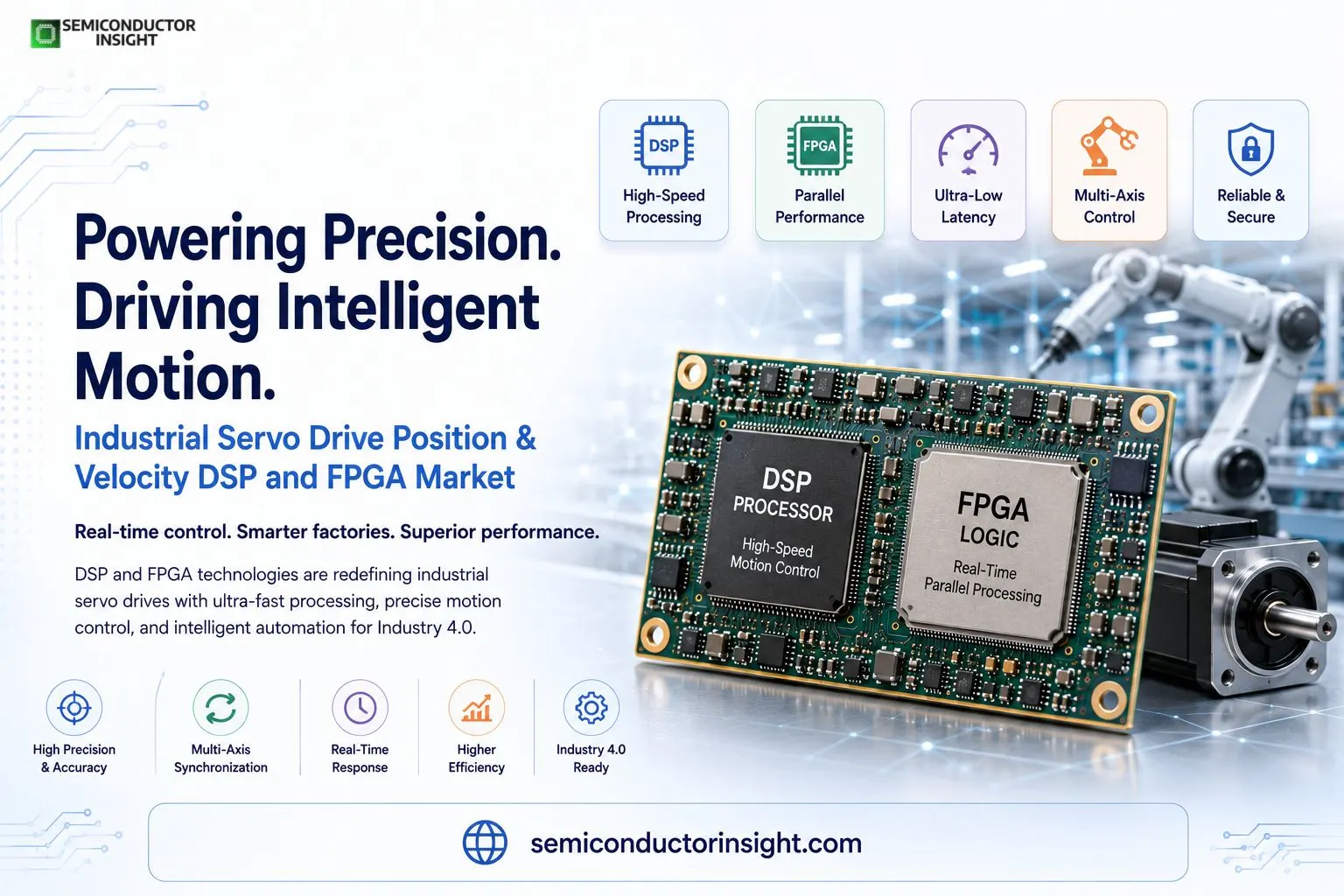
Industrial Servo Drive DSP and FPGA Market Intelligence Redefining Smart Motion Control Systems
Industrial automation is entering a phase where motion precision is becoming as valuable as computing power. Across semiconductor fabrication plants, EV battery facilities, robotic assembly lines, and packaging systems, industrial servo drives powered by DSP and FPGA architectures are becoming the silent backbone of intelligent manufacturing.
The Industrial Servo Drive Position and Velocity DSP plus FPGA Market is no longer evolving around simple motor control. It is now deeply connected with edge computing, AI-assisted automation, semiconductor processing, and ultra-fast real-time industrial communication systems.
Modern factories are demanding motion systems capable of controlling thousands of synchronized operations within microseconds. This is where digital signal processors and field programmable gate arrays are transforming servo drive engineering.
DSP chips provide high-speed mathematical processing for motion algorithms, while FPGA platforms deliver parallel computing and ultra-low latency performance for multi-axis synchronization. Together, these semiconductor technologies are enabling motion systems that are faster, more adaptive, and significantly more energy efficient than traditional architectures.
Control Architecture Adoption in New Drives
- In 2025, DSP-only solutions account for the largest share of new drives shipped at 42%, reflecting their strong balance of performance and cost efficiency.
- FPGA plus DSP hybrid architectures follow closely at 38%, showing growing demand for flexible and high-performance control systems.
- SoC FPGA solutions with HPS hold 12%, while FPGA-only systems represent 8% of shipments, indicating a smaller but still relevant share in specialized applications.
Semiconductor Intelligence Moving Inside Factory Motion Systems
Industrial servo systems were once designed mainly for torque and speed regulation. Today, semiconductor-driven servo architectures are becoming intelligent decision-making systems integrated directly into smart manufacturing networks. Companies building semiconductor fabs, advanced robotics, and precision CNC equipment are increasingly relying on FPGA-enabled motion controllers to reduce signal delay and improve positional accuracy during high-speed manufacturing operations.
- Recent automation engineering publications and industrial case studies show that EtherCAT-based servo communication systems are expanding rapidly because of their ability to handle synchronized motion with minimal latency.
- High-performance FPGA chips are particularly valuable in these environments because they process multiple real-time control loops simultaneously without sacrificing system responsiveness.
In semiconductor wafer handling systems, even microscopic positioning errors can affect manufacturing yield. This has increased demand for FPGA-driven servo control systems inside cleanroom robotics where nanometer-level movement precision is essential.
Curious about the report? Dive into our newest updated version at no cost: https://semiconductorinsight.com/report/industrial-servo-drive-position-velocity-dsp-fpga-market/
Robotics Expansion Accelerating DSP and FPGA Adoption
- The global robotics surge is directly reshaping the industrial servo drive ecosystem.
- Automotive assembly plants, electronics manufacturers, and warehouse automation systems are deploying more robotic arms that require advanced motion coordination between multiple servo axes.
- DSP processors are increasingly being used to optimize velocity calculations, adaptive feedback loops, and predictive motion correction in robotic environments.
- Industrial automation articles published during 2026 highlighted how collaborative robots are creating fresh demand for compact servo systems with integrated AI-assisted motion processing.
- Some advanced servo drives now include embedded machine learning models capable of adjusting motor response based on vibration patterns and load conditions during live production cycles.
- Japan, South Korea, Germany, and China remain among the strongest adopters of high-performance servo platforms because of their dominance in industrial robotics and semiconductor equipment manufacturing.
- Japan continues to lead in ultra-precision servo technologies used in semiconductor fabrication tools and advanced robotic machining systems.
FPGA Architectures Becoming Critical for Real Time Manufacturing
One of the biggest transformations happening inside industrial motion systems is the migration toward FPGA-based architectures. FPGAs are very useful in synchronised motion situations with dozens of servo motors because they perform numerous actions at once, unlike traditional controllers that conduct tasks sequentially.
Recent FPGA technology reports show that industrial automation, edge computing, automotive electronics, and embedded AI applications are contributing to strong FPGA demand growth. Mid-range FPGA devices are seeing rising adoption across industrial control systems because they provide a balance between processing performance, thermal efficiency, and supply stability.
Research papers focused on FPGA-driven servo systems also demonstrate how advanced FPGA controllers are achieving extremely low latency motion control while supporting high-bandwidth feedback loops. Academic experiments involving multi-channel FPGA servo architectures achieved servo loop latencies below microsecond ranges, showing the growing technical advantage of programmable semiconductor platforms in industrial control environments.
The increasing complexity of industrial machinery is making these semiconductor advantages more important than ever. Modern packaging systems, battery production lines, and semiconductor wafer tools require continuous synchronization between sensors, drives, machine vision systems, and robotic actuators.
Supply Chain Pressure Reshaping Motion Control Manufacturing
- The semiconductor supply chain remains one of the defining factors influencing industrial servo drive production. Multiple industrial automation sources reported that FPGA controller chips, encoders, and communication modules experienced noticeable price increases and extended delivery timelines during recent manufacturing cycles.
- These supply fluctuations are pushing equipment manufacturers toward more diversified semiconductor sourcing strategies. Some industrial automation companies are redesigning servo platforms around modular FPGA architectures that allow easier component substitution during supply shortages.
At the same time, global semiconductor investment continues expanding. Industry surveys published during 2026 showed strong confidence in AI-driven semiconductor demand, with industrial automation and automotive systems remaining major growth areas for advanced semiconductor deployment.

Comments (0)