MARKET INSIGHTS
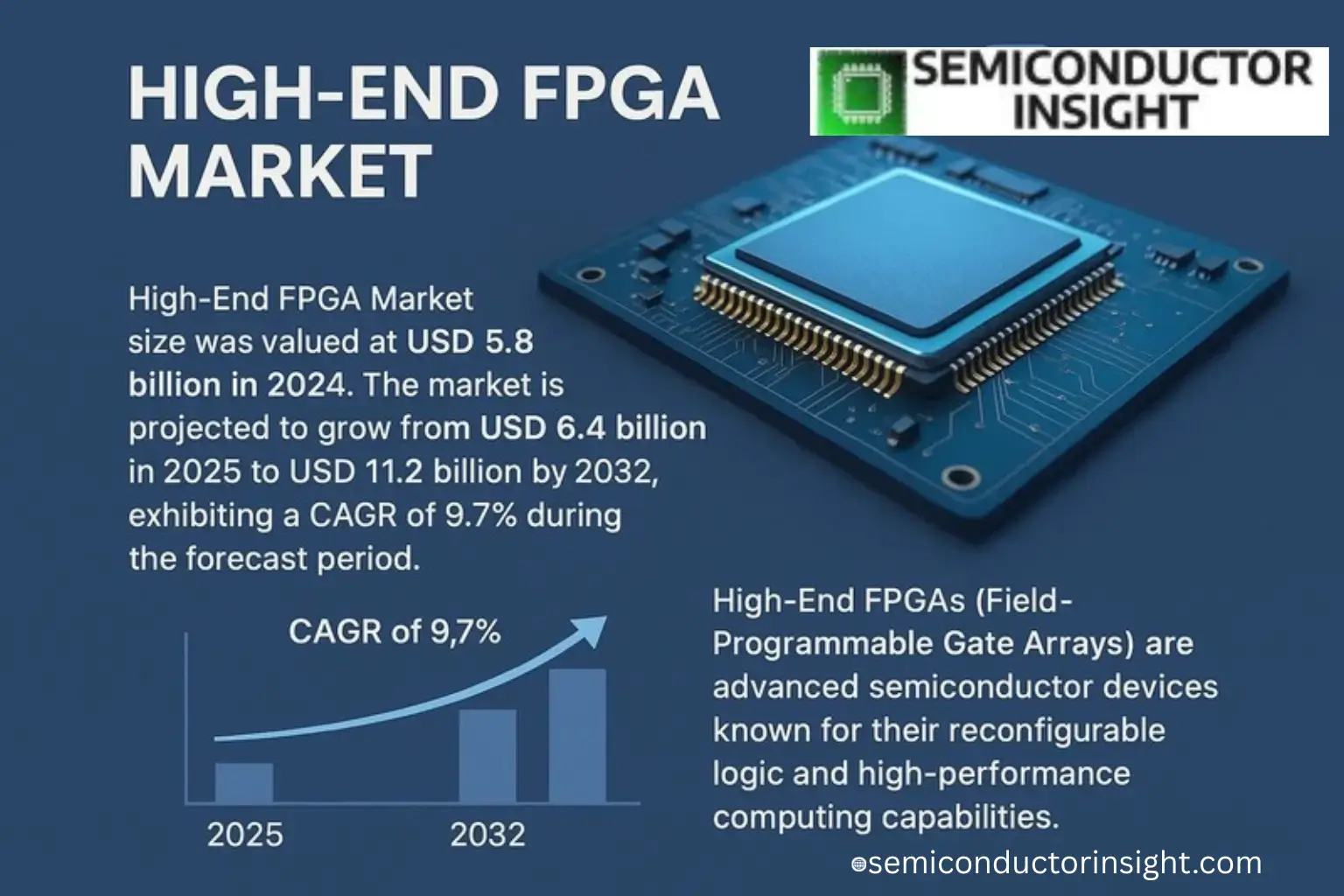
Global High-End FPGA Market size was valued at USD 5.8 billion in 2024. The market is projected to grow from USD 6.4 billion in 2025 to USD 11.2 billion by 2032, exhibiting a CAGR of 9.7% during the forecast period.
High-End FPGAs (Field-Programmable Gate Arrays) are advanced semiconductor devices known for their reconfigurable logic and high-performance computing capabilities. These devices feature complex architectures with large-scale logic elements, embedded memory blocks, and high-speed transceivers, making them ideal for applications requiring parallel processing and low-latency operations. Key components include SRAM-based, flash-based, and antifuse-based FPGAs, each catering to specific industry needs.
The market is driven by increasing demand for AI acceleration, 5G infrastructure deployment, and data center expansion. While traditional sectors like telecommunications and aerospace remain dominant, emerging applications in autonomous vehicles and edge computing are fueling growth. Major players such as AMD (Xilinx), Intel (Altera), and Lattice Semiconductor continue to innovate with SoC-integrated solutions, though supply chain constraints pose challenges for new entrants.
MARKET DRIVERS
Increasing Demand for High-Performance Computing
The High-End FPGA Market is experiencing significant growth due to rising demand for high-performance computing across industries like data centers, telecommunications, and aerospace. These advanced chips enable accelerated processing for AI workloads, 5G infrastructure, and military applications, where traditional processors fall short.
Advancements in Parallel Processing
Recent technological breakthroughs in parallel processing architectures have enhanced the capabilities of High-End FPGAs, making them indispensable for real-time data analysis and complex algorithm execution. Their ability to be reprogrammed post-deployment gives them an edge over ASICs in dynamic environments.
Major tech companies are investing heavily in FPGA-based solutions to gain competitive advantages in speed and energy efficiency, particularly for machine learning inference tasks at the network edge.
MARKET CHALLENGES
High Development Complexity
The High-End FPGA Market faces obstacles from the significant expertise required for FPGA programming and design. Hardware description languages like VHDL and Verilog present steep learning curves, limiting the talent pool and increasing development costs.
Other Challenges
Power Consumption Issues
While offering superior performance, High-End FPGAs often consume more power than alternative solutions, creating thermal management challenges in space-constrained applications.
Competition from GPUs and ASICs
The rising capabilities of GPUs for parallel processing and specialized ASICs for specific workloads threaten market share in some High-End FPGA applications.
MARKET RESTRAINTS
Supply Chain Constraints
The High-End FPGA Market is impacted by ongoing semiconductor supply chain disruptions and geopolitical factors affecting production. Limited foundry capacity for leading-edge nodes exacerbates shortages and extends lead times for high-performance FPGA components.
MARKET OPPORTUNITIES
AI and Edge Computing Expansion
The High-End FPGA Market stands to benefit significantly from the explosive growth in AI inferencing at the edge. FPGAs offer the perfect balance of programmability and performance required for adaptive machine learning models in decentralized computing environments.
Next-Gen Wireless Networks
Deployment of 5G advanced and future 6G networks creates substantial opportunities for High-End FPGAs in base stations and network infrastructure, where they provide the flexibility to handle evolving communication protocols and standards.
High-End FPGA Market Trends
Accelerated Adoption in AI and Cloud Computing
The High-End FPGA Market is experiencing significant growth, projected to reach USD million by 2032, driven by rising demand in AI acceleration and cloud computing infrastructure. These programmable devices offer superior parallel processing capabilities, making them ideal for machine learning workloads. Major cloud providers are increasingly adopting FPGA-based solutions to enhance data center efficiency and reduce latency in real-time processing scenarios.
Other Trends
5G Infrastructure Expansion
Deployment of 5G networks globally is creating substantial opportunities for High-End FPGAs in base stations and network equipment. Their reconfigurable nature allows for rapid protocol updates and hardware acceleration of signal processing tasks, reducing time-to-market for telecom operators.
Emerging Automotive Applications
The automotive sector is emerging as a key growth area, with High-End FPGAs enabling advanced driver assistance systems (ADAS) and autonomous driving solutions. Their ability to process multiple sensor inputs simultaneously while meeting stringent safety standards positions them as critical components in next-generation vehicles.
Other Trends
Supply Chain and Geopolitical Considerations
Market concentration among major players like Intel and AMD (Xilinx) presents challenges for new entrants, while geopolitical tensions are impacting supply chain stability. Domestic chip initiatives in several countries are creating regional growth opportunities amidst these constraints.
Heterogeneous Computing Integration
High-End FPGAs are increasingly being deployed alongside CPUs and GPUs in heterogeneous computing architectures, particularly in high-performance computing applications. This trend is driving innovation in chiplet technologies and 3D packaging solutions to enhance system performance and power efficiency.
COMPETITIVE LANDSCAPE
Key Industry Players
Market Dominance & Strategic Positioning in High-End FPGA Sector
The High-End FPGA Market is characterized by strong dominance from established semiconductor giants, with AMD (Xilinx) and Intel (Altera) collectively holding over 75% market share. Their technological leadership in 7nm and 16nm architectures, coupled with extensive IP portfolios, creates significant barriers for competitors. Xilinx’s Versal ACAP platform and Intel’s Stratix 10 FPGAs demonstrate advanced SoC integration for AI/ML workloads. The duopoly maintains advantage through vertical integration, controlling everything from EDA tools to packaging technologies.
Emerging Chinese players like Tongxin Micro and S2C are gaining traction through government-supported initiatives, focusing on secure applications in defense and telecom. Fabless innovators such as Achronix and Efinix compete through architectural breakthroughs – Achronix’s Speedster7t offers revolutionary memory bandwidth, while Efinix’s Quantum technology enables cost-effective reconfiguration. Lattice Semiconductor and Microchip Technology successfully target edge computing niches with low-power solutions, demonstrating viability in automotive and industrial segments.
List of Key High-End FPGA Companies Profiled
- AMD (Xilinx)
- Intel (Altera)
- Microchip Technology
- Lattice Semiconductor
- Achronix Semiconductor
- Efinix
- Flex Logix Technologies
- QuickLogic
- S2C
- Tongxin Micro
- TSMC
- GlobalFoundries
- United Microelectronics
- Broadcom
- Cypress Semiconductor
Segment Analysis:
| Segment Category | Sub-Segments | Key Insights |
| By Type |
|
SRAM-based FPGAs dominate due to their reconfigurability and high-performance characteristics:
|
| By Application |
|
Data Center & Computing shows strongest growth potential:
|
| By End User |
|
Cloud Service Providers are driving significant adoption:
|
| By Technology Node |
|
16/14nm and below represents the cutting edge:
|
| By Configuration |
|
FPGA SoCs demonstrate strongest growth trajectory:
|
Regional Analysis: High-End FPGA Market
The Pentagon’s modernization initiatives create sustained FPGA demand for radar systems, electronic warfare platforms, and secure communications. Contractors leverage high-density FPGAs for adaptable signal processing in next-gen military hardware.
Academic institutions in Toronto and Waterloo partner with FPGA vendors to develop quantum computing interfaces. Government grants support hybrid FPGA-QPU architectures for commercial applications in financial modeling and drug discovery.
Telecom operators collaborate with FPGA manufacturers to develop beamforming solutions for mmWave deployments. Field-programmable arrays enable rapid base station reconfiguration across varied North American terrain and frequency bands.
Detroit and Silicon Valley OEMs integrate high-end FPGAs in ADAS prototyping. Programmable logic devices allow flexibility in sensor fusion algorithms during autonomous vehicle development cycles before ASIC production.
Europe
European high-end FPGA adoption grows through industrial automation modernization in Germany and telecom standardization efforts. The EU’s semiconductor sovereignty initiative prioritizes FPGA-based solutions for secure IoT applications in smart factories. France leads in aerospace deployments, utilizing radiation-hardened FPGAs for satellite payloads. Nordic countries demonstrate strong demand for low-power FPGA implementations in edge AI nodes across renewable energy grids. Stricter data protection regulations drive customized FPGA security solutions for banking and healthcare sectors.
Asia-Pacific
China’s domestic FPGA manufacturers gain traction through government-backed fabless design programs, challenging traditional vendors in telecom infrastructure. Japan maintains leadership in automotive-grade FPGAs for premium vehicle ECUs, while South Korean foundries develop hybrid FPGA-ASIC solutions for memory processing. India emerges as a design hub for cost-optimized FPGA implementations in industrial IoT, supported by engineering talent pools in Bangalore and Hyderabad.
Middle East & Africa
GCC nations invest in high-end FPGAs for oilfield monitoring systems and smart city infrastructure. Israel’s defense electronics sector drives demand for ruggedized FPGA solutions in unmanned systems. South Africa develops localized FPGA expertise through university programs focused on radio astronomy applications at SKA telescope facilities.
South America
Brazilian aerospace and agricultural equipment manufacturers adopt mid-range FPGAs for equipment monitoring systems. Chile’s astronomy research centers utilize radiation-tolerant FPGAs for telescope arrays. Regional economic challenges limit widespread adoption, but niche applications in mining automation show growth potential.
Report Scope
This market research report provides a comprehensive analysis of the High-End FPGA Market, covering the forecast period 2025–2032. It offers detailed insights into market dynamics, technological advancements, competitive landscape, and key trends shaping the industry.
Key focus areas of the report include:
- Market Overview: The report begins with an overview outlining its current market scenario, key growth indicators, and industry transformation drivers. It discusses macroeconomic factors, demand–supply balance, regulatory landscape, and the strategic role of semiconductors in powering advancements across industries such as automotive, telecommunications, consumer electronics, and industrial automation.
- Market Size & Forecast: Historical data and future projections for revenue, unit shipments, and market value across major regions and segments.
- Segmentation Analysis: Detailed breakdown by product type, technology, application, and end-user industry to identify high-growth segments and investment opportunities.
- Regional Insights: Insights into market performance across North America, Europe, Asia-Pacific, Latin America, and the Middle East & Africa, including country-level analysis where relevant.
- Competitive Landscape: Profiles of leading market participants, including their product offerings, R&D focus, manufacturing capacity, pricing strategies, and recent developments such as mergers, acquisitions, and partnerships.
- Technology Trends & Innovation: Assessment of emerging technologies, integration of AI/IoT, semiconductor design trends, fabrication techniques, and evolving industry standards.
- Market Drivers & Restraints: Evaluation of factors driving market growth along with challenges, supply chain constraints, regulatory issues, and market-entry barriers.
- Stakeholder Insights: Insights for component suppliers, OEMs, system integrators, investors, and policymakers regarding the evolving ecosystem and strategic opportunities.
Primary and secondary research methods are employed, including interviews with industry experts, data from verified sources, and real-time market intelligence to ensure the accuracy and reliability of the insights presented.
FREQUENTLY ASKED QUESTIONS:
What is the current market size of High-End FPGA Market?
-> High-End FPGA Market size was valued at USD 5.8 billion in 2024. The market is projected to grow from USD 6.4 billion in 2025 to USD 11.2 billion by 2032, exhibiting a CAGR of 9.7% during the forecast period.
Which key companies operate in High-End FPGA Market?
-> Key players include Xilinx (AMD), Intel (Altera), Microchip Technology, Lattice Semiconductor, Achronix, and Efinix, among others.
What are the key growth drivers?
-> Key growth drivers include AI/cloud computing, 5G/6G communications, autonomous driving, data center expansion, and defense/aerospace requirements.
Which region shows strongest growth potential?
-> Asia dominates the market, with China showing significant growth due to domestic substitution policies.
What are the emerging application areas?
-> Emerging applications include AI inference, cybersecurity, financial technology, and advanced automotive systems.

Get Sample Report PDF for Exclusive Insights
Report Sample Includes
- Table of Contents
- List of Tables & Figures
- Charts, Research Methodology, and more...
 Download Sample Report PDF