
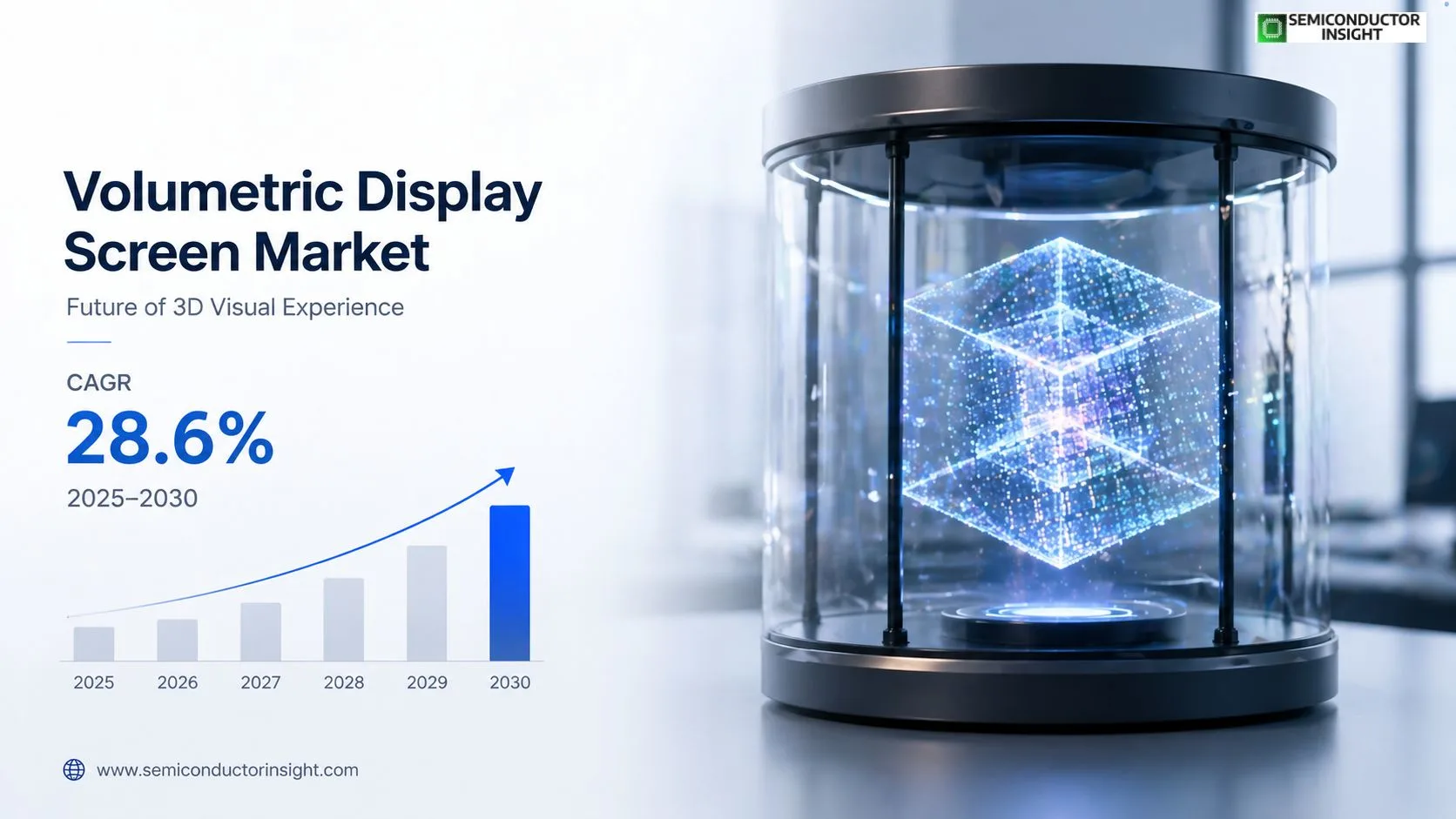
Imaging Depth and Semiconductor Design in the Volumetric Display Market
Volumetric displays are redefining how visual information is perceived by projecting images in true three-dimensional space rather than on flat panels. Volumetric systems create light points in real space, unlike stereoscopic displays that depend on optical illusion, enabling users to view images from various perspectives without the need for headgear. This shift is deeply rooted in semiconductor innovation, particularly in micro-LED arrays, laser diodes, and high-speed processing chips that enable real-time rendering of volumetric pixels, or voxels.
A single volumetric frame may consist of millions of voxels refreshed at rates exceeding 30 frames per second, demanding immense computational throughput. Advanced GPUs and ASIC-based processors are increasingly used to handle this load, often processing terabytes of data per hour in high-resolution systems.
Unique Interaction & Mechanics
- Reach-Through Interaction: Newer prototypes like FlexiVol use elastic diffusers, allowing users to physically reach into the 3D volume and manipulate digital objects with their bare hands.
- Acoustic & Laser Trapping: Some systems use ultrasound to trap a tiny physical particle and move it so fast through the air that it creates a persistent light image. Others use femtosecond lasers to create plasma points directly in mid-air.
- Swept-Volume Dynamics: Many common versions, like Voxon Photonics, use a rapidly vibrating or rotating screen to sweep through space, projecting image slices so quickly that they appear as a solid 3D object to the human eye.
- 3D Laser Pointers: Standard mouse cursors don’t work in 3D space. Tools like PointerVolhave been developed specifically to allow users to point to exact 3D coordinates inside a display using a modified laser.
Optical Pathways and Material Interfaces
The interaction between semiconductor light sources and optical materials defines display clarity. Volumetric systems often rely on rotating diffusers, transparent screens, or photoreactive media to create depth perception.
Key material interactions include:
- Photopolymer layers that scatter light to form volumetric points
- Rotational glass or acrylic volumes spinning at 600-1,200 RPM
- Liquid crystal modulators controlling light phase and intensity
These components must synchronize with semiconductor drivers at microsecond precision, ensuring consistent image stability.
Uncommon Applications & Prototypes
- Medical Volume Slices: They are uniquely suited for medical imaging, as they can reconstruct MRI or CT slices into a physical volume that doctors can inspect from any angle.
- Ethereal Displays (FogScreens): Some systems project images onto a thin wall of non-turbulent fog, creating a walk-through 3D screen that feels immaterial.
- Rare-Earth Doped Glass: Researchers are developing static displays made of solid glass doped with rare-earth ions that glow in different colors when hit by specific laser frequencies.
Spatial Visualization Moving Toward Practicality
Volumetric displays are gradually moving from laboratory demonstrations to structured applications, driven by semiconductor miniaturization and computational efficiency. The ability to generate true 3D imagery without wearable devices positions this technology uniquely within the display ecosystem.
What stands out is the convergence of optics, materials science, and semiconductor engineering. Each voxel rendered in space is not just a point of light but a result of synchronized electronic control, advanced chip design, and precise optical manipulation. As semiconductor capabilities continue to scale, volumetric displays are expected to become more compact, energy-efficient, and widely deployable across industries that depend on spatial visualization.
You can freely browse our most recent updated report to learn more about it before scrolling further: https://semiconductorinsight.com/report/volumetric-display-screen-market/
Uncommon Technical Benefits
Zero Vergence-Accommodation Conflict: Most VR/AR headsets make your eyes hurt because they make you gaze at a screen () and a faraway object () at the same time. This is fixed with volumetric displays, which make the light come from the depth where the item looks like it is.
ACM Digital Library ACM Digital Library +3 360-Degree Collaborative Viewing: With this feature, several people can stand around the display and observe the same 3D object from their own unique point of view at the same time without wearing glasses.
ACM Digital Library ACM Digital Library +1 Natural Occlusion: Some free-space displays can make points that are naturally opaque and block the background, making objects look more solid. This is different from holograms, which can look ghostly.

Comments (0)