

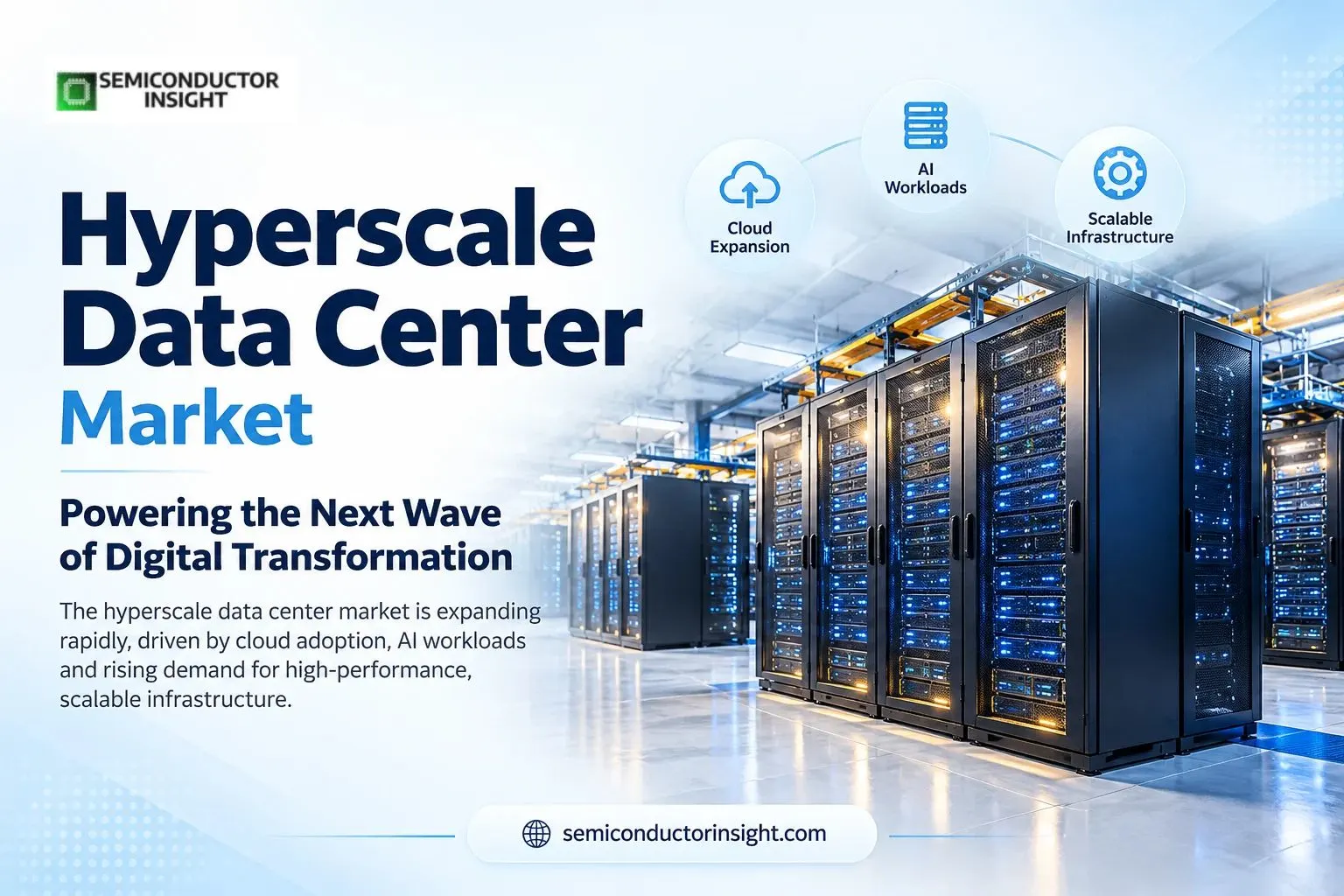
Hyperscale Data Center Market Moves Beyond Cloud Storage into Gigawatt-Scale AI Computing in 2026-2035
The next phase of digital infrastructure is being shaped by a fundamental change in computing: artificial intelligence requires far more than additional server space.
It demands powerful semiconductor platforms, high-speed data movement, sophisticated thermal management, and dependable access to electricity. This shift is turning hyperscale data centers into strategic assets for cloud providers, chipmakers, and enterprises building AI-driven services.
When Computing Infrastructure Becomes an AI Production Engine
- Hyperscale facilities were originally associated with cloud storage, online platforms, and large-scale enterprise computing.
- Today, generative AI and advanced model training are changing their architecture. Dense GPU clusters, high-bandwidth memory, high-speed interconnects, and increasingly complex server configurations are becoming central to infrastructure planning.
- The semiconductor connection is especially important. More powerful processors can accelerate AI workloads, but they also increase rack-level power consumption and cooling requirements.
- Consequently, data center expansion is becoming closely linked to developments in accelerator design, memory bandwidth, networking silicon, and power-management components.
The U.S. Electricity Equation Is Changing
The scale of this transformation is visible in government-backed research. Lawrence Berkeley National Laboratory’s June 2026 update estimated that U.S. data centers could consume 11.8% of national electricity by 2030, with modeled scenarios ranging from 9.5% to 15.3%. The projections reflect the effects of growing computing demand, equipment deployment, and cooling requirements. LBNL and the U.S. Department of Energy.
For developers, electricity availability is now a site-selection consideration alongside fiber connectivity, land, construction costs, and proximity to customers. Grid interconnection schedules, substations, backup systems, and long-term power procurement can determine whether a proposed campus becomes operational on its intended timeline.
Cooling Is Moving Closer to the Semiconductor
As accelerator performance rises, removing heat efficiently becomes an engineering priority. Conventional air cooling remains relevant, but high-density AI deployments are encouraging greater attention to direct-to-chip liquid cooling, advanced cold plates, coolant distribution systems, and facility-level heat rejection.
These technologies create opportunities across the semiconductor supply chain. Thermal interface materials, sensors, power electronics, pumps, and control systems all contribute to reliable operation. The commercial question is no longer simply how many servers a facility can accommodate, but how much useful computing performance it can deliver within its power and thermal limits.
United State Hyperscale Data Center Market: Key Players, Challenges and Opportunities
- The U.S. hyperscale landscape includes Amazon Web Services, Microsoft, Google, Meta, and Oracle, alongside specialist infrastructure developers and colocation providers.
- Their strategies differ, but all depend on scalable computing infrastructure, reliable power, and efficient deployment.
A notable example arrived in February 2026, when Meta announced a planned data center campus in Lebanon, Indiana, designed for 1 gigawatt of capacity. The company reported an investment exceeding $10 billion and anticipated more than 4,000 construction jobs and 300 operational positions. The project illustrates the scale at which AI infrastructure planning is taking place. Meta.
Microsoft also announced in June 2026 that its first data center facility in Mount Pleasant, Wisconsin, had become operational after construction and startup activities. The development demonstrates how major technology investments are extending beyond established data center clusters.
The central challenges include electricity procurement, grid capacity, construction schedules, water management, equipment availability, and community acceptance. Opportunities are emerging in advanced cooling, semiconductor integration, modular electrical infrastructure, renewable power procurement, and data center engineering services.
The Geography of Expansion Is Being Reconsidered
Established U.S. markets continue to benefit from network connectivity and experienced infrastructure ecosystems. However, large new campuses are also drawing attention to locations where land availability, power development, and local investment conditions may support expansion.
This creates a more complex development strategy. A site with inexpensive land may still be unsuitable if transmission infrastructure is constrained, while a location with strong connectivity may face lengthy permitting or power-delivery timelines. Successful projects increasingly require coordinated planning among utilities, developers, equipment suppliers, local authorities, and cloud operators.
For a more thorough report, please contact us using our most recent related report: https://semiconductorinsight.com/report/cpu-for-data-center-market/
What Semiconductor Suppliers Should Watch Next?
- For semiconductor businesses, hyperscale expansion extends well beyond processor shipments. Demand can reach high-bandwidth memory, optical transceivers, networking switches, power-conversion devices, advanced substrates, thermal components, and server-management electronics.
- Suppliers should pay attention to three practical indicators: announced campus capacity, deployment schedules for AI accelerators, and the transition toward higher-density rack designs. These signals can help distinguish infrastructure announcements from projects moving toward equipment procurement and operation.
- The strongest commercial position will belong to companies that can meet performance requirements while addressing power efficiency, thermal reliability, manufacturing capacity, and supply-chain resilience.
The Next Competitive Advantage Is Infrastructure Readiness
Hyperscale data center market is evolving into a meeting point for semiconductor innovation, energy planning, and AI deployment. U.S. investment announcements show that the next generation of computing facilities is being planned at unprecedented physical and electrical scales, although announced capacity should not be confused with capacity already operating.
For semiconductor suppliers and infrastructure partners, the opportunity lies in delivering the technologies that make these facilities viable: faster data processing, efficient power delivery, dependable cooling, and scalable system integration. As AI workloads expand, infrastructure readiness will increasingly determine how quickly computing innovation can translate into real-world services.

Comments (0)