
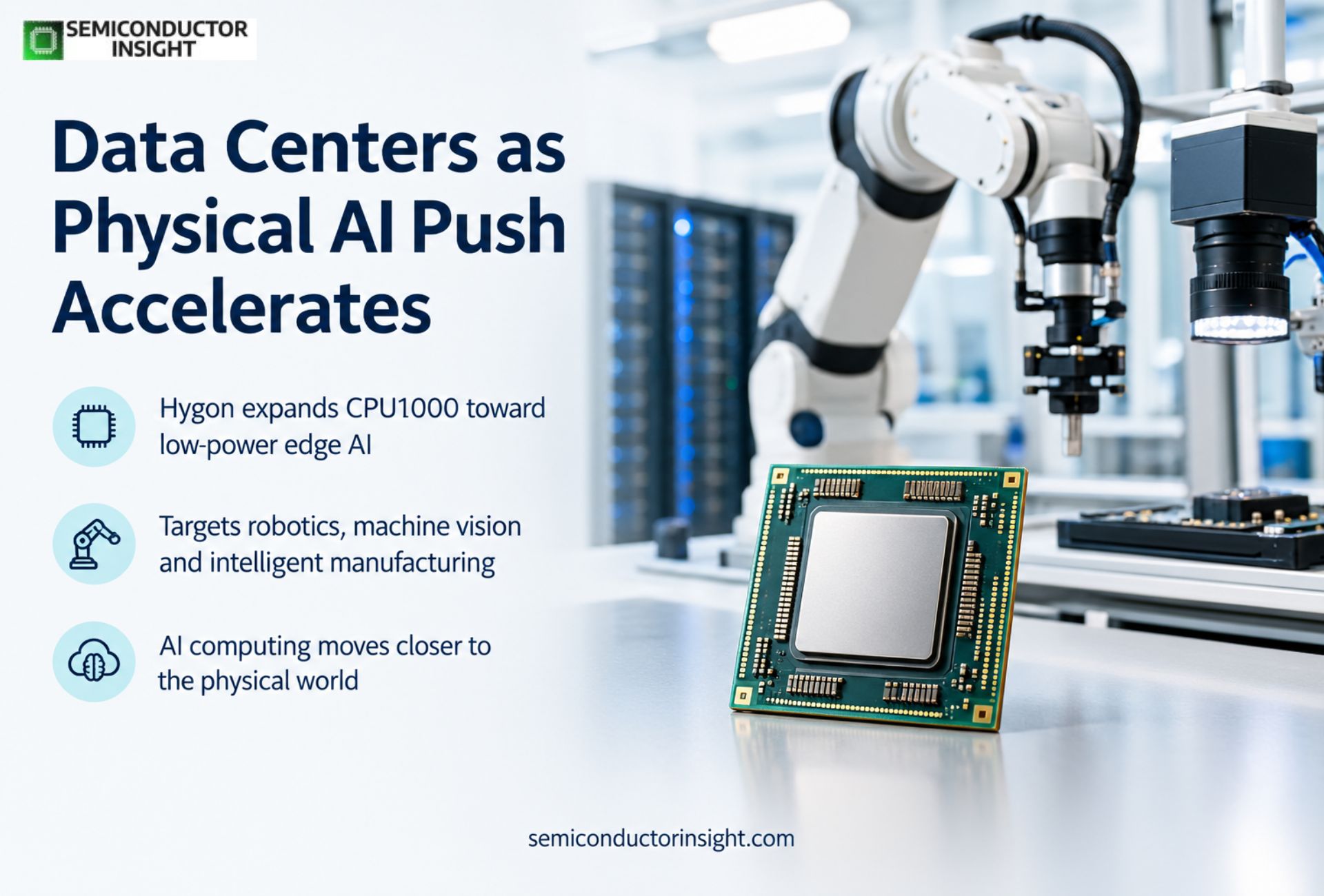
Hygon Takes Computing Beyond Data Centers as Physical AI Push Accelerates
The next semiconductor battleground may not be confined to hyperscale data centers. As artificial intelligence increasingly moves into robots, factory equipment and intelligent machines, Chinese chipmaker Hygon Information Technology is preparing to take its computing platform closer to the physical world.
Hygon is set to introduce a new iteration of its CPU1000 series aimed at low-power, embedded and edge-computing environments. The chip is expected to support applications spanning robotics, machine vision and intelligent manufacturing, signaling an expansion beyond the company’s established concentration on data-center and high-performance computing.
From Server Racks to Machines That Act
The announcement arrives as the semiconductor industry increasingly focuses on physical AI systems in which AI does not simply generate information but interprets surroundings and helps machines respond to real-world conditions.
Hygon’s Shenzhen launch is being promoted under the slogan “Let computing power reach the physical world.” The company’s positioning highlights a shift in where computing is performed: instead of sending every workload back to a centralized cloud or data center, processing can increasingly happen close to sensors, cameras, robots and industrial machinery.
That transition creates a different set of semiconductor requirements. Industrial and robotic platforms need rapid response times, efficient power consumption, compact integration and reliable operation in environments where connectivity and operating conditions can vary.
Why Edge Silicon Is Becoming More Important?
The growth of physical AI is creating demand for chips capable of handling computation at the point where physical activity occurs.
For a robotic arm inspecting a component, a machine-vision system identifying defects or an automated production line adjusting its operation, latency can become a critical consideration. Moving selected workloads closer to the machine can reduce dependence on continuous cloud connectivity while enabling faster local decision-making.
This is where Hygon’s latest direction becomes significant for the broader semiconductor ecosystem.
The company’s existing portfolio already spans different computing environments. Its 3000-series CPUs target cost-sensitive applications, while its 5000-series products address general-purpose server requirements and its 7000-series processors focus on higher-performance servers. Hygon also develops deep computing units (DCUs) for accelerated computing and AI workloads.
The emerging edge opportunity therefore represents an extension of an existing computing portfolio rather than an isolated move into robotics.
- Hygon’s move comes at a period of substantial business growth.
- For the first half of 2026, the company reported RMB 9.10 billion in revenue, representing a 66.52% year-on-year increase. Net profit attributable to shareholders reached approximately RMB 1.80 billion, up 49.69% from the same period a year earlier.
- The company is also continuing to invest heavily in technology. Its first-half research and development spending reached approximately RMB 2.54 billion, according to its half-year report, underscoring the scale of investment required to expand high-end processor capabilities.
- Recent industry analysis has also identified Hygon as one of China’s major domestic computing-chip developers, with its CPU and DCU portfolio supporting the country’s broader push toward locally developed computing infrastructure.
Hygon’s upcoming CPU1000-series expansion is therefore about more than a new processor category. It reflects the industry’s broader transition from AI that primarily processes information to AI that increasingly interacts with physical environments.
As robotics and intelligent manufacturing scale globally, the ability to place reliable computing directly inside machines could become an increasingly important semiconductor design priority.
For Hygon, the immediate question is how successfully its processor technology can translate from centralized computing infrastructure into demanding real-world deployments. For the wider semiconductor industry, the development adds another signal that the next phase of AI hardware competition will increasingly be fought at the edge, inside factories and ultimately inside the machines themselves.
Tap into the Latest Trends from Our Recent Report: https://semiconductorinsight.com/report/pcie-6-0-ai-accelerator-interconnect-market/

Comments (0)