
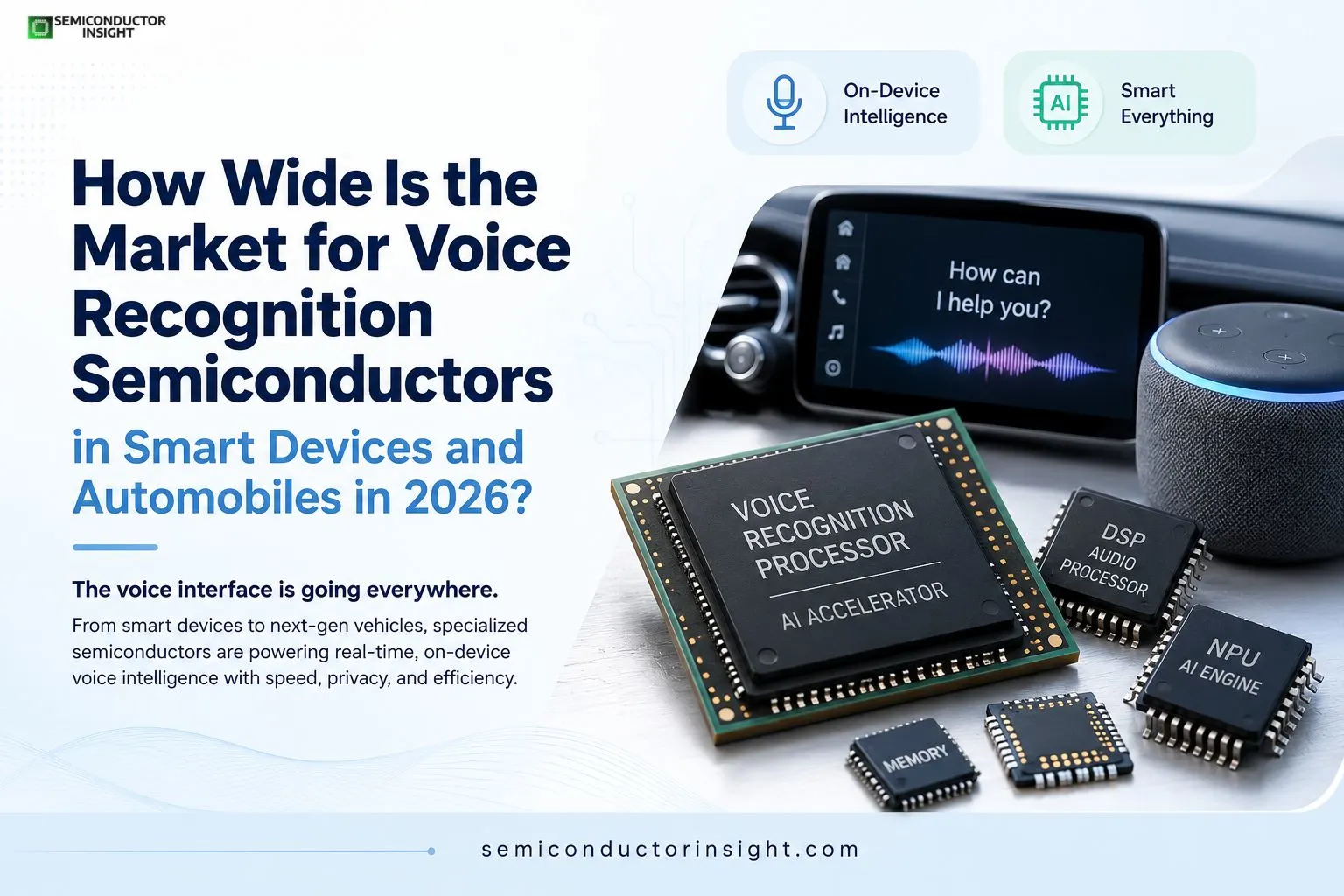
How Wide Is the Market for Voice Recognition Semiconductors in Smart Devices and Automobiles in 2026?
The voice recognition semiconductor market is becoming one of the most strategically important segments within the broader semiconductor industry as artificial intelligence shifts from cloud-based systems to edge devices.
Every spoken command to a smartphone, smart speaker, vehicle infotainment system, wearable device, or industrial machine relies on specialized semiconductor components capable of processing audio signals, filtering background noise, and executing speech recognition algorithms in real time.
The New Silicon Layer behind Everyday Conversations
Voice interaction is no longer limited to virtual assistants. It is increasingly embedded into televisions, appliances, security systems, medical devices, and enterprise communication platforms. This expansion is creating demand for dedicated voice recognition processors, digital signal processors (DSPs), neural processing units (NPUs), and AI accelerators optimized for speech workloads.
According to data published by the industry association GSMA, global mobile internet users exceeded 5.8 billion in 2025, creating a vast ecosystem of connected devices where voice interfaces are becoming a preferred mode of interaction. As voice-enabled applications grow, semiconductor manufacturers are focusing on chips that can process speech locally without relying on constant cloud connectivity.
When Cars Become the Fastest Growing Voice Platform
· Modern vehicles are rapidly evolving into voice-first environments. Drivers increasingly use voice commands to control navigation, climate systems, entertainment, and communication functions.
· Recent vehicle launches from companies such as Mercedes-Benz, BMW, and Hyundai Motor Company showcase advanced conversational assistants powered by dedicated AI processing hardware. These systems require semiconductor solutions capable of understanding commands even in noisy cabin environments.
· Industry data from the International Organization of Motor Vehicle Manufacturers indicates that global vehicle production exceeded 93 million units in 2024. Each new generation of connected vehicles adds more microphones, audio processors, and AI-enabled semiconductor content, creating a significant growth opportunity for voice-focused chip suppliers.
Tiny Chips Making Smart Speakers Smarter
Smart speakers remain one of the largest deployment areas for voice recognition semiconductors. Devices such as Amazon Echo and Google Nest Audio rely on specialized semiconductor architectures that continuously listen for wake words while consuming minimal power.
Research published by the Consumer Technology Association highlights that millions of smart speakers continue to be shipped annually across North America, Europe, and Asia. The challenge for semiconductor designers is balancing responsiveness with energy efficiency. This has accelerated innovation in ultra-low-power DSPs and neural accelerators specifically optimized for speech processing tasks.
The Shift from Cloud Recognition to On Device Intelligence
One of the most significant developments in the voice recognition semiconductor market is the migration of speech processing from centralized cloud servers to local hardware.
On-device voice recognition delivers several advantages. Commands can be processed faster, internet connectivity becomes less critical, and sensitive voice data remains on the user’s device. These benefits align with growing privacy expectations and stricter data protection regulations worldwide.
Companies such as Apple Inc. have increasingly emphasized on-device AI capabilities through custom silicon architectures that support speech recognition directly within smartphones and wearable products.
Explore the full report details in our recently refreshed edition anytime: https://semiconductorinsight.com/report/voice-recognition-semiconductor-market/
Multilingual AI Creates New Chip Requirements
Ø The next wave of innovation involves supporting dozens of languages and dialects simultaneously. Markets such as India, Southeast Asia, Africa, and Latin America present unique linguistic challenges that require more sophisticated semiconductor designs.
Ø Voice models capable of handling multilingual inputs demand higher memory bandwidth, faster inference capabilities, and improved AI acceleration. Semiconductor companies are responding with increasingly specialized architectures tailored for natural language processing and speech understanding.
Ø As voice interfaces expand globally, chipmakers that can efficiently process complex language models while maintaining low power consumption are likely to gain a significant competitive advantage.
Voice Technology Expands Beyond Consumer Electronics
Industrial facilities, hospitals, warehouses, and retail environments are increasingly deploying voice-enabled systems. Healthcare professionals can use hands-free voice commands to access patient information, while warehouse workers rely on voice-guided workflows to improve productivity.
These applications require highly reliable semiconductor platforms capable of operating under challenging environmental conditions. Ruggedized AI processors and advanced audio processing chips are therefore emerging as important product categories within the market.
Accelerating Digital Experiences through Advanced Computing Solutions
Voice recognition has evolved from a convenience feature into a fundamental interface connecting humans and machines. Whether embedded in a vehicle, smartphone, industrial system, or wearable device, advanced semiconductors enable accurate, real-time speech processing that makes natural interaction possible.
As generative AI, edge computing, and multilingual speech models continue advancing, the demand for specialized voice recognition semiconductors is expected to intensify. The companies developing faster, more efficient, and privacy-focused chips will play a defining role in the next generation of intelligent connected devices.

Comments (0)