

How Smartwatches Market Is Redefining Semiconductor Innovation in Wearable Computing?
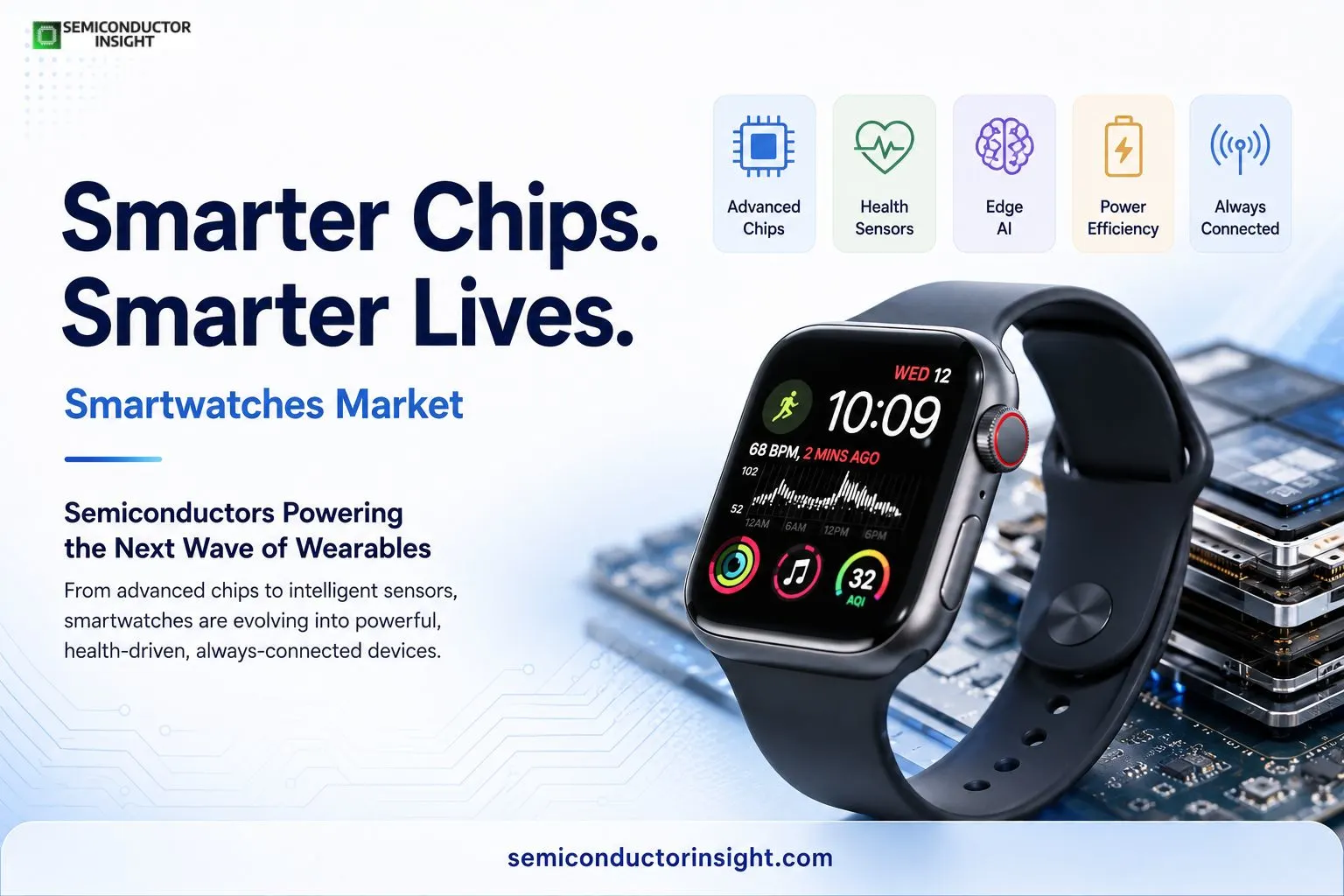
The current Smartwatches Market is no longer just about design or fitness tracking. At its core lies a dense semiconductor ecosystem combining system-on-chip architectures, MEMS sensors, and wireless communication modules. Devices today integrate processors comparable to early smartphones, yet operate within tight thermal and battery constraints.
Modern smartwatch chipsets like those used in Apple Watch Series 9 and Samsung Galaxy Watch 6 rely on highly integrated SoCs that combine CPU, GPU, neural engines, and connectivity blocks into a single package. According to public filings from Apple Inc., its custom silicon approach enables on-device processing for health metrics without constant cloud dependency, improving both privacy and speed.
Miniaturisation, Race, and Advanced Packaging
One of the most defining semiconductor trends in the smartwatch market is advanced packaging. Technologies such as System-in-Package allow multiple chips to be stacked vertically, reducing board space while improving efficiency.
Case studies from IEEE publications highlight how smartwatch modules now integrate sensors, memory, and processors within millimetre-scale footprints. This level of miniaturisation is critical as consumers demand thinner devices without compromising battery life or performance.
Health Monitoring Sensors Becoming Semiconductor Goldmine
Health tracking has shifted from basic step counting to clinical-grade monitoring. Semiconductor-driven biosensors now enable ECG, SpO2, skin temperature, and even stress tracking.
- For instance, Fitbit Sense 2 uses electrodermal activity sensors, while Garmin Venu 3 integrates advanced heart rate variability tracking.
According to data published by the World Health Organisation, wearable health monitoring devices are increasingly being explored for early detection of cardiovascular conditions, reflecting the growing medical relevance of semiconductor sensors.
View our latest report release for more background and analysis: https://semiconductorinsight.com/report/smartwatches-market/
Edge AI Moves onto the Wrist
A major shift in Smartwatches Market is the integration of edge AI directly into semiconductor chips. Instead of relying on smartphones, smartwatches now process voice commands, fitness analytics, and anomaly detection locally.
Companies like Qualcomm have introduced wearable platforms with dedicated AI engines, enabling features like fall detection and sleep stage classification in real time. This reduces latency and power consumption, which are critical constraints in wearable devices.
Battery Efficiency and Power Management Breakthroughs
Battery life remains one of the most visible challenges. Semiconductor innovation is addressing this through ultra-low power nodes and intelligent power management ICs.
Research from government-backed energy labs shows that optimised chip architectures can reduce power consumption in wearable by up to 30-40% compared to older designs. Hybrid architectures now dynamically switch between high-performance and low-power cores depending on usage.
Connectivity Chips Enabling Standalone Devices
Smartwatches are rapidly becoming independent devices. Embedded LTE, Bluetooth Low Energy, and GNSS chips allow them to function without smartphones.
The adoption of eSIM-enabled smartwatches has grown significantly, supported by telecom infrastructure upgrades. Devices from Huawei and Xiaomi increasingly offer standalone calling and streaming features powered by compact connectivity chipsets.
Leading Smartwatch Brands Dominating the Current Market
Smartwatches Market today is led by a mix of consumer electronics giants and specialised wearable companies:
- Apple Inc.
- Samsung Electronics
- Garmin Ltd.
- Fitbit under Google
- Huawei
- Xiaomi
- Amazfit by Zepp Health
According to annual reports and shipment disclosures, Apple Inc. alone ships tens of millions of smartwatches yearly, making it one of the largest wearable semiconductor consumers globally.
Increasing Market Penetration across Diverse Industries
Smartwatches are now used in enterprise and healthcare scenarios. Hospitals are piloting wearable monitoring systems for patient tracking, while logistics companies use smartwatches for workforce management.
A notable example includes remote patient monitoring programs in the US and Europe, where smartwatch ECG data is integrated into clinical workflows, demonstrating how semiconductor-enabled wearable are entering regulated environments.
What Makes This Market a Semiconductor Hotspot?
Smartwatches Market sits at the intersection of multiple semiconductor innovations, including AI chips, MEMS sensors, low-power processors, and advanced packaging. Unlike smartphones, smartwatches push the limits of size, efficiency, and integration simultaneously.
This combination makes them one of the most demanding and fast-evolving applications for semiconductor engineering today.

Comments (0)