
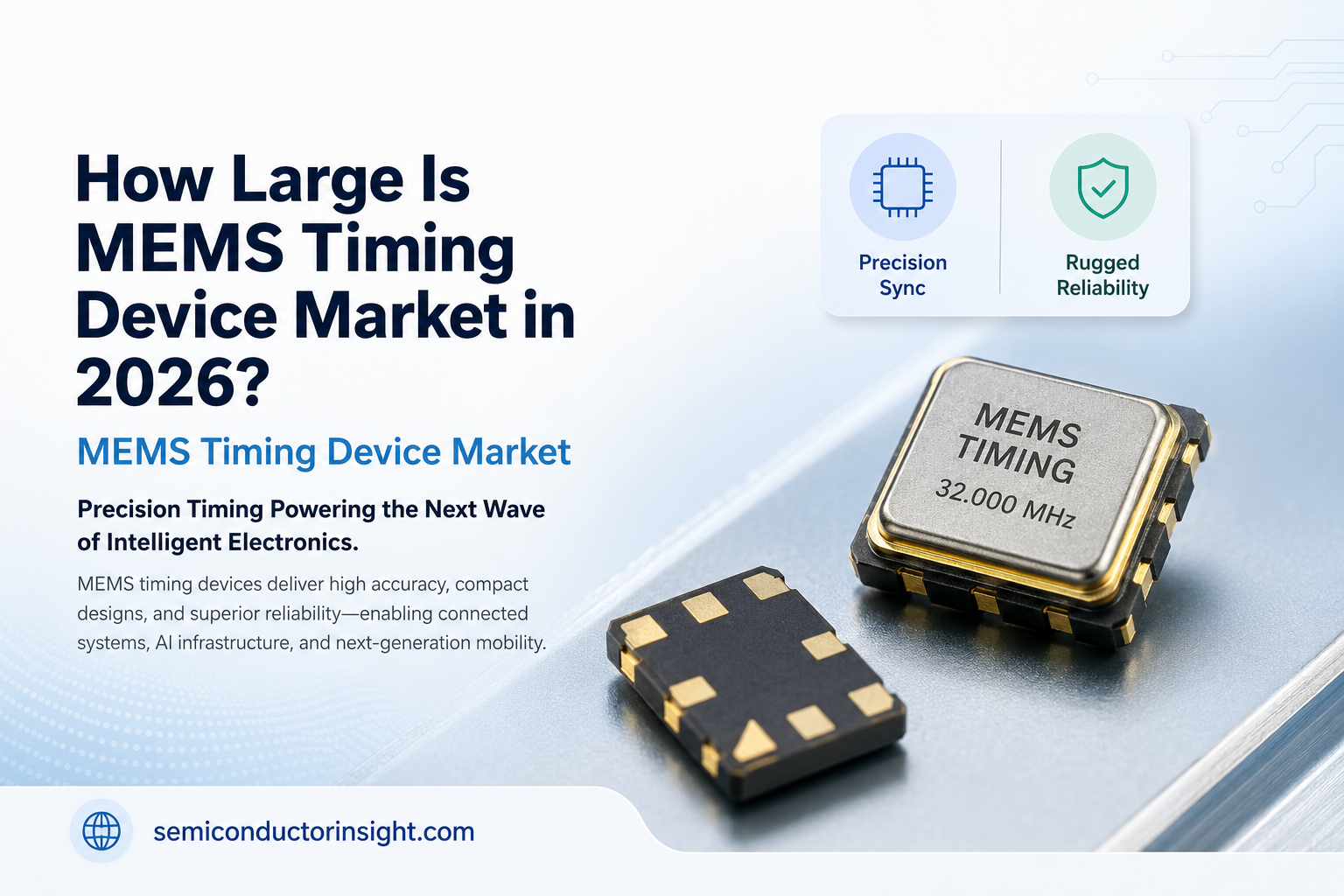
How Large Is MEMS Timing Device Market in 2026? Key Industry Insights and Growth Factors?
Timing components rarely receive the spotlight in semiconductor discussions, yet every connected system depends on accurate clock signals. From smartphones and satellites to autonomous vehicles and AI servers, precise synchronization determines performance and reliability. MEMS Timing Device Market has emerged as a strong alternative to conventional quartz based solutions by offering smaller footprints, higher shock resistance, and better adaptability to harsh operating environments.
According to industry publications and technical resources, billions of electronic devices require timing components annually, while connected IoT endpoints are projected to exceed 40 billion worldwide over the next few years, creating sustained demand for compact and energy efficient timing technologies.
Why Silicon Timing Is Becoming an Engineering Priority?
MEMS timing devices employ semiconductor fabrication techniques to produce minuscule resonators, in contrast to quartz crystals that depend on the mechanical vibration of a mineral. This increases manufacturing flexibility and enables manufacturers to include precise timing into sophisticated chip packaging.
Modern applications demanding MEMS timing include
- AI accelerators
- 5G base stations
- Smart factories
- Electric vehicles
- Wearable medical devices
- Satellite communication systems
Recent semiconductor design trends favor components that can withstand vibration, rapid temperature changes, and miniaturization without compromising signal integrity.
Tiny Components Supporting Massive Data Traffic
The digital economy runs on synchronized infrastructure. Every data packet traveling across networks depends on accurate timing references.
Global internet traffic continues to expand rapidly. According to authorized network studies and internet monitoring organizations, worldwide IP traffic exceeds hundreds of exabytes each month, while hyperscale cloud facilities continue expanding their server capacity.
MEMS timing devices are used in a wide range of critical applications, including network synchronization, processor clock management, storage systems, optical communication modules, and industrial Ethernet networks. Their ability to deliver stable frequencies even under demanding operating conditions makes them highly suitable for next-generation computing infrastructure.
Automotive Electronics Creating New Opportunities
Modern vehicles contain hundreds of semiconductor chips managing safety, navigation, battery systems, and entertainment functions.
Industry data from automotive organizations shows that advanced vehicles can integrate more than 100 electronic control units along with thousands of semiconductor components.
As electric vehicles become more sophisticated, they require highly reliable timing solutions for battery management, radar sensors, LiDAR modules, vehicle networking, autonomous driving platforms, and other critical systems. MEMS devices are especially valuable in this environment because they offer strong resistance to vibration and mechanical shock, making them well suited for automotive applications where quartz components may face performance limitations.
How 5G and Space Technology Are Expanding the Market?
The rollout of 5G infrastructure requires precise synchronization between network equipment.
Telecommunications authorities report continued global deployment of millions of 5G base stations, increasing the need for stable clock sources capable of operating across varying climates.
At the same time, commercial satellite launches continue to increase. Space missions require timing devices that can tolerate radiation, vibration, and extreme temperatures.
MEMS timing products are increasingly evaluated for
- Low Earth orbit satellites
- Aerospace electronics
- Navigation payloads
- Ground communication terminals
These applications demonstrate how semiconductor timing technologies are moving beyond traditional consumer electronics.
Manufacturing Innovation Is Changing the Supply Chain
- One advantage of MEMS timing devices lies in semiconductor style manufacturing processes.
- MEMS timing devices employ semiconductor fabrication techniques to produce minuscule resonators, in contrast to quartz crystals that depend on the mechanical vibration of a mineral. This brings several important advantages, including batch manufacturing, high design consistency, faster product customization, and easier integration with CMOS technologies. As a result, MEMS-based production offers greater efficiency and flexibility for modern device development.
- Leading semiconductor manufacturers are investing in advanced packaging and wafer level manufacturing strategies to improve efficiency and reduce production complexity.
- The trend aligns with global semiconductor investment programs announced across the United States, Europe, Japan, South Korea, Taiwan, and India.
AI Hardware Needs Better Timing Accuracy
Artificial intelligence workloads generate enormous data movement between processors, memory systems, and networking hardware.
Training clusters containing thousands of GPUs require synchronized communication to maximize efficiency. Small timing deviations can affect latency and data integrity.
MEMS timing devices contribute to
- AI server synchronization
- High speed memory systems
- Edge AI processors
- Smart robotics
- Industrial machine vision
As AI hardware scales upward, precision timing becomes an increasingly valuable semiconductor segment rather than a supporting component.
Sustainability Is Becoming Part of Timing Technology
Environmental considerations are influencing semiconductor manufacturing decisions.
MEMS timing devices may reduce material dependence on mined quartz while benefiting from established silicon fabrication ecosystems. Smaller packages can also reduce board space and material usage in compact electronics.
Meanwhile, industries adopting predictive maintenance and energy efficient industrial automation increasingly seek reliable timing components that support long operational lifecycles.
This combination of durability and manufacturing flexibility positions MEMS technology within broader sustainability initiatives across electronics production.
Stay connected for additional in-depth information right here: https://semiconductorinsight.com/report/global-mems-timing-device-market/
What Makes MEMS Timing Different From Earlier Solutions?
The evolution of semiconductor timing is no longer simply about generating a clock signal. Engineers increasingly prioritize resilience, miniaturization, integration, and adaptability across diverse environments.
MEMS timing devices distinguish themselves through
- High shock tolerance
- Compact form factors
- Temperature stability
- Semiconductor compatible manufacturing
- Flexible frequency programming
- Support for connected digital infrastructure
As AI, autonomous mobility, advanced communications, and industrial automation continue expanding globally, MEMS Timing Device Market is transitioning from a specialized semiconductor niche into a foundational technology supporting the next generation of intelligent electronic systems.

Comments (0)