
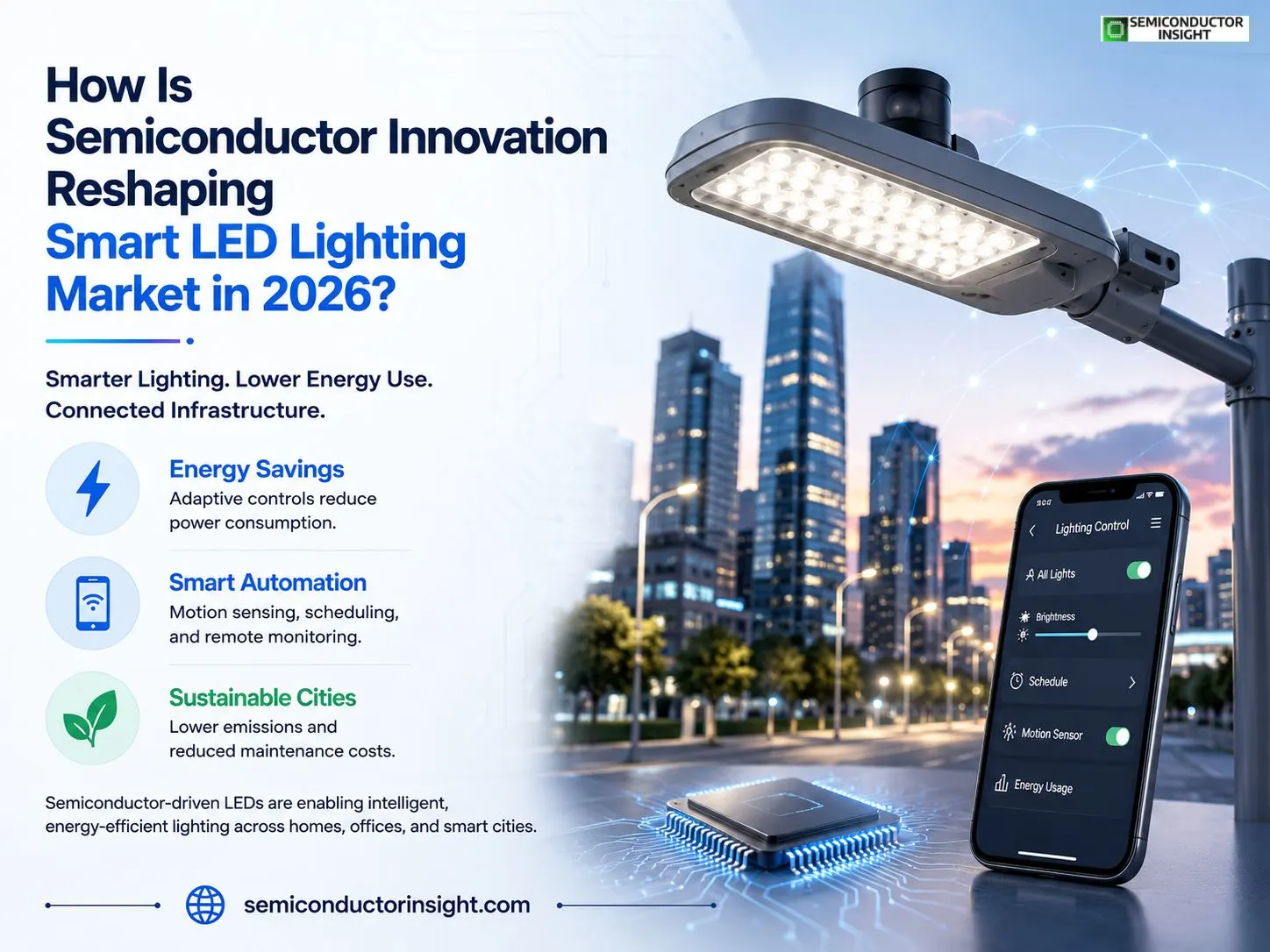
How Is Semiconductor Innovation Reshaping smart LED lighting market in 2026?
Smart LED lighting systems blend advanced semiconductor chips with connectivity features to deliver adaptable illumination that responds to people, schedules, and environmental conditions. These solutions go far beyond basic on-off switches, creating dynamic environments in homes, streets, and workplaces while cutting energy demands through precise control.
Energy Savings Achieved Through Real-World Deployments
- One of the strongest advantages of smart LED lighting is its ability to deliver measurable energy savings across residential, commercial, and public-sector applications.
- The U.S. Department of Energy has reported that LED technology generated approximately 1.1 quadrillion British thermal units (quads) of energy savings in 2017 alone, highlighting the significant impact of efficient lighting technologies on national energy consumption.
- When combined with smart controls such as motion detection, remote monitoring, adaptive dimming, and automated scheduling, energy reductions can become even more substantial.
- Office buildings can automatically lower lighting levels in unoccupied spaces, while warehouses and manufacturing facilities can optimize illumination based on operational requirements.
- Municipalities that have adopted smart street lighting networks often report considerable reductions in electricity costs and maintenance expenses.
- Beyond financial savings, these deployments contribute to sustainability goals by lowering carbon emissions and reducing pressure on power grids.
- As governments and organizations pursue energy-efficiency targets, smart LED lighting continues to demonstrate its value through practical and quantifiable results.
Los Angeles Street Lighting Transformation Story
The city of Los Angeles represents one of the most widely recognized examples of large-scale smart LED lighting implementation. Beginning in 2009, the city launched an ambitious modernization program to replace more than 180,000 conventional street lights with energy-efficient LED fixtures. The initiative was later enhanced through the integration of a smart management platform that allows city officials to remotely monitor, control, and optimize lighting performance across the urban network.
Through centralized management, operators can identify maintenance issues in real time, adjust brightness levels based on traffic conditions, and respond more effectively to public safety requirements. The project has delivered substantial reductions in energy consumption while improving lighting quality and visibility on city streets. Additionally, the data-driven nature of the system has enabled more efficient resource allocation and faster maintenance response times.
Los Angeles has become a global reference point for municipalities exploring smart city technologies, demonstrating how connected LED lighting can support both sustainability objectives and urban infrastructure modernization.
You Can Freely Surf Our Latest Updated Report Here: https://semiconductorinsight.com/report/global-smart-led-lighting-market/
Buenos Aires Public Lighting Retrofit Experience
Buenos Aires provides another compelling example of how smart LED lighting can transform public infrastructure. As part of a citywide modernization effort, approximately 91,000 conventional street lights were replaced with smart LED fixtures equipped with tele-management capabilities. The system allows operators to remotely monitor each lighting unit, track performance metrics, and adjust brightness levels according to traffic density, pedestrian activity, weather conditions, and special events. This level of control has improved operational efficiency while enhancing public safety and visibility throughout the city.
By receiving real-time information on fixture performance, maintenance teams can quickly identify faults and prioritize repairs, reducing downtime and operational costs. The transition to smart LEDs has also contributed to lower energy consumption and improved environmental performance. Buenos Aires’ experience demonstrates how intelligent lighting infrastructure can help cities manage growing urban populations while maintaining budget efficiency and delivering reliable public services. The project continues to serve as an example for municipalities seeking to combine digital transformation, energy efficiency, and smart city development initiatives.
Greenhouse and Agricultural Lighting Advances
University studies, including work from the University of Georgia, show predictive smart lighting controls in greenhouses can slash electricity costs by up to 33% during peak seasons by using sunlight forecasts and running supplemental LEDs only when necessary. Semiconductor sensors feed data into systems that balance plant growth needs with energy efficiency, proving valuable for controlled environment agriculture expanding worldwide.
- Maintenance and Longevity Benefits Observed in Field Use
Because LEDs last significantly longer than traditional bulbs and resist vibration or temperature swings common in outdoor settings, smart systems reduce replacement frequency. Connected diagnostics alert managers to potential issues before failures occur, streamlining operations for large portfolios of lights in warehouses, airports, and campuses.
- Material and Manufacturing Evolutions Supporting Market Expansion
Ongoing improvements in semiconductor wafer production have lowered costs and improved light quality, allowing wider color ranges and higher efficacies. Manufacturers incorporate recyclable designs and modular components that simplify upgrades as new protocols emerge, addressing concerns around electronic waste in growing installations.
- Residential Adoption Patterns and User Experiences
Homeowners appreciate smart bulbs that integrate with existing fixtures, offering color-changing capabilities for ambiance or task lighting. Popular models provide strong performance across different room sizes, with apps enabling customized routines that align with daily lifestyles. Feedback from users often mentions easier evening wind-downs and security features like simulated occupancy when away.
Industrial and Commercial Sector Implementations
Factories and distribution centres deploy smart LED systems tied to production schedules and safety protocols. Lighting adjusts automatically during shift changes or low-activity periods, contributing to lower operational expenses. Case examples from various regions show measurable improvements in visibility for detailed work while keeping energy consumption in check.
These developments in smart LED lighting market reflect deeper semiconductor progress that continues to influence how spaces are illuminated and experienced globally. From bustling city streets to quiet home corners, the technology delivers practical benefits that align efficiency with enhanced functionality as adoption spreads through 2026 and beyond.

Comments (0)