
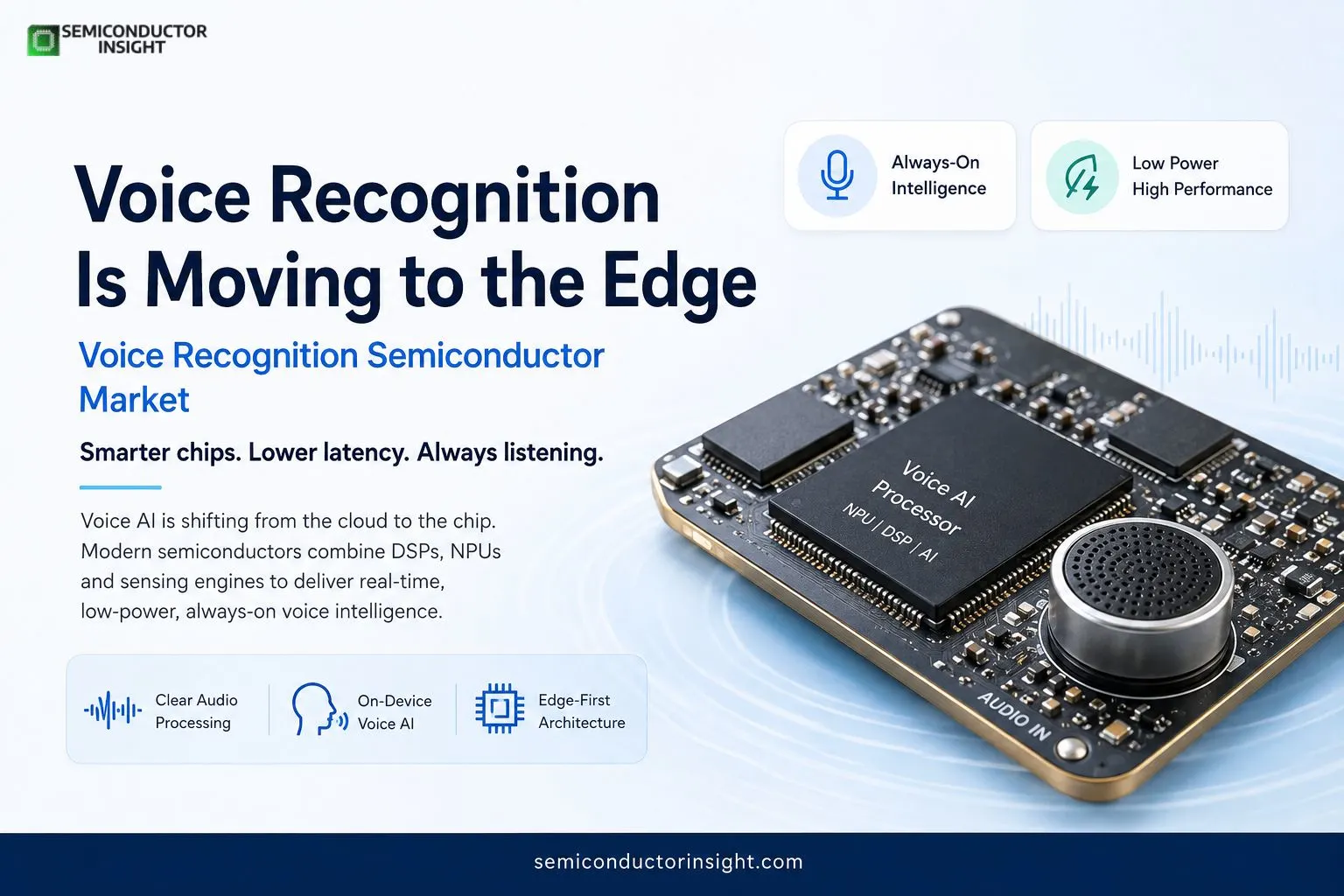
How Does the Voice Recognition AI Chip Market Work in 2026? From Microphones to Instant AI Responses
Voice recognition is moving steadily away from the model in which a microphone captures speech and sends almost everything to a remote server. Modern semiconductor platforms can divide the workload between digital signal processors, CPUs, NPUs and dedicated sensing engines, allowing wake-word detection, noise suppression and increasingly sophisticated speech recognition to happen locally.
That shift matters because voice interfaces need three things simultaneously: rapid response, low energy consumption and continuous availability. Qualcomm’s current Snapdragon architecture, for example, combines its Hexagon NPU with a Qualcomm Sensing Hub designed for multimodal AI activation, while earlier Snapdragon platforms incorporated dedicated voice-assistant acceleration and always-on audio processing.
The Chip Has to Hear Before It Can Understand
The semiconductor workload begins well before an AI model interprets a sentence. Microphone signals must be cleaned, separated and converted into a representation that machine-learning models can process.
A typical edge voice pipeline now resembles:
Microphone array → Beamforming → Echo cancellation → Noise suppression → Voice activity detection → Keyword spotting → Speech recognition → Intent extraction → Local response
This architecture makes specialised silicon particularly valuable. Renesas, for instance, provides voice-recognition implementations with DSP instruction support and reports a 30% processing-speed improvement for its DSP-instruction version. Its noise-suppression implementation can use approximately 40 KB of ROM and 10 KB of RAM for beamforming or noise suppression workloads.
Which Semiconductor Platforms Support Voice Recognition and DSP?
Several semiconductor architectures now support different parts of the voice-recognition workload. Qualcomm’s Hexagon family is particularly notable because its architecture evolved from a DSP foundation into an integrated AI accelerator containing scalar, vector and tensor processing capabilities. Qualcomm states that the original Hexagon DSP launched on Snapdragon in 2007, while later generations integrated these processing elements into its NPU architecture.
- Arm takes another route through combinations such as Cortex-M55 and Ethos-U55.
- While Ethos-U55 can be set up for 32, 64, 128, or 256 MAC operations per cycle, Arm’s ML Evaluation Kit offers automated speech-recognition workloads and keyword identification.
- Arm reports up to a 480× ML performance uplift for Cortex-M55 paired with Ethos-U55 compared with existing Cortex-M systems.
Renesas supports voice applications across RX DSP-enabled processors and Arm Cortex-M families. Its RA8M1 voice-command demonstration supports more than 40 languages, illustrating how speech processing is moving beyond simple wake-word recognition toward intent-aware command interpretation.
For higher-compute systems, NVIDIA’s GPU platforms provide another layer. TensorRT supports speech and audio workloads alongside transformer models, while TensorRT for RTX targets RTX GPUs ranging from Turing through Blackwell and provides optimisations for edge and PC AI inference.
For More Detailed Insights, You Can Surf Our Latest Report Here: https://semiconductorinsight.com/report/voice-recognition-semiconductor-market/
The TinyML Story Is Particularly Important
Voice recognition does not always require a large processor. Arm has demonstrated keyword-detection models operating with extremely small memory footprints; earlier TinyML examples used around 15 KB of code and 22 KB of data for speech-recognition wake-up functionality.
A more recent Arm case study with Sensory demonstrates how optimisation can reduce a microwave language model from 17 MB to 1.6 MB, while distributing processing between Cortex-M55 and Ethos-U55. Speech recognition can run primarily on the NPU while the processor handles text and intent operations.
Voice AI Is Expanding Beyond Smartphones
- The semiconductor opportunity is widening because voice interfaces are appearing in appliances, automobiles, industrial equipment, wearables and embedded control
- Arm and Sensory have already demonstrated embedded voice control for automobiles and consumer products, while Qualcomm’s latest Snapdragon platforms are pushing voice interaction toward contextual and multimodal assistants.
- At the high-performance end, NVIDIA’s 2025 work with Sarvam AI also illustrates the growing importance of speech models for multilingual applications.
- Its GTC session focused on building voice-first generative AI for 1 billion Indian voices, using automatic speech recognition, text-to-speech and language models on NVIDIA infrastructure.
Why the Next Chip Generation Will Be Designed Around the Ear?
The important semiconductor change is not simply adding another AI accelerator. Voice systems require an architecture capable of remaining active while consuming very little energy, filtering imperfect audio, recognising speech quickly and escalating only complex tasks to larger processors or cloud systems.
That is why DSPs, NPUs, microphone interfaces, memory optimisation and dedicated sensing engines are increasingly being designed as one connected computing layer. The voice recognition AI chip is consequently becoming less of a standalone component and more of a specialised intelligence platform embedded inside the devices people already use every day.

Comments (0)