
How DDR5 Chips Market is Redefining Memory Architecture in Advanced Systems?
DDR5 chip market represents one of the most significant architectural transitions in semiconductor memory history. As data volumes expand across cloud computing, artificial intelligence (AI), machine learning (ML), high-performance computing (HPC), and network infrastructure, traditional memory standards are being pushed to their limits. DDR5 (Double Data Rate 5) memory, designed to deliver higher bandwidth, greater capacity, and improved power efficiency, is emerging as the foundational memory platform for next-generation compute and storage systems.
What distinguishes DDR5 from its predecessors is not just faster data transfer rates but a comprehensive upgrade in memory architecture, enabling systems to scale compute performance without being bottlenecked by data movement inefficiencies.
DDR5 Architecture: Performance Gains Rooted in Semiconductor Innovation
DDR5 memory introduces several key semiconductor advancements that collectively lift system performance:
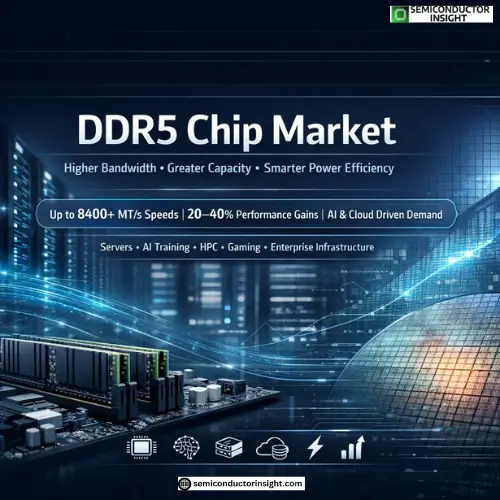
- Increased Data Rates: Baseline DDR5 speeds start at 4,800 MT/s and scale toward 8,400 MT/s and beyond under emerging JEDEC specifications, nearly doubling typical DDR4 rates.
- Higher Density Modules: DDR5 supports up to 64 GB per DIMM (and higher with advanced packaging), enabling server and HPC configurations with terabytes of memory.
- Improved Power Efficiency: Lower core voltage (1.1 V nominal) paired with on-die ECC (Error Correcting Code) and bank grouping enhances reliability and reduces energy per bit transferred.
- Enhanced Channel Architecture: Splitting a DIMM into two independent 32-bit channels improves parallelism and system responsiveness.
This combination of architectural improvements allows DDR5 to directly support memory-intensive workloads such as large language model processing, real-time analytics, and in-memory databases.
Market Demand Underpinned by AI, Cloud, and HPC Trends
Drive toward DDR5 adoption is strongly correlated with the exponential growth in memory-hungry workloads:
- Cloud service providers are upgrading server fleets to support multi-tenant virtualization and AI inference services.
- AI training clusters depend on bandwidth-rich memory to feed large arrays of accelerators.
- HPC installations require both capacity and reliability to maintain consistency during long compute runs.
Industry surveys indicate that over 70% of new enterprise server deployments in 2025 include DDR5 as a primary memory option, reflecting a near-universal transition plan among hyperscale operators. Benchmark reports also show performance improvements of 20-40% across select workloads when migrating from DDR4 to DDR5, solidifying investment cases for system architects.
Semiconductor Ecosystem Shifts and Supply Chain Realities
DDR5 chips are complex assemblies of DRAM cells fabricated on advanced nodes, often requiring tight process control and yield optimization. Leading global semiconductor manufacturers including Samsung Electronics, SK Hynix, Micron Technology, and Kioxia-Western Digital alliance have prioritized DDR5 production capacity to meet this demand.
However, supply remains sensitive to:
- Fab utilization cycles, with lead times often measured in quarters rather than weeks
- Packaged testing bottlenecks, as memory modules require rigorous validation under diverse operating conditions
- Constraints in precursor materials, especially high-purity silicon wafers and specialized lithography cycles
Memory supply planners now integrate predictive analytics and demand forecasting to align production with cyclical demand from enterprise and consumer markets.
You can freely browse our most recent updated report to learn more about it before scrolling further:
https://semiconductorinsight.com/report/ddr5-chip-market/
DDR5 in Consumer Electronics and Gaming Platforms
While enterprise systems anchor DDR5 demand, consumer segments particularly high-end gaming platforms and creator workstations are also accelerating adoption. Enthusiast motherboards and next-generation consoles are shipping DDR5 modules in increasing volumes, driven by higher resolution imaging, real-time physics simulation, and advanced rendering workloads that expose memory limitations in earlier standards.
In these use cases, DDR5’s increased burst transfer capabilities and latency improvements translate into perceptible responsiveness improvements that influence purchasing decisions.
Power Efficiency and Thermal Management: Semiconductor Design Impacts
DDR5’s lower operating voltage and efficient signalling help address thermal challenges that were previously managed through elaborate cooling systems. This has several downstream effects:
- Easier system integration for compact form factors
- Reduced cooling infrastructure costs for data centres
- Improved performance per watt a key metric for AI and ML accelerators
Semiconductor designers are embedding sophisticated power management features directly within memory die, enabling dynamic voltage and frequency scaling (DVFS) for intelligent throttling based on workload demand.
Emerging DDR5-Related Innovations and Adjacent Trends
Beyond the core mechanics of speed and capacity, several innovations are shaping the market:
- On-die error correction to improve system robustness
- Integrations with computational memory architectures for offloading simple logic functions
- Software-driven memory profiling to tailor performance to workload classes
- DDR5-LP (Low Power) variants for mobile and ultra-thin form factors
DDR5 chip market is firmly embedded in the broader narrative of digital transformation. Its role is not merely supportive; DDR5 is structuring performance expectations across compute ecosystems. As workloads become more intensive, systems more distributed, and applications more predictive, memory capabilities will continue to drive architectural decisions.
Looking forward, the conversation is already expanding to DDR5+ and emerging interface standards that promise even greater integration with accelerators and heterogeneous compute fabrics. For stakeholders and clients, understanding the DDR5 trajectory means appreciating memory as a strategic fulcrum of semiconductor innovation, not a passive component.

Comments (0)