
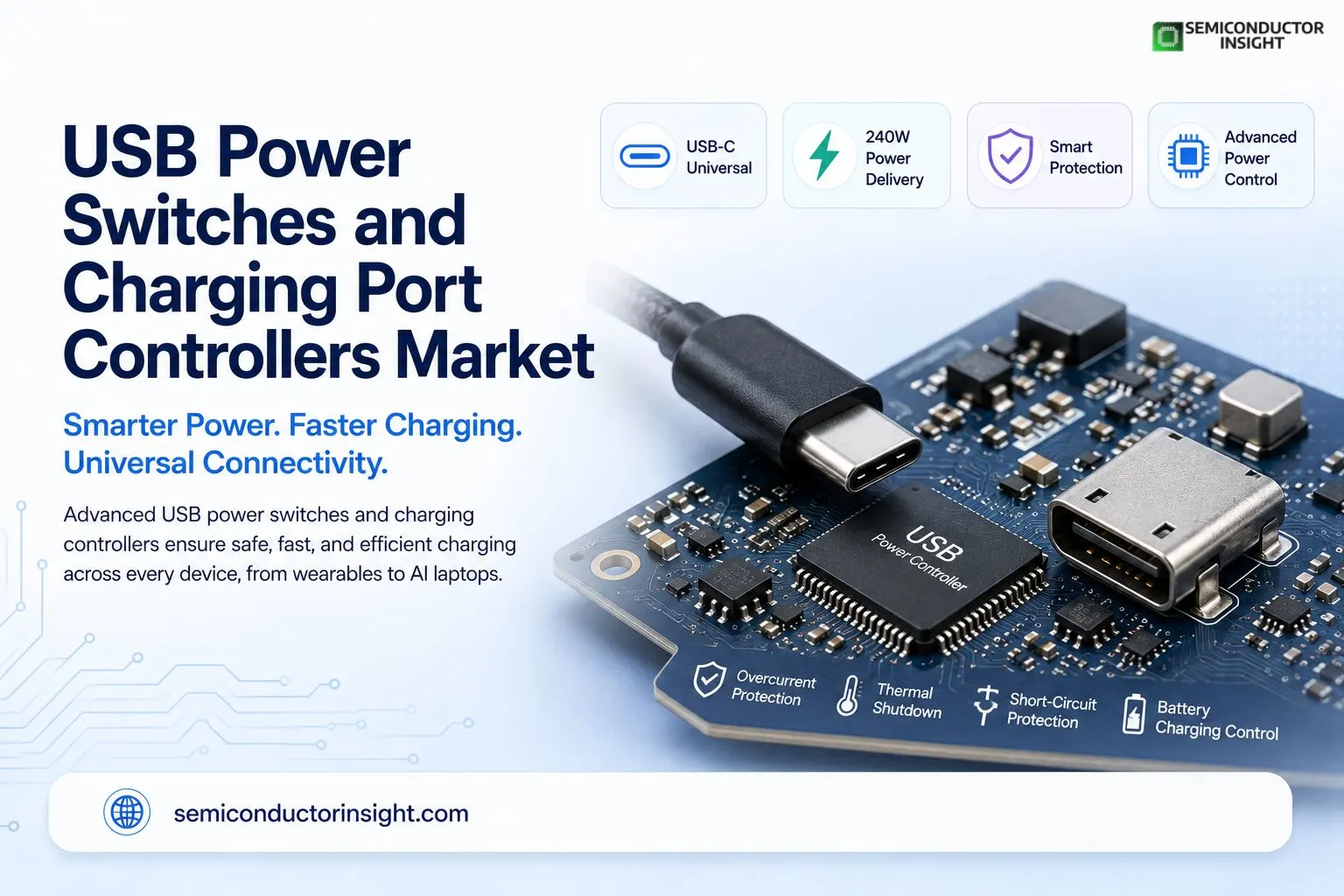
How Big Is the USB Power Switches and Charging Port Controllers Market in 2026?
When users connect a laptop, smartphone, gaming console, or wearable device to a USB cable, the charging process appears effortless. Behind that simple connection, however, dedicated semiconductor devices continuously monitor voltage, regulate current, negotiate charging protocols, detect faults, and protect expensive electronics from damage. USB power switches and charging port controllers have become indispensable as devices demand faster charging speeds, higher power levels, and universal compatibility.
The shift toward USB Type-C and USB Power Delivery (USB PD) has transformed these controllers from basic protection ICs into sophisticated power-management solutions capable of supporting everything from wireless earbuds to AI-enabled laptops and industrial embedded systems.
A Universal Standard Is Reshaping Electronics
- USB has evolved into one of the world’s most widely adopted electronic interfaces. According to the USB Implementers Forum (USB-IF), billions of USB-enabled products are shipped globally every year, with more than 5 billion USB devices entering the market annually.
- USB Type-C has rapidly become the preferred connector across smartphones, tablets, monitors, gaming devices, and notebooks due to its reversible design and support for high-speed data transfer and power delivery.
- The latest USB Power Delivery 3.1 specification enables power transfer of up to 240 watts, a significant leap from the earlier 100-watt limit. This capability allows a single USB-C cable to power high-performance laptops, displays, industrial equipment, and other power-hungry devices while simplifying cable ecosystems.
Every Connected Device Needs Intelligent Power Decisions
Modern charging controllers perform far more than simple on-and-off switching. They continuously communicate with connected devices to determine the safest and most efficient charging profile. If abnormal conditions such as overcurrent, overheating, reverse polarity, or short circuits are detected, the controller responds within microseconds to isolate faults and protect sensitive components.
Today’s semiconductor solutions integrate multiple functions into a compact footprint, including current limiting, thermal shutdown, programmable power paths, battery charging control, and USB PD negotiation. This high level of integration reduces board space, lowers component counts, and supports the miniaturization demanded by consumer electronics manufacturers.
Regulatory Changes Are Accelerating Design Transitions
Recent regulatory developments have increased the adoption of standardized charging interfaces. The European Union’s Common Charger legislation, which requires many portable electronic devices sold in the EU to use USB Type-C charging, has encouraged manufacturers to redesign product platforms around universal charging standards.
This transition extends beyond smartphones. Tablets, digital cameras, headphones, portable gaming devices, and numerous consumer electronics categories are incorporating USB-C interfaces, creating sustained demand for advanced charging port controllers capable of supporting multiple charging protocols while maintaining interoperability across brands.
To find out more, feel free to browse our latest updated report: https://semiconductorinsight.com/report/usb-power-switches-and-charging-port-controllers-market/
AI Devices and High Performance Computing Require Smarter Power Paths
The rapid expansion of AI-enabled laptops, edge computing devices, and portable workstations has introduced new power management challenges. Many next-generation notebooks now require charging capacities exceeding 140 watts, while docking stations simultaneously deliver power, video output, and high-speed data through a single connector.
To address these requirements, semiconductor companies are developing intelligent USB controllers with programmable firmware, integrated protection logic, and real-time telemetry. These features allow systems to monitor energy consumption, optimize charging efficiency, and dynamically allocate power between processors, displays, storage devices, and external peripherals.
Automotive Electronics Are Becoming an Unexpected Growth Platform
- USB charging has become a standard feature inside modern vehicles. Premium electric vehicles increasingly incorporate multiple USB-C ports capable of supporting fast charging for passengers while simultaneously powering infotainment systems and connected accessories.
- According to the International Energy Agency (IEA), global electric car sales exceeded 17 million units in 2024, creating additional demand for automotive-grade USB power management ICs designed to operate under wider temperature ranges and stricter reliability requirements.
- Automotive semiconductor suppliers are responding with controllers qualified under rigorous automotive standards, enabling dependable operation in connected vehicle environments.
Sustainability Begins with Efficient Power Management
Improving charging efficiency is becoming an important sustainability objective. Every percentage point of efficiency gained reduces energy losses across billions of charging cycles worldwide. Semiconductor designers are introducing lower-resistance switching architectures, improved thermal performance, and intelligent load management techniques that minimize wasted power during charging and standby operation.
Manufacturers are also integrating diagnostic capabilities that extend battery life by preventing excessive heat generation and maintaining optimized charging profiles. These improvements contribute to longer device lifespans, reduced electronic waste, and lower overall energy consumption across consumer and industrial electronics.
Semiconductor Innovation Is Expanding Beyond Consumer Electronics
USB power management technology is increasingly appearing in medical equipment, industrial automation systems, laboratory instruments, collaborative robots, point-of-sale terminals, and aerospace electronics. The versatility of USB-C, combined with programmable power negotiation and high-speed connectivity, has made these controllers essential building blocks for equipment requiring reliable power distribution and secure communication.
As electronics continue moving toward higher power densities, universal connectivity, and intelligent energy management, USB power switches and charging port controllers are evolving from supporting components into strategic semiconductor technologies that enable safer, faster, and more efficient digital ecosystems.

Comments (0)