
How Big Is Data Center Environment Sensors Market in 2026 and What Is Changing Facility Monitoring?
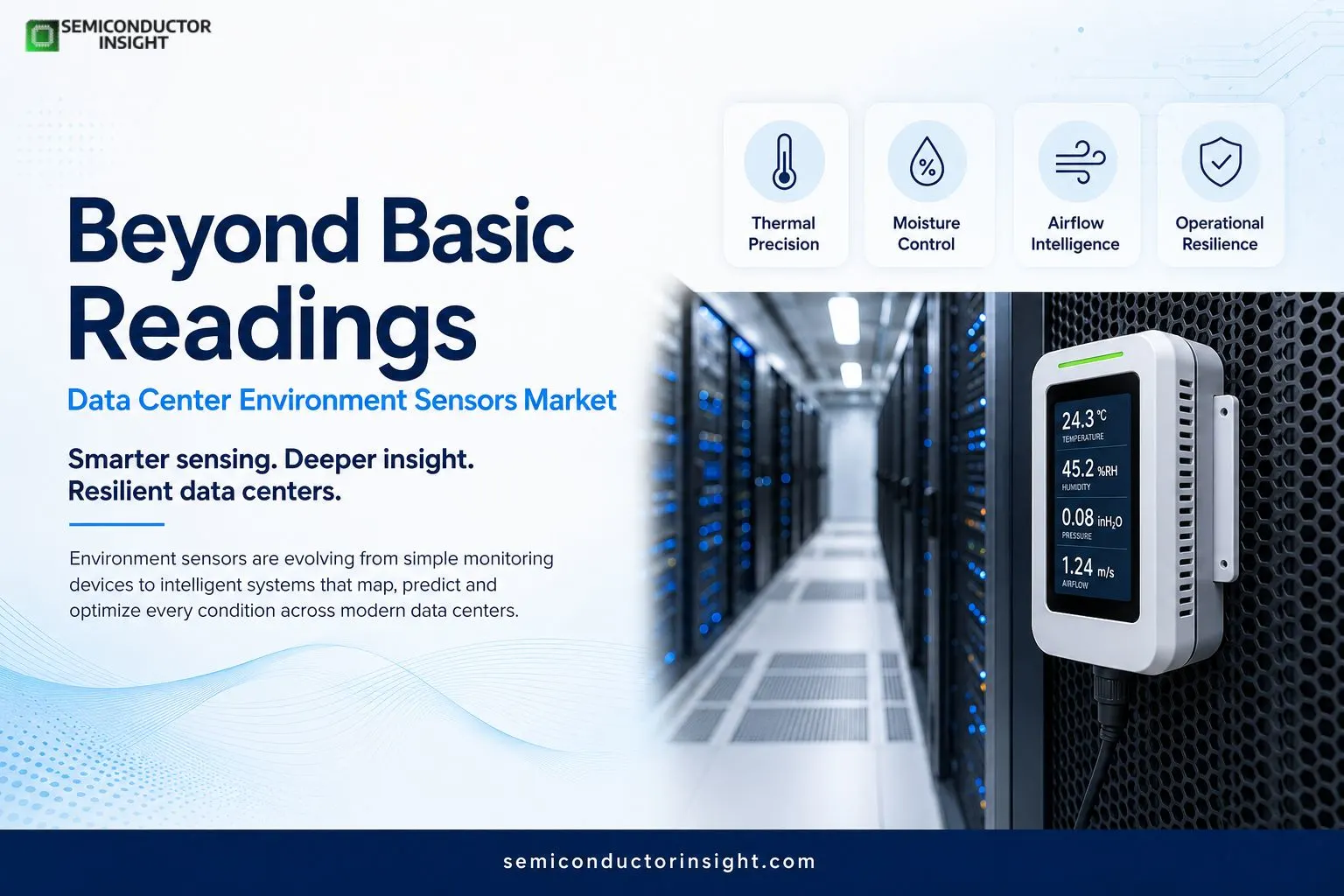
Data center environment sensors are moving beyond their traditional role of displaying room temperature or humidity. As facilities become more densely packed with computing hardware, sensors are increasingly being used to understand how heat, moisture, airflow, pressure and other environmental conditions behave across individual racks, aisles and cooling zones.
The timing is significant. The International Energy Agency estimates that data centers consumed around 415 TWh of electricity in 2024, equivalent to about 1.5% of global electricity consumption. Under its base case, consumption could reach approximately 945 TWh by 2030. AI-accelerated servers are expected to be a major contributor to this increase.
That expansion creates a larger monitoring requirement because every additional concentration of computing power introduces another thermal and operational variable.
A New Measurement Map inside the Facility
- The modern monitoring architecture can be viewed as a layered system rather than a collection of standalone devices.
Rack inlet sensors → aisle monitoring → environmental gateway → analytics platform → automated alert → cooling or maintenance response
- Temperature remains fundamental, but the sensor portfolio is becoming broader. Facilities can monitor relative humidity, dew point, differential pressure, airflow, water leakage and other conditions depending on the design and risk profile.
- ASHRAE’s data center guidance emphasizes maintaining appropriate equipment inlet conditions and notes that prolonged exposure outside recommended environmental ranges can affect equipment reliability and longevity.
- This makes sensor placement increasingly important. A single room-level reading can hide thermal differences between racks, while distributed measurements can reveal localized hot spots before they become facility-wide problems.
Why AI Racks Are Changing Thermal Visibility?
The growth of accelerated computing is altering the thermal profile of data centers. IEA estimates that electricity consumption from accelerated servers could grow at around 30% annually in its base case, compared with approximately 9% annually for conventional servers. Accelerated servers are projected to account for almost half of the net increase in data center electricity consumption through 2030.
Higher-density computing means operators increasingly need information at a much finer resolution. Instead of asking whether an entire server room is within an acceptable range, operators may need to determine which rack, row or cooling zone is experiencing abnormal conditions.
This is pushing Data Center Environment Sensors Market toward high-density measurement architectures capable of delivering readings continuously and feeding them into infrastructure-management software.
The 18 to 27°C Window Shows Why Precision Matters
- ASHRAE’s current thermal guidance provides a recommended dry-bulb temperature range of 18°C to 27°C for air-cooled datacom equipment classes A1 through A4 under its recommended envelope. Its guidance also emphasizes dew point and humidity conditions rather than relying exclusively on room temperature.
- The significance is operational. A facility operating near the upper end of its thermal envelope needs accurate information about where heat is accumulating. Similarly, moisture monitoring can help operators identify conditions that could contribute to condensation or other environmental risks.
- Consequently, sensor accuracy, response time and placement can become just as important as the number of sensors installed.
Liquid Cooling Opens a Different Monitoring Layer
The transition toward high-performance computing is also increasing interest in liquid cooling. ASHRAE’s data center guidance contains separate environmental considerations for liquid-cooled equipment, reflecting the fact that thermal management is no longer limited to room air.
This creates additional opportunities for environmental sensing around coolant conditions, distribution systems, leakage detection and localized thermal behaviour. In facilities combining air and liquid cooling, monitoring platforms may need to correlate information from multiple environmental layers rather than treating cooling as one isolated system.
From Alarm Generation to Predictive Decisions
The more valuable development is the conversion of sensor readings into operational intelligence. Instead of generating an alarm only after a temperature threshold has been exceeded, analytics platforms can examine historical patterns and identify gradual changes in airflow, thermal distribution or humidity.
For example, a recurring rise in rack inlet temperature during specific workloads could indicate an airflow imbalance rather than an immediate cooling-system failure. Detecting that pattern earlier can give facility teams an opportunity to investigate before the condition escalates.
This evolution is turning sensors into inputs for predictive maintenance, digital twins, automated cooling controls and energy-management systems.
Edge Intelligence Is Reducing the Distance between Detection and Response
- As sensor deployments become larger, sending every raw measurement to a centralized platform may not always be necessary.
- Edge gateways can process readings locally, identify threshold violations or unusual patterns and forward higher-value events to facility-management systems.
- This architecture can be particularly useful in large facilities where thousands of measurement points may operate simultaneously.
- The result is a shift from sensor → dashboard toward sensor → interpretation → action.
You can freely browse our most recent updated report to learn more about it before scrolling further: https://semiconductorinsight.com/report/data-center-environment-sensors-market/
The Next Differentiator Is Environmental Resolution
Data Center Environment Sensors Market is increasingly being shaped by one question: how precisely can operators understand what is happening inside a critical facility?
With global data center electricity consumption projected by the IEA to more than double from 2024 levels to around 945 TWh by 2030, thermal management and infrastructure efficiency will remain closely connected to computing expansion.
The next generation of environmental monitoring will therefore be less about simply measuring temperature and more about creating a continuously updated environmental picture of the facility.
Sensors that connect thermal, moisture, airflow and cooling information with analytics and automated control systems are becoming an important digital layer between semiconductor-powered computing infrastructure and the physical environment that keeps it operating.

Comments (0)