
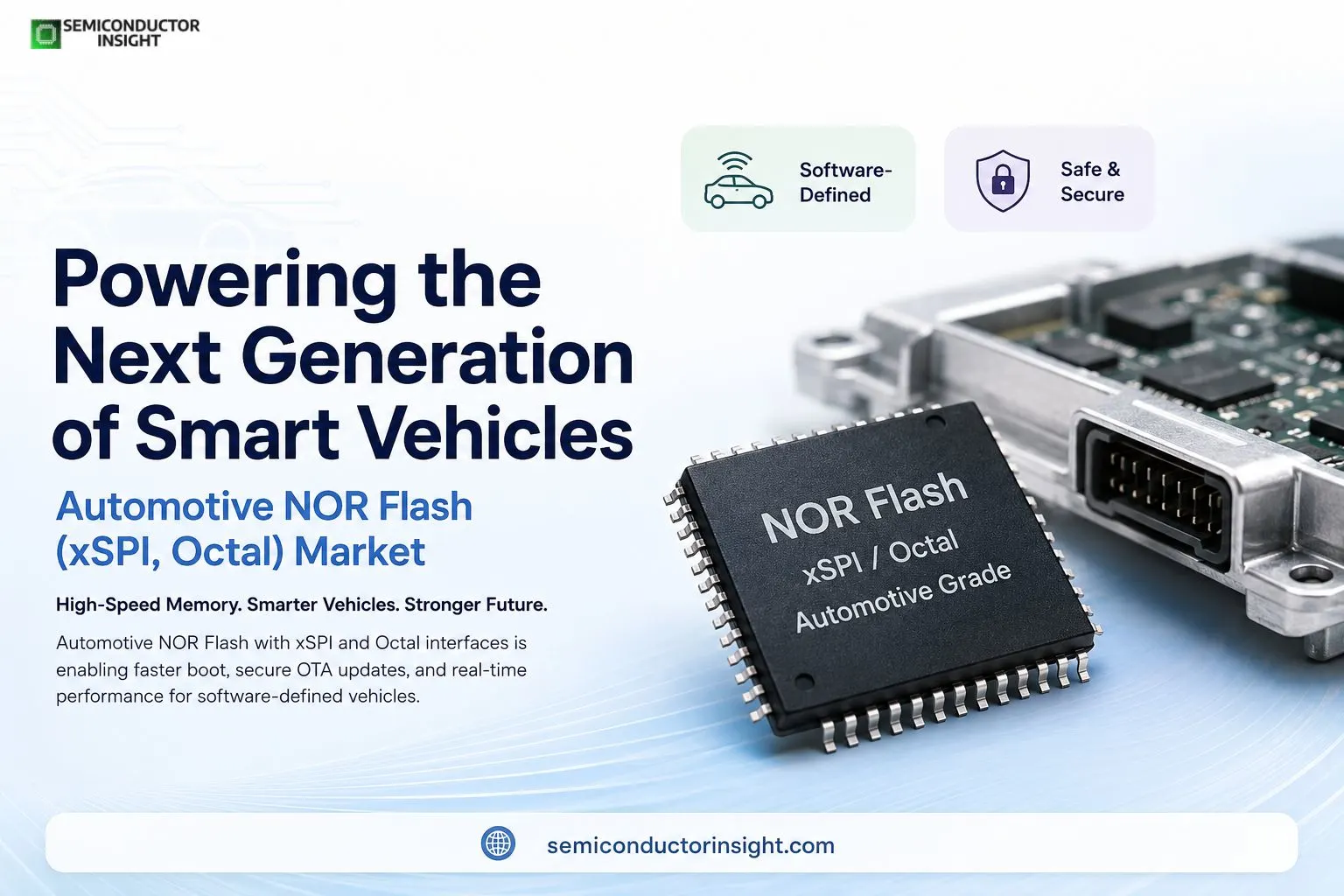
How Autonomous Platforms Are Influencing Automotive NOR Flash (XSPI, Octal) Market?
The automotive semiconductor ecosystem is undergoing a major transformation as vehicles evolve into software-defined platforms. Modern vehicles are no longer dependent solely on mechanical systems; instead, they rely heavily on embedded software, high-speed connectivity, artificial intelligence, and real-time processing architectures. This shift is significantly increasing demand for high-performance non-volatile memory solutions, particularly NOR Flash devices using xSPI and Octal interfaces.
Automotive NOR Flash memory plays a critical role in storing boot code, firmware, safety software, infotainment operating systems, advanced driver-assistance system (ADAS) applications, and over-the-air (OTA) update packages. NOR Flash is crucial for automotive electronic control units (oecus) because it provides better random read performance, execute-in-place (XiP) capabilities, and more reliability for code storage applications than NAND Flash.
Why xSPI and Octal Interfaces Are Becoming Critical?
Traditional SPI interfaces are increasingly insufficient for modern automotive workloads. As vehicle software stacks become larger and more complex, automakers require faster boot speeds, lower latency, and improved bandwidth. This is where xSPI and Octal NOR Flash technologies are gaining traction.
The JEDEC xSPI standard was introduced to standardize communication protocols, commands, and interoperability across next-generation NOR Flash products. The technology enables significantly higher throughput compared to conventional SPI memory architectures. Industry discussions around xSPI highlight sustained transfer speeds reaching nearly 400 MB/s, supporting faster system initialization and reduced software loading delays.
Octal SPI interfaces also reduce bottlenecks in automotive systems where ADAS processors, infotainment SoCs, digital cockpit platforms, and autonomous driving controllers require immediate access to stored firmware. Faster memory access directly improves boot performance and real-time response capability.
Software-Defined Vehicles Expanding Memory Requirements
The rise of software-defined vehicles (SDVs) is fundamentally changing automotive electronics architecture. Vehicles now receive continuous OTA updates, cybersecurity patches, AI feature enhancements, and cloud-connected services throughout their lifecycle.
Recent automotive software industry surveys indicate that manufacturers are increasingly prioritizing AI-enabled systems, OTA infrastructure, and embedded software development to support SDV platforms.
This trend directly benefits automotive NOR Flash adoption because every ECU requires reliable boot memory capable of supporting secure firmware authentication and rapid software execution. High-density NOR Flash solutions are becoming essential in domains such as:
- ADAS controllers
- Digital instrument clusters
- Domain controllers
- Infotainment systems
- Telematics modules
- EV battery management systems
- Autonomous driving compute platforms
Modern vehicles now integrate dozens of processors and controllers, each requiring dedicated memory for safety-critical operations.
For More Detailed Insights, You Can Surf Our Latest Report Here: https://semiconductorinsight.com/report/automotive-nor-flash-xspi-octal-market/
Functional Safety Driving Automotive-Grade NOR Flash Innovation
Reliability remains one of the most important requirements in automotive semiconductors. Automotive-grade NOR Flash solutions are increasingly designed to comply with ISO 26262 functional safety standards and AEC-Q100 automotive qualification requirements.
Semiconductor manufacturers are introducing advanced safety capabilities including ECC correction, CRC protection, SafeBoot functionality, and ASIL-compliant architectures. Some high-performance NOR Flash platforms now support ASIL-B compliance and ASIL-D readiness for mission-critical automotive applications.
These safety enhancements are crucial because automotive memory failures can directly impact braking systems, steering systems, ADAS reliability, and cybersecurity integrity.
Automotive ECU Complexity Is Increasing Rapidly
Automotive electronic architectures are transitioning from distributed ECUs toward centralized and zonal computing systems. This evolution requires memory devices capable of supporting massive firmware images and real-time software execution.
High-bandwidth NOR Flash devices are increasingly used in:
- Autonomous driving domain controllers
- Centralized compute modules
- Smart cockpit processors
- AI-enabled driver monitoring systems
- High-resolution infotainment platforms
Industry technical discussions show that next-generation NOR Flash significantly reduces code download times while improving execute-in-place performance for embedded automotive systems.
As vehicles integrate larger AI models and more sophisticated operating systems, demand for high-speed automotive memory will continue rising.
Automotive NOR Flash (XSPI, Octal) Market is entering a new phase driven by software-defined vehicles, autonomous driving technologies, EV adoption, and connected mobility platforms. High-speed xSPI and octal interfaces are addressing the growing need for rapid firmware execution, secure OTA updates, and real-time processing performance.
As automotive systems become increasingly software-centric, NOR Flash memory is evolving from a supporting component into a foundational technology for next-generation vehicle intelligence. The industry’s focus on bandwidth, safety, power efficiency, and reliability will continue accelerating innovation across automotive semiconductor memory architectures.

Comments (0)