
The Global Vehicle ECU Market size was valued at US$ 35.67 billion in 2024 and is projected to reach US$ 56.92 billion by 2030, at a CAGR of 8.1% during the forecast period 2024-2030.
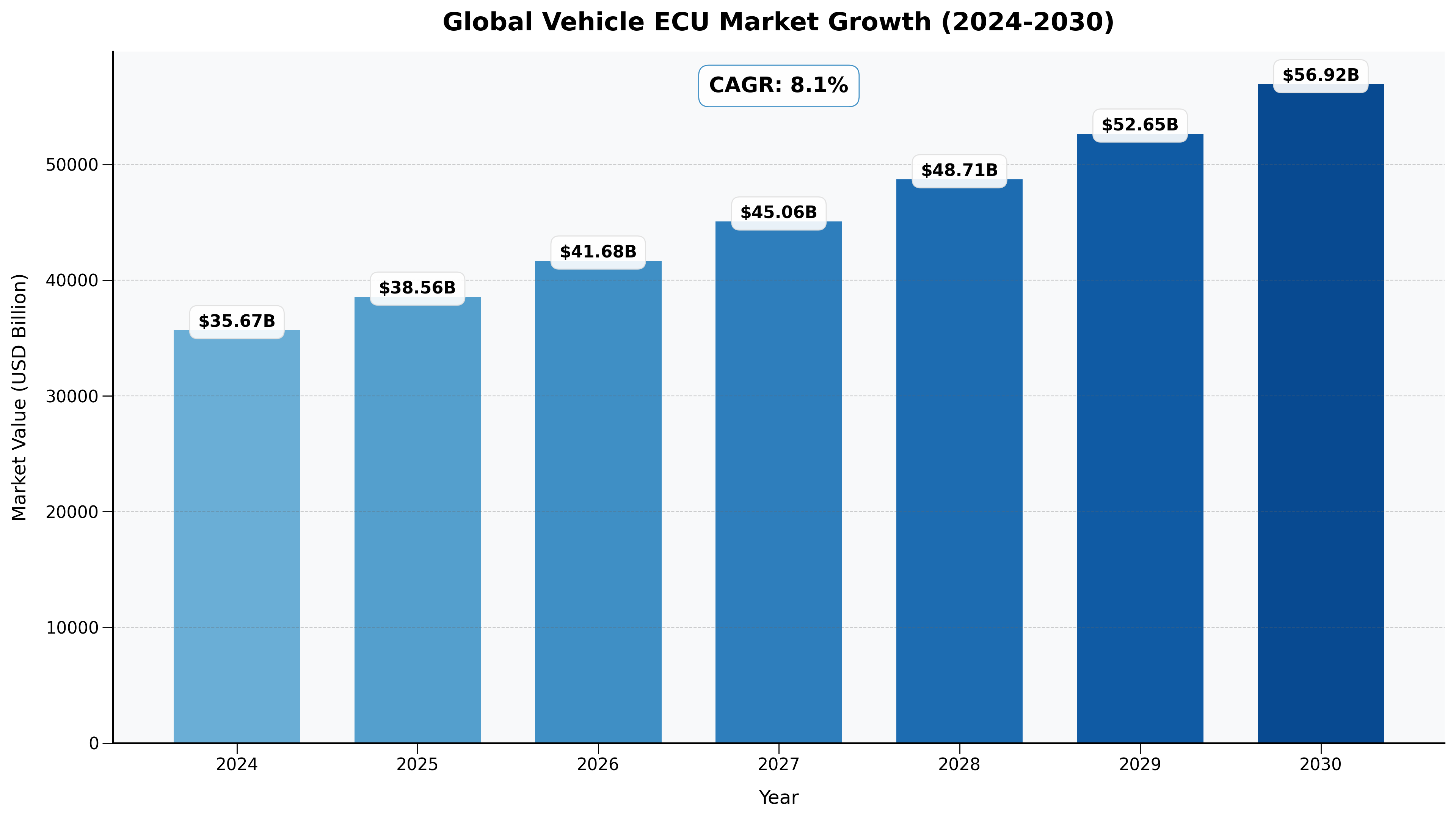
The United States Vehicle ECU market size was valued at US$ 9.89 billion in 2024 and is projected to reach US$ 15.34 billion by 2030, at a CAGR of 7.6% during the forecast period 2024-2030.
Electronic control units managing various vehicle functions.
The global market is experiencing strong growth, driven by automotive electronics adoption. In 2023, total production reached 280 million units, with engine management systems accounting for 35% of demand. The safety systems segment is growing at 9.5% annually. The market saw a 30% increase in demand for integrated systems in 2023. Single-function ECUs dominate with a 65% market share, while multi-function ECUs are growing at 12% annually. Asia Pacific leads with a 42% market share, while North America is the fastest-growing region at 8.8% CAGR. The industry is focusing on developing cybersecurity features, with a 35% growth in R&D investments.
Report Overview
AnElectronic Control Unit(ECU) is anyembedded systeminautomotive electronicsthat controls one or more of theelectrical systemsor subsystems in a vehicle.
This report provides a deep insight into the global Vehicle Electronic Control Units (ECU) market covering all its essential aspects. This ranges from a macro overview of the market to micro details of the market size, competitive landscape, development trend, niche market, key market drivers and challenges, SWOT analysis, value chain analysis, etc.
The analysis helps the reader to shape the competition within the industries and strategies for the competitive environment to enhance the potential profit. Furthermore, it provides a simple framework for evaluating and accessing the position of the business organization. The report structure also focuses on the competitive landscape of the Global Vehicle Electronic Control Units (ECU) Market, this report introduces in detail the market share, market performance, product situation, operation situation, etc. of the main players, which helps the readers in the industry to identify the main competitors and deeply understand the competition pattern of the market.
In a word, this report is a must-read for industry players, investors, researchers, consultants, business strategists, and all those who have any kind of stake or are planning to foray into the Vehicle Electronic Control Units (ECU) market in any manner.
Global Vehicle Electronic Control Units (ECU) Market: Market Segmentation Analysis
The research report includes specific segments by region (country), manufacturers, Type, and Application. Market segmentation creates subsets of a market based on product type, end-user or application, Geographic, and other factors. By understanding the market segments, the decision-maker can leverage this targeting in the product, sales, and marketing strategies. Market segments can power your product development cycles by informing how you create product offerings for different segments.
Key Company
- BOSCH
- Continental
- DENSO
- Delphi
- ZF TRW
- Hyundai AUTRON
- Marelli
- Mitsubishi Electric
- UAES
- Weifu Group
- LinControl
- Troiltec
- Hitachi Automotive
- Passenger Vehicle
- Commercial Vehicle
- OEM
- Aftermarket
- North America (USA, Canada, Mexico)
- Europe (Germany, UK, France, Russia, Italy, Rest of Europe)
- Asia-Pacific (China, Japan, South Korea, India, Southeast Asia, Rest of Asia-Pacific)
- South America (Brazil, Argentina, Columbia, Rest of South America)
- The Middle East and Africa (Saudi Arabia, UAE, Egypt, Nigeria, South Africa, Rest of MEA)
- Industry drivers, restraints, and opportunities covered in the study
- Neutral perspective on the market performance
- Recent industry trends and developments
- Competitive landscape & strategies of key players
- Potential & niche segments and regions exhibiting promising growth covered
- Historical, current, and projected market size, in terms of value
- In-depth analysis of the Vehicle Electronic Control Units (ECU) Market
- Overview of the regional outlook of the Vehicle Electronic Control Units (ECU) Market:
- Access to date statistics compiled by our researchers. These provide you with historical and forecast data, which is analyzed to tell you why your market is set to change
- This enables you to anticipate market changes to remain ahead of your competitors
- You will be able to copy data from the Excel spreadsheet straight into your marketing plans, business presentations, or other strategic documents
- The concise analysis, clear graph, and table format will enable you to pinpoint the information you require quickly
- Provision of market value (USD Billion) data for each segment and sub-segment
- Indicates the region and segment that is expected to witness the fastest growth as well as to dominate the market
- Analysis by geography highlighting the consumption of the product/service in the region as well as indicating the factors that are affecting the market within each region
- Competitive landscape which incorporates the market ranking of the major players, along with new service/product launches, partnerships, business expansions, and acquisitions in the past five years of companies profiled
- Extensive company profiles comprising of company overview, company insights, product benchmarking, and SWOT analysis for the major market players
- The current as well as the future market outlook of the industry concerning recent developments which involve growth opportunities and drivers as well as challenges and restraints of both emerging as well as developed regions
- Includes in-depth analysis of the market from various perspectives through Porters five forces analysis
- Provides insight into the market through Value Chain
- Market dynamics scenario, along with growth opportunities of the market in the years to come
- 6-month post-sales analyst support
Customization of the Report
In case of any queries or customization requirements, please connect with our sales team, who will ensure that your requirements are met.
1. Drivers:
- Increasing Vehicle Electrification: The growing trend of electrification in vehicles, including electric vehicles (EVs) and hybrid electric vehicles (HEVs), is a significant driver for the Vehicle ECU (Electronic Control Unit) market. Vehicle ECUs play a crucial role in controlling powertrains, energy management, and vehicle safety in electrified vehicles.
- Advanced Driver Assistance Systems (ADAS): The rising demand for ADAS, including features such as lane-keeping assist, automated parking, adaptive cruise control, and collision avoidance, has led to an increased adoption of ECUs in vehicles. ECUs are essential for processing data from sensors and controlling various aspects of ADAS.
- Growing Demand for Autonomous Vehicles: The development of self-driving cars requires a vast array of ECUs for real-time decision-making, sensor fusion, and vehicle control. Autonomous vehicle technology heavily relies on sophisticated ECUs to process information from cameras, LiDAR, radar, and other sensors to enable safe operation.
- Rising Focus on Fuel Efficiency and Emission Control: Governments worldwide are imposing stringent emission regulations, driving automakers to invest in advanced ECU solutions to optimize engine performance, reduce fuel consumption, and manage exhaust emissions more effectively.
- Technological Advancements in ECU Systems: The continual evolution of ECU technology, with improved microprocessors, memory, and software capabilities, is enabling the development of more efficient, powerful, and reliable ECUs. These advancements support the growing complexity of vehicle systems and contribute to the broader adoption of ECUs.
2. Restraints:
- High Costs of Advanced ECUs: While advanced ECUs provide numerous benefits, they also come with high development and manufacturing costs. The complex integration of hardware and software for modern ECUs, along with the need for advanced semiconductors, can significantly increase the price of vehicles, especially electric and autonomous vehicles.
- Complexity in Integration and Software Development: As vehicle systems become more complex, the integration of multiple ECUs into a single system and the development of compatible software platforms become increasingly challenging. Ensuring that different ECUs work together seamlessly without issues like system malfunctions or compatibility failures is a significant hurdle.
- Security Concerns and Vulnerabilities: As vehicles become more connected, they are susceptible to cybersecurity risks. ECUs that manage critical functions such as braking, steering, and powertrain are vulnerable to hacking or unauthorized access. Ensuring the security of ECUs against cyberattacks remains a challenge for automakers.
- Supply Chain Challenges: The global semiconductor shortage and supply chain disruptions have impacted the production of ECUs, leading to delays and increased costs for automakers. The automotive industry’s reliance on specific components for ECU production can cause bottlenecks in production and affect market growth.
3. Opportunities:
- Expansion in Emerging Markets: With the increasing adoption of automobiles in emerging markets, especially in Asia-Pacific, there is a growing demand for advanced ECUs. These regions are witnessing higher vehicle sales, along with a rising trend toward vehicle electrification and adoption of advanced safety systems, creating opportunities for ECU manufacturers.
- Development of Multi-Function ECUs: The demand for multi-functional ECUs that can control multiple systems within a vehicle is on the rise. Manufacturers have the opportunity to design ECUs that can consolidate several functions, reducing the complexity and cost of the vehicle’s electronics, which is attractive to automakers aiming for more efficient designs.
- Opportunities in Electric Vehicles (EVs): The ongoing shift toward electric mobility presents significant growth potential for the vehicle ECU market. EVs require a larger number of ECUs than traditional internal combustion engine (ICE) vehicles, including for battery management, charging systems, thermal management, and regenerative braking systems. This growing market presents an opportunity for manufacturers to develop specialized ECUs for EVs.
- Advances in Artificial Intelligence and Machine Learning for ECUs: The integration of AI and machine learning into vehicle ECUs is an emerging opportunity. AI-powered ECUs can enhance vehicle performance by enabling predictive maintenance, optimizing energy use, and improving safety features by making real-time decisions based on data from vehicle sensors.
4. Challenges:
- Technological Challenges in Autonomous Vehicles: While autonomous vehicles offer a significant market opportunity, they present technical challenges, particularly in ensuring the reliability and safety of ECUs in high-stakes, real-time driving environments. Developing ECUs that can handle the massive data processing required for fully autonomous driving, while being reliable and resilient, remains a major hurdle.
- Compliance with Global Regulatory Standards: Different countries and regions have their own automotive regulations, particularly in terms of emissions standards, safety requirements, and cybersecurity laws. Complying with these diverse regulatory standards when developing ECUs for global markets can be complex and costly for manufacturers.
- Battery and Power Consumption Management in EVs: While ECUs are central to the functioning of electric vehicles, managing the power consumption of these ECUs is a key challenge. In EVs, which rely on battery power, efficient management of power-consuming systems is critical. Developers must create ECUs that are both high-performing and energy-efficient to avoid draining the vehicle’s battery life.
- Long Development Cycles for Automotive ECUs: The long development cycles in the automotive industry, where ECUs often take several years to develop and receive approval, can be a challenge. Any delays in the design or approval process can impact market readiness and delay product launches, affecting time-to-market and revenue generation

Get Sample Report PDF for Exclusive Insights
Report Sample Includes
- Table of Contents
- List of Tables & Figures
- Charts, Research Methodology, and more...



