
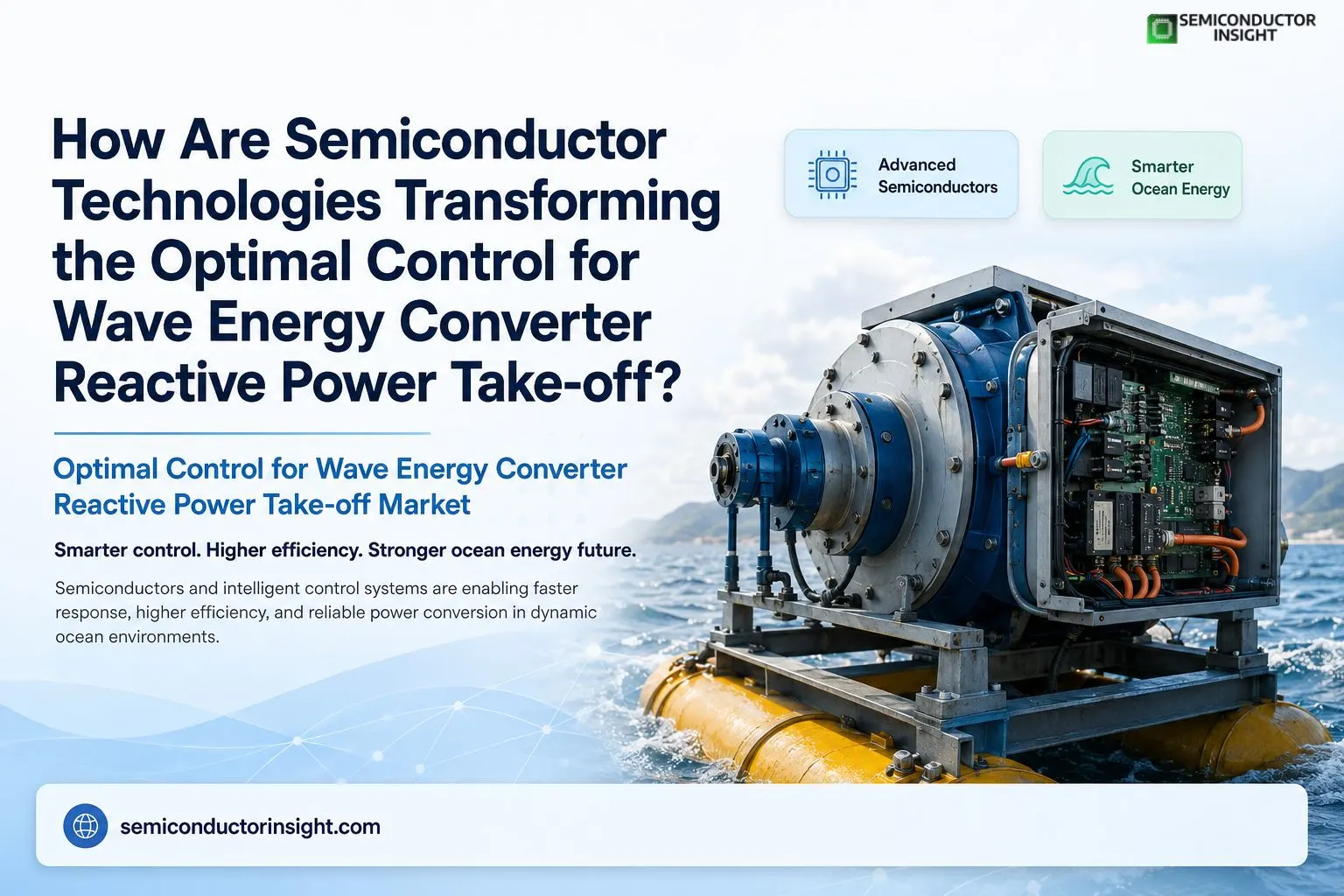
How Are Semiconductor Technologies Transforming the Optimal Control for Wave Energy Converter Reactive Power Take-off Market?
The world’s oceans contain immense untapped energy. According to estimates from international marine energy organizations, global wave energy resources exceed 29,000 TWh annually equivalent to current global electricity demand. Capturing even a fraction of this energy could significantly diversify renewable power generation. At the center of this transformation lies the Optimal Control for Wave Energy Converter Reactive Power Take-off Market, where advanced semiconductors, digital controllers, and power electronics work together to maximize energy extraction from ocean waves.
Unlike conventional renewable systems, wave energy converters (WECs) operate in highly dynamic environments. Ocean waves constantly change in height, frequency, and direction, requiring intelligent control systems that can respond in milliseconds to maintain efficiency.
The Hidden Intelligence Behind Ocean Energy Harvesting
Reactive power take-off systems function as the “brain” of wave energy converters. By adjusting force and motion in real time, these systems synchronize with incoming waves to maximize captured energy.
Ocean Waves → Mechanical Motion → Reactive Power Take-off → Power Electronics → Grid Integration
Modern control architectures increasingly rely on semiconductor-based inverters, sensors, and digital signal processors to execute these complex operations.
Ocean Energy by the Numbers
The scale of wave energy potential makes it a highly promising area for future power generation, with the global theoretical wave resource estimated at around 29,000 TWh per year.
More than 30 countries are now actively exploring offshore wind and ocean energy, while typical wave energy converter systems are designed for a service life of 20 to 25 years. Since control response times must operate in milliseconds and grid frequency targets remain fixed at 50 Hz or 60 Hz, these figures clearly show why efficient control systems are critical for commercial deployment.
Why Semiconductors Matter More Than Ever?
The latest generation of power semiconductors is redefining wave energy conversion efficiency. Wide-bandgap materials such as silicon carbide (SiC) and gallium nitride (GaN) enable higher switching frequencies, lower heat generation, and improved power density.
Key semiconductor components include:
- SiC MOSFETs for high-voltage switching
- GaN devices for compact converters
- Digital signal processors for control algorithms
- MEMS sensors for wave monitoring
- FPGA platforms for real-time optimization
These technologies reduce losses while enabling faster adaptive control.
Real-World Deployments Shaping the Industry
Marine renewable projects continue to advance globally. Demonstration sites in Europe have tested wave energy systems connected to national grids, while research programs explore autonomous offshore energy platforms.
Recent examples include:
- The European Marine Energy Centre in Scotland testing multiple marine energy devices.
- Portugal’s continued support for wave-energy pilot infrastructure.
- Research initiatives integrating AI-based control strategies for offshore converters.
These projects provide valuable operational data that improve future control algorithms.
The Rise of Digital Twins at Sea
One emerging trend is the use of digital twin’s virtual replicas of physical wave energy systems. By simulating ocean conditions before deployment, operators can optimize control parameters and predict maintenance needs.
Digital Twin Workflow
Wave Data → Simulation Engine → Optimal Controller → Power Output Forecast → System Adjustment
This approach reduces operational risk and enhances reliability in harsh marine environments.
Materials Innovation beneath the Surface
Marine environments expose equipment to corrosion, biofouling, and extreme mechanical stress. Consequently, researchers are developing:
- Advanced protective coatings
- Corrosion-resistant alloys
- Smart composite materials
- Self-monitoring sensor networks
Take a Quick Glance at Our In-Depth Analysis Report: https://semiconductorinsight.com/report/optimal-control-for-wave-energy-converter-reactive-power-take-off-market/
Such innovations improve reliability and extend operational life in offshore environments.
As renewable energy systems evolve beyond land-based wind and solar installations, wave energy technologies are increasingly entering the spotlight. The convergence of semiconductor innovation, intelligent control algorithms, and advanced marine engineering is positioning reactive power take-off systems as a foundational technology for the future of ocean energy.

Comments (0)